


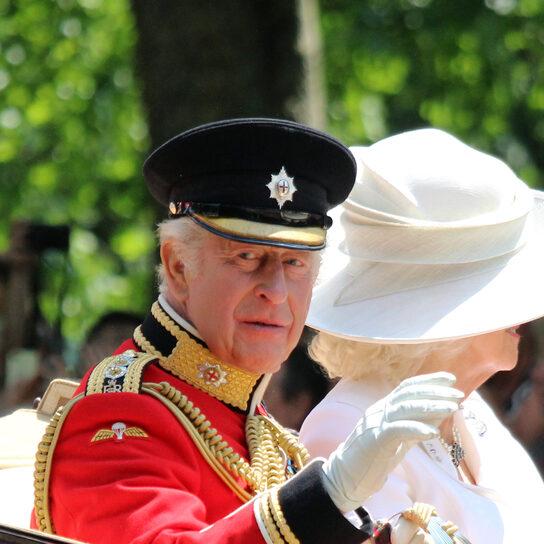
King Charles III is reportedly preparing to hand over the throne to Prince William within the next year, according to multiple palace sources who say the 77-year-old monarch’s health will serve as the official explanation for the historic transition.
Journalist Rob Shuter, citing conversations with royal insiders, reported that while there has been no public announcement or constitutional motion filed, discussions about succession timing are no longer hypothetical. The Prince of Wales, 43, has increasingly assumed unofficial leadership of the monarchy as his father continues treatment for cancer diagnosed in 2024.
“In many ways, he’s already king unofficially,” a longtime aide told Shuter. “The institution is preparing emotionally, even if the paperwork hasn’t caught up.”
King Charles ascended the throne in September 2022 at age 73 following Queen Elizabeth II’s death after her 70-year reign. He was formally crowned at Westminster Abbey in May 2023, but his sovereignty has been marked by health challenges and family controversies.
The monarch’s cancer was discovered during treatment for an enlarged prostate in February 2024. While palace officials confirmed the diagnosis was not prostate cancer, they have not disclosed the specific type. Charles has continued working throughout his treatment, though Prince William has taken on significantly more royal duties.
A senior courtier described the potential transition as carefully orchestrated, with health providing “the most unassailable explanation.” The strategy, sources say, is not dramatic abdication but controlled evolution.
Palace insiders emphasize that any abdication would be entirely on Charles’s terms. After waiting decades as heir apparent—longer than anyone in British history—the King is determined to control the narrative of his reign’s conclusion. A palace insider told Shuter that Charles “will not be seen as pushed” and that when he steps back, “it will be entirely on his terms.”
Prince William, first in line to the throne since September 2022, now functions as de facto monarch in many capacities, according to sources. His wife, Princess Kate, 44, has also been managing her own health challenges after receiving a cancer diagnosis in 2024. The Princess of Wales has returned to work following treatment and reportedly has ambitious plans for the coming year.
The couple’s three children—Prince George, 12, Princess Charlotte, 10, and Prince Louis, 7—occupy the second, third, and fourth positions in the line of succession. Prince Harry remains fifth in line despite stepping back from royal duties.
Charles’s reign has been complicated by ongoing scandal surrounding his younger brother, Andrew Mountbatten-Windsor. The King stripped Andrew of his royal titles—including his designation as prince—and served him formal notice to surrender his lease on Royal Lodge in October 2025, following continued fallout from his association with Jeffrey Epstein.
Royal author Russell Myers revealed in his book “William and Catherine: The Intimate Inside Story” that the Prince of Wales had advocated for stronger action against Andrew years earlier. According to Myers, William told the late Queen and his father that the disgraced royal “must be banished before the rot sets in.” King Charles took six years to finally strip Andrew of his titles and exile him from public life.
Princess Diana’s former butler, Paul Burrell, has publicly stated his belief that abdication is likely. He has suggested Charles and Queen Camilla have a roughly 10-year plan for their reign, noting that the King likely wants to see William enjoy a longer reign than he himself will have.
Unlike Queen Elizabeth II, who ruled until her death and viewed the monarchy as a lifelong commitment, Charles may follow the example of other European monarchs who have abdicated in favor of younger heirs—including Denmark’s Queen Margrethe II, who stepped down in January 2024. Burrell predicted Charles would take inspiration from Prince Philip and retire to private life when the time comes.
A former palace adviser described the potential handover as inevitable rather than forced, telling Shuter: “If there’s a handover, it won’t feel like surrender. It will feel inevitable.”
The monarchy’s ability to adapt has long been credited for its survival through centuries of political and social change. A former aide noted that “the monarchy survives because it adapts before it has to.”
Prince William has been preparing for kingship his entire life, and sources say he is ready for the responsibility. His increasingly prominent role in royal affairs suggests the transition, whenever it officially occurs, will be seamless.
While Buckingham Palace has not commented on the succession speculation, the palace historically maintains silence on internal deliberations until formal announcements are ready. Constitutional experts note that any abdication would require careful legal preparation involving all Commonwealth realms where Charles serves as head of state.
The potential abdication would mark only the second voluntary departure of a British monarch in modern history, following Edward VIII’s 1936 abdication to marry Wallis Simpson. Unlike that constitutional crisis, a health-related transition from Charles to William would likely proceed with broad public support and constitutional clarity.