


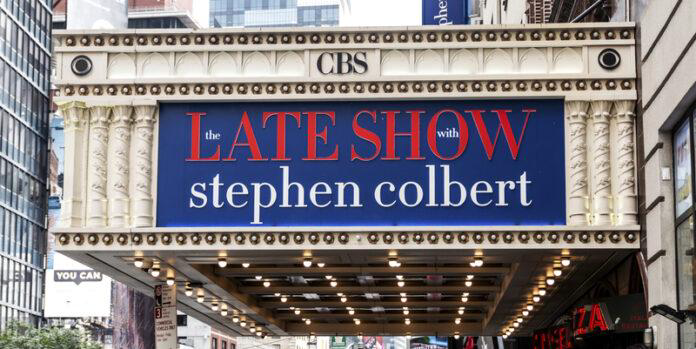
“Late Show” host Stephen Colbert skewered President Donald Trump on Tuesday night over a peculiar White House habit that has administration officials walking around in ill-fitting footwear — literally.
The comedian tore into Trump’s latest obsession: buying $145 Florsheim shoes for members of his inner circle, guessing their sizes rather than simply asking, then expecting them to wear the shoes regardless of fit.
“You know, there’s a word for a leader selecting clothing for his disciples,” Colbert pointed out during his monologue. “It’s ‘cult.'”
The Wall Street Journal reported Monday that Trump has been purchasing the leather oxfords for top officials and sending them to the White House. The 79-year-old president, known for expensive Brioni suits and long red ties, discovered the brand late last year while searching for comfortable dress footwear for long workdays. The recipients feel obligated to wear the shoes even when they don’t fit properly, leading to awkward photo opportunities with administration members sporting footwear that appears comically oversized.
Vice President JD Vance and Secretary of State Marco Rubio have both received shoes from the president. Photos of Rubio wearing shoes that were obviously too large went viral on social media this week after the Journal published its report Monday.
The shoe distribution extends well beyond the vice president and secretary of state. Trump has reportedly sent the Florsheim oxfords to Defense Secretary Pete Hegseth, Commerce Secretary Howard Lutnick, Transportation Secretary Sean Duffy, communications director Steven Cheung, deputy chief of staff James Blair, speechwriter Ross Worthington, Sen. Lindsey Graham, and Fox News personality Sean Hannity. During a January lunch with Tucker Carlson, Trump handed the media personality a pair of brown wingtips without warning. At cabinet meetings, the president has even asked recipients directly: “Did you get the shoes?”
“All the boys have them,” one female White House official told the Journal. Another staffer described the situation as “hysterical because everybody’s afraid not to wear them.” At least one cabinet secretary has privately complained about having to shelve his Louis Vuitton shoes in favor of the Florsheims.
Colbert seized on that quote with characteristic wit. “Hysterical,” he repeated. “Just like that classic joke: Knock, knock. Who’s there? It’s the man who checks the shoes. I see you’re not wearing them. Get in the van.”
The shoe ritual follows a distinct pattern. Trump spots a visitor’s footwear during a meeting, sometimes makes his assessment clear in characteristically blunt language, then retrieves a Florsheim catalog and asks the person their shoe size — or simply guesses it himself. An aide places the order, and roughly a week later a brown Florsheim box arrives at the White House, sometimes bearing Trump’s signature or a handwritten note. White House officials told reporters that Trump personally pays for the footwear rather than using government funds.
The origin of the gesture surfaced during a December Oval Office meeting that included Vance and Rubio. According to Vance’s own account, Trump examined their footwear over the Resolute Desk and declared bluntly that their shoes were unacceptable. Vance said he wears a size 13; Rubio said he is an 11.5. A third, unnamed individual present said size 7, prompting Trump to reportedly remark: “You can tell a lot about a man by his shoe size.”
Rather than consulting with White House employees about their actual shoe sizes, Trump prefers to eyeball their feet and make his best guess. The guessing hasn’t always gone well. The photograph of Rubio in oversized shoes on Capitol Hill sparked widespread mockery online — he was pictured with a wide chasm visible at the back of his right shoe. However, a more recent image from February 15, taken during a meeting with Slovakian President Peter Pellegrini in Bratislava, shows the secretary of state wearing shoes that appear to fit considerably better — suggesting he may have either broken in the original pair or secured a replacement in the correct size.
The potential health implications are not trivial. Menswear writer Derek Guy told the Journal that poorly fitting shoes can affect more than appearance. Shoes that are too large can cause blisters, altered gait, stress fractures, and plantar fasciitis over prolonged wear — a genuine concern for senior officials who spend long hours on their feet at official engagements.
Colbert concluded his segment by listing the officials who have been spotted wearing Trump’s mandatory footwear, dubbing them collectively as “Trump’s wet little shoe cucks.”
HuffPost reached out to both Rubio’s office and Florsheim for comment on the shoe situation, but neither immediately responded to requests. Thomas Florsheim Jr., the CEO of Florsheim’s parent company Weyco Group and a fifth-generation descendant of the founder, told the Journal he was not aware of Trump’s purchases and declined to comment further.
In an ironic twist, Weyco Group — the Wisconsin-based company that owns Florsheim — filed a lawsuit against the Trump administration in December 2025 in the U.S. Court of International Trade, seeking a refund of tariffs imposed under Trump’s use of the International Emergency Economic Powers Act. The company disclosed it had paid approximately $16 million in incremental tariff costs during 2025 alone.
Florsheim, founded in Chicago in 1892 by Milton Florsheim and his father Sigmund, has a storied history in American footwear. The brand supplied U.S. troops during both World Wars and gained cultural recognition when Michael Jackson wore Florsheim loafers during his famous moonwalk performance at Motown 25. Today, most production has moved overseas to Cambodia, China, India, Mexico, and the Dominican Republic — making the shoes an odd choice for a protectionist “America First” White House.
The $145 price tag places Florsheim far below the luxury footwear typically worn by wealthy political figures. For comparison, Louis Vuitton shoes cost north of $1,000. Yet the shoes have become an unexpected symbol of inner-circle membership during Trump’s second term — a role previously occupied by signed MAGA caps and presidential coins.