


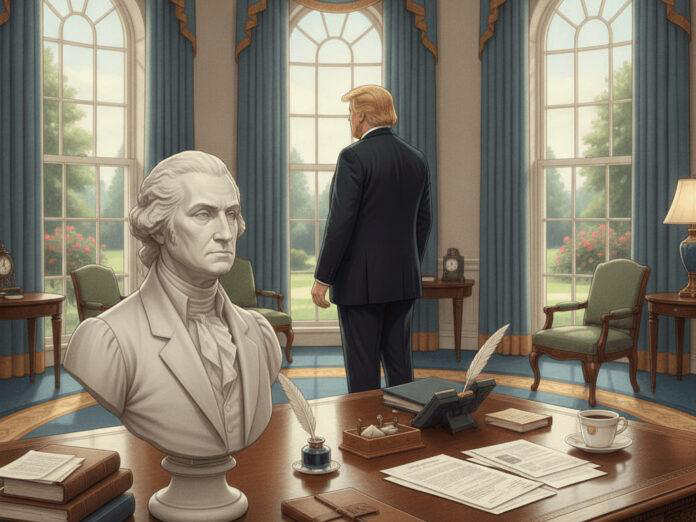
Here’s a fun party trick for the country’s 250th birthday: ask a room full of Americans whether the Founding Fathers would be proud of the place today, and watch the mood curdle. Most people now say the men who launched the whole experiment would take one look at modern America and shake their powdered heads.
That gloomy verdict has been building for a while. The share of Americans who think the Founders would be let down has climbed for more than two decades — from 42 percent in 2001 to 71 percent in 2013, and higher still today. And no, this isn’t a one-party sulk. Only about 20 percent of Republicans and Independents believe the Founders would be pleased, and among Democrats the figure droops to a mere 13 percent. Rare is the issue that unites the country. Apparently, picturing George Washington’s frown is one of them.
But before we all agree to feel bad, it’s worth asking a sneaky little question: what did Washington actually believe about power? Because once you know, today’s headlines start to read very differently.
What Washington Truly Believed
Strip away the marble, and Washington had one obsession that ran through everything: nobody, including him, should get to hold too much power for too long.
This wasn’t a talking point. It was the whole plot of his life. When some officers hinted they might like to make him king, he shot the idea down cold. After winning the Revolution, he did the thing almost no victorious general in history does — he handed power back and went home to farm. King George III reportedly said that if Washington truly gave it up, he’d be “the greatest man in the world.” He did, twice, walking away again after two terms as president and inventing, through pure stubbornness, the idea that a leader leaves on schedule.
His other convictions all pointed the same direction. In his Farewell Address, Washington practically begged the country to avoid two poisons: vicious political parties that treat rivals as enemies, and the temptation to let any one faction dominate the rest. He believed the government’s branches were supposed to check each other, and that the whole design collapses the moment one of them stops pushing back. He was a private, undogmatic believer who told a Jewish congregation in Newport that the country would give “to bigotry no sanction, to persecution no assistance.” And in the most complicated corner of his legacy — a man who enslaved people his entire life — he grew uneasy enough to free them in his will. Late and partial, but it tells you he wrestled with the very contradiction we still argue about.
Boil it down and Washington’s politics were simple: temporary power, divided power, and a deep suspicion of anyone convinced the rules didn’t apply to them.
The Rest of the Gang Didn’t Agree on Much — Except That
Here’s what’s easy to forget: the Founders argued constantly. They did not share one tidy ideology. What they shared was a fear of concentrated power, born from firsthand experience with a king.
Thomas Jefferson wanted a small federal government, strong states, and a nation of independent farmers; he was suspicious of banks, cities, and executive muscle. Alexander Hamilton wanted almost the opposite — an energetic central government, a national bank, and a strong executive who could actually get things done. James Madison, the shy “Father of the Constitution,” split the difference by engineering the whole machine so ambition would fight ambition; his entire design assumed leaders would be power-hungry and built the branches to cancel each other out. John Adams, prickly and brilliant, was obsessed with balanced government and the rule of law standing above any one man. Benjamin Franklin, asked what kind of government they’d created, supposedly answered, “A republic, if you can keep it” — less a victory lap than a warning.
Different heroes, different politics, one shared nightmare: a single person or faction grabbing the whole thing. That fear is the closest thing the Founders had to a unanimous vote.
Now Look at the Scoreboard
Which brings us, awkwardly, to the present.
In his second term, President Trump has governed heavily by executive order — signing more than 250 of them, plus dozens of memos and proclamations, at a pace that outstrips modern predecessors. When the Supreme Court struck down his emergency tariffs in February 2026, he simply reached for a different, rarely used statute and imposed a 10 percent tariff anyway — and, by his own account, wanted Congress to sit on its hands. His budget office has floated “pocket rescissions,” a maneuver to let billions in funds Congress appropriated quietly expire, which critics across the spectrum call a plain violation of the 1974 Impoundment Control Act. Deciding what money gets spent was supposed to be Congress’s superpower. It has largely watched from the bleachers.
The Justice Department is its own chapter. Since day one of the term, the administration has purged prosecutors seen as insufficiently loyal and, watchdog groups report, opened investigations and prosecutions aimed at the president’s political opponents — the kind of “your turn in the barrel” justice the Founders specifically dreaded. Former career lawyers have left in droves, warning that a Justice Department that answers to one man rather than the law stops being justice at all.
And the referee has mostly blown the whistle in one direction. In June 2026, a 6–3 Supreme Court in Trump v. Slaughter tossed a 91-year-old precedent to rule that the president can fire the heads of independent agencies at will — embracing the “unitary executive” theory that everyone enforcing federal law ultimately answers to the president. Justice Sotomayor warned in dissent that this reaches dozens of bodies Congress meant to keep independent. As one analysis put it bluntly, the term “weakens Congress and expands Trump power.” The Court has reined him in occasionally — it blocked his tariffs and his attempt to rewrite birthright citizenship — but the arrow points steadily toward the Oval Office.
So, Would Washington Be Turning in His Grave?
To be fair, some of the Founders’ hypothetical disappointment is actually our applause line. The original Constitution protected slavery and counted Black Americans as three-fifths of a person. The narrow club that reserved real citizenship for white male landowners would be stunned that women vote, that people of color are full citizens, that a Black man has been president. If that reality would scandalize a few of them, good — their shock is our progress made visible.
But the power story is different, and it’s the one that would genuinely alarm the man who refused a crown. Washington’s core beliefs — temporary power, branches that check each other, no faction running the whole show — describe almost exactly the guardrails now under strain. A Congress declining to defend its own purse. A Justice Department pointed at enemies. A judiciary handing more and more rope to the executive. Washington didn’t fear a villain so much as a vacuum: the moment the other branches stop pushing back and simply let power flow to the top.
So would he be turning in his grave? On the progress, no — he’d be amazed and, one hopes, humbled. On the concentration of power, absolutely. And here’s the twist: the Founders never wanted to be worshipped as referees. They wanted the argument to stay alive, the branches to keep shoving, the citizens to keep noticing. The most patriotic thing you can do on the country’s 250th birthday isn’t to guess Washington’s mood. It’s to make sure the guardrails he obsessed over are still doing their job.
The 20-Year Tug-of-War
For the record, this drift toward the Oval Office didn’t start with any single president, and that’s exactly why Washington would care. The last two decades read like a bipartisan tug-of-war over the guardrails, with each side pulling hard when it held the rope. President Barack Obama, frustrated by a gridlocked Congress, famously vowed to govern with “a pen and a phone,” using executive action to shield millions of immigrants from deportation — until the courts blocked his DAPA program in 2016.
President Trump’s first term leaned on the same lever from the right, declaring a national emergency in 2019 to fund a border wall Congress had refused to bankroll.
President Joe Biden then reached for it himself, attempting to cancel some $430 billion in student debt by executive order before the Supreme Court struck it down in 2023, ruling that only Congress holds the power of the purse.
Notice the pattern: in each case, the guardrails largely held, because a court or a coequal branch pushed back. What’s different now is less the ambition than the erosion of the pushback itself — a Congress reluctant to defend its turf and a judiciary increasingly willing to widen the executive’s lane. The Founders built a system that assumed every president would test the limits; they were counting on everyone else to test back. That, not the mood of a man dead since 1799, is the real measure of whether the experiment is still working.