


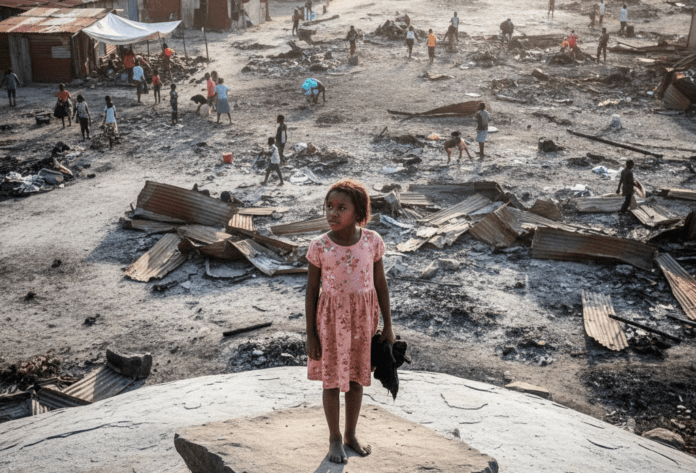
A fire and stampede that tore through two schools and a neighboring settlement in the eastern Democratic Republic of Congo city of Bukavu on Thursday, September 10, 2026, killed at least 26 children and injured 25 others, the United Nations children’s agency (UNICEF) said on Friday, September 11.
The blaze began in the Chimpunda neighborhood of Bukavu, one of DR Congo’s most crowded hillside cities, before the flames reached Ujamaa primary school and Furaha secondary school. It broke out around 9 a.m. (0700 GMT), while children were still at their desks, and some pupils leaped from upper-floor windows to get out.
“In the middle of class, I suddenly heard students screaming, some were jumping from the upper floors, and others were running away through the doors,” said Simon Kasamira, who teaches at Ujamaa primary school and spoke to AFP from a clinic bed where he was receiving treatment.
Trampled in the Rush to Escape
A report issued on Friday, September 11, by inspectors from DR Congo’s education ministry found that the fire set off a crush, with students trampled after they fell and those left trapped inside overcome by asphyxiation. Fires ignited at the same moment in three separate spots about 500 meters apart, the inspectors said.
Patrice Buduge, a local official, said the fire set off a violent stampede in which students trampled one another or hunted for dangerous ways out, and that many fainted or lost consciousness.
Conflicting Death Tolls in a Rebel-Held City
Counts of the dead have differed. Rebel-appointed authorities put out a provisional toll of 24 schoolchildren on Thursday evening, September 10, though fears persisted that more had died in the densely populated Kadutu commune. Local officials cited a toll of at least 29 people killed, including students. M23 said the victims included 20 girls and six boys. Adults, among them teachers, were also reported among the dead and the injured.
Lawrence Kanyuka, a spokesperson for the AFC/M23 rebel movement that controls Bukavu, said 29 people were being treated in local medical facilities, 21 of them in intensive care. Seventeen of the critically injured were at Kadutu General Hospital and four at Bukavu Provincial General Hospital, he said. Christophe Zigashane, a nurse at a local clinic in the city, said his facility took in about 50 students, several teachers among them, in critical condition from asphyxiation. Footage from the scene showed children lying on hospital floors in pain, and pictures circulating on social media showed young children motionless on the ground.
A Hillside City Built of Wood
Dunia Masumbuko Bwenge, vice governor of South Kivu province, told Reuters that the schools and about 300 wooden homes were destroyed. Kasamira said the Ujamaa school was built of wooden planks. Bukavu, the provincial capital, sits on the shores of Lake Kivu and is known for its wooden houses stacked along steep slopes, where deadly fires are frequent. Specialists say such blazes are common across Congolese cities, which largely lack firefighting equipment, and are often traced to buildings crammed together without spacing and to illegal connections to the power grid.
A witness said the fire had been extinguished by the afternoon, though smoke was still rising from rubble and corrugated metal. Another fire in Bukavu on Sunday, September 6, destroyed more than 45 houses.
The disaster also came after a fire at a wedding banquet hall in Kinshasa, the capital, in which 12 people were killed in a stampede. In response to that blaze, the government ordered strict safety measures and sent teams across the country to enforce standards at venues where crowds gather.
Mourning in a Region at War
M23 declared three days of mourning on Friday, September 11, and funerals for the victims were expected to be held on Saturday, September 12. The group said emergency teams were deployed and contained the fire, that it had mobilized assistance for those affected, and that it was appealing for calm, solidarity and vigilance while investigations continue. Authorities in Kinshasa and M23 have both called for an inquiry into the cause of the fire, which had not been established.
The Ministry of National Education and New Citizenship expressed profound sadness in a statement on Thursday, September 10, noting that the disaster came amid a string of fires in Bukavu that had caused alarm. In a statement posted on X, the government said the minister had offered condolences, pledged solidarity with the families and ordered assessments of the affected schools so that classes could continue.
“A tragedy of such magnitude, which has shattered the dreams and futures of so many children, cannot become just another news story,” Denis Mukwege, the Congolese Nobel Peace Prize laureate, wrote on X. He called for urgent measures to deliver humanitarian aid to those affected.
The Rwanda-backed AFC/M23 has held Bukavu since February 2025, when it seized the city while broadening its campaign to seize mineral-rich territory in eastern DR Congo. The country’s east has endured years of fighting, with countless armed factions battling one another for control of the land. DR Congo and the M23 rebels have agreed on a roadmap for peace talks, and the Congolese government has taken Rwanda to an international court over decades of conflict.