


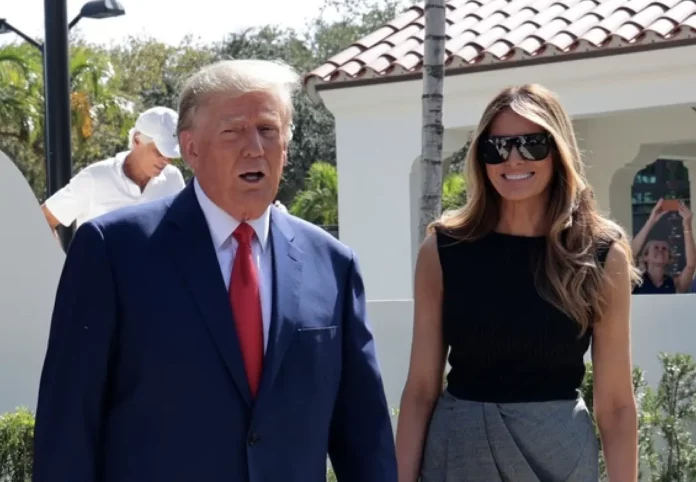
A kiss that landed somewhere near her temple has turned a Rose Garden signing ceremony into a frame-by-frame study of the Trump marriage.
President Donald Trump, 80, signed an executive order on women’s health in the White House Rose Garden on Monday, Oct. 19, 2026, standing alongside First Lady Melania Trump, 56, whose initiative it was — and the internet could not stop replaying what happened next.
Trump held the signed document up for the room, then reached over for his wife’s hand and leaned in. Melania Trump turned her head far to the side, and the kiss glanced off the side of her head. He kept hold of her hand and patted it several times.
Journalist Aaron Rupar posted the clip on X, where viewers traded jokes and body-language analysis.
“I Don’t Know the Protocol Here”
Behavior analyst and body language expert Traci Brown weighed in on the kiss. “I don’t know the protocol here,” she said.
Brown was blunter about what the president’s hand did afterward. “And then we see him use his signature pat. This is belittling,” she said. According to Brown, Trump told Melania “great job” once the moment passed, and the couple were later seen sharing a kiss during the event.
Clinical psychologist Denise Dudley reserved her criticism for something the president said out loud, calling his remark about his wife’s signature “utter public status diminishment.”
A Sharpie, Then an Aside
Trump had signed the order moments earlier with a Sharpie and pronounced himself pleased with the result. He handed the marker to his wife and told the crowd, “I don’t know if her signature means anything” — drawing uncomfortable laughs from some guests — then added, “I think it does.”
Melania Trump smiled and replied, “Yours is the most important.” The document carried her name without giving it any legal weight. Afterward, pens went to women in the audience from the couple, who then posed for a photo.
Speaking before her husband, the first lady set out five objectives: steering research money toward cures for diseases that disproportionately affect women, using artificial intelligence to speed discoveries, accelerating new therapeutics, delivering breakthroughs at prices women can afford, and making conversations about women’s health less taboo. The idea for the division was hers, Trump said: she had noted that NIH lacked one, and the gap made no sense to him.
A Cancer Survivor Co-Chairs the Task Force
A Women’s Health Division at the National Institutes of Health (NIH) comes out of the order, as does a White House Women’s Health Task Force. The division must be stood up within 90 days, inside an appropriate NIH institute or center, and the Office of Research on Women’s Health, which NIH established in 1990, will work with it rather than be replaced by it.
Coordinating research is among its duties, along with improving data on how health outcomes differ by sex and getting more women and girls into clinical trials. Heart disease, cancer, endometriosis, infertility and menopause are singled out in the order.
Co-chairing the task force will be White House Chief of Staff Susie Wiles and Health and Human Services Secretary Robert F. Kennedy Jr., joined by the education, labor and veterans affairs secretaries and the heads of the EPA, FDA, CDC and NIH. Breast cancer was diagnosed in Wiles in March; she stayed in the job through treatment and announced in September that she was cancer-free. Trump praised her from the lectern, calling her a tremendous fighter. The co-chairs may hold public hearings, meetings and roundtables, and the Department of Health and Human Services will fund the task force’s administrative costs.
White House spokeswoman Allison Schuster said the task force “will work to close critical research gaps and strengthen care for women across all stages of life, targeting some of the most widespread health conditions affecting them.”
No Dollar Figure in the Order
No research-spending target appears in the order, and implementation is subject to available appropriations. Dr. Jay Bhattacharya, the NIH Director, told “CBS Mornings” that the amount of money behind the effort remains undetermined, though topics the first lady wants prioritized, among them endometriosis and menopause, are very likely to receive new funding.
Her agency expects several announcements over the course of the year, Alicia Jackson, director of the Advanced Research Projects Agency for Health, told the same program, with $100 million to $200 million going toward large efforts affecting women. A March 2024 executive order and a November 2023 presidential memorandum on women’s health research are both revoked by the order.
Critics have questioned the order’s effectiveness given federal workforce cuts. Thousands of NIH employees have been laid off, and the agency faces a deadline to cut spending by 35 percent across all divisions, a $2.6bn reduction. HHS moved in April 2025 to terminate regional contracts for the Women’s Health Initiative, prompting a multi-state lawsuit.
“Impossible to Live With”
Two days after the signing, Trump turned to his wife again at an Oct. 21 rally in Pendleton, South Carolina, held in support of Senator Lindsey Graham. He said Melania dislikes his dancing and joked that she is “impossible to live with.”
He also recounted what she told him after a past speech: “What happened to you? Are you OK? They had you walking around the stage, hitting the wall.”