


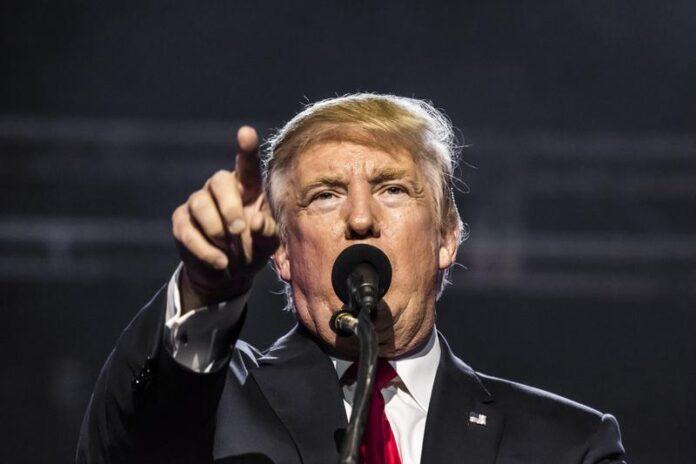
President Donald Trump dismissed reports Friday that he is considering a controversial executive order to declare a national emergency over the 2026 midterm elections. Speaking to reporters outside the White House before departing for Texas, the president denied any knowledge of the proposal—despite sources indicating he has reviewed multiple versions of the draft.
The 17-page draft order, circulating among pro-Trump attorneys and activists, would use unsubstantiated claims of Chinese interference in the 2020 election as justification to federalize control of November’s midterm elections. The proposal would mandate voter ID requirements, ban mail-in ballots except for limited circumstances, eliminate electronic voting machines, and require hand-counted ballots nationwide.
When PBS News Hour White House correspondent Liz Landers pressed Trump on the draft order, he appeared caught off guard. He flatly denied any knowledge of the proposal.
The denial contradicts information from multiple sources who told news organizations that Trump has reviewed versions of the draft order and held discussions with individuals involved in crafting the proposal. Florida attorney Peter Ticktin, one of the key advocates pushing the executive order, told ABC News on Thursday he has been in contact with the White House about the draft.
Ticktin represents former Colorado county clerk Tina Peters, who is serving a nine-year prison sentence for breaching her own election equipment in 2021. He defended the proposal by invoking national security concerns, telling the Washington Post: “We have a situation where the president is aware that there are foreign interests that are interfering in our election processes.”
The attorney emphasized urgency, telling ABC News: “At this point, it’s got to be ASAP, because we got primaries.” He identified hand-counting as the most critical component, arguing that eliminating voting machines should happen immediately.
According to ABC News, Ticktin has been coordinating with prominent figures in Trump’s orbit during the drafting process, including Michael Flynn, MyPillow CEO Mike Lindell, and Patrick Byrne. All three played significant roles in efforts to overturn the 2020 election results. Former White House adviser Steve Bannon discussed the draft order concept on his War Room show last week, claiming without evidence that China actively worked to remove Trump from office in 2020.
The proposal faces immediate constitutional challenges. Article I, Section 4 of the U.S. Constitution assigns authority over elections to state legislatures and Congress—not the executive branch. Ticktin acknowledged this constitutional structure but argued that alleged foreign interference creates an exception.
House Minority Leader Hakeem Jeffries and Rep. Joe Morelle, ranking member of the House Administration Committee, issued a joint statement condemning any potential executive order. They rejected “the legality of any executive order based on debunked claims of Chinese interference in the 2020 election.”
Rep. Ted Lieu pointed to constitutional constraints, noting there is no national emergency exception to Article I, Section 4. He predicted courts would block any such order, comparing it to judicial resistance against Trump’s tariff policies.
The Trump administration has offered little clarity on the matter. A White House official told ABC News that staff regularly communicates with “a variety of outside advocates who want to share their policy ideas with the President,” describing speculation about potential announcements as just that—speculation.
Trump appeared to preview such an order in a February 13 social media post, writing that Democrats refuse to support voter ID or citizenship requirements because “They want to continue to cheat in Elections.” He promised to present “an irrefutable” legal argument for implementing voter ID for the midterm elections “whether approved by Congress or not.”
The president has separately pushed for passage of the SAVE America Act, which would require proof of citizenship to register to vote and mandate voter ID for casting ballots. The House passed the legislation 218-213, but it faces significant hurdles in the Senate, where Democrats have vowed to block it.
Despite the draft order’s central premise, the U.S. intelligence community found no evidence that any foreign actor altered vote tallies or changed election results in 2020. There is no credible evidence supporting allegations of widespread voter fraud or foreign interference in that election. Nevertheless, pro-Trump activists have spent months urging the president and White House staff to use executive action to declare a national emergency ahead of the midterms.
The disconnect between Trump’s public denial and sources describing his involvement with the draft remains unexplained. With primary elections already underway in some states, any executive action would need to come quickly to affect the 2026 midterm cycle.