


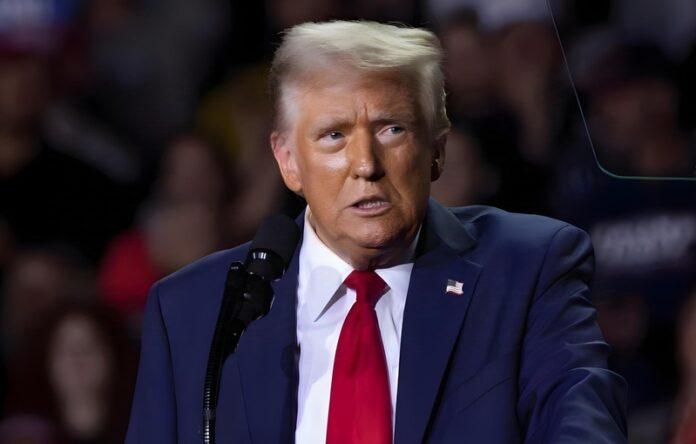
President Donald Trump has unleashed a new threat against Canada over a regulatory dispute involving private jets, warning that the United States will ban Canadian-made aircraft until his preferred American models receive certification north of the border.
The president announced Thursday that he will decertify all Bombardier Global Express jets and other Canadian-manufactured aircraft in retaliation for what he called Canada’s “wrongful” refusal to approve certain Gulfstream models for operation in Canadian airspace.
“Based on the fact that Canada has wrongfully, illegally and steadfastly refused to certify the Gulfstream 500, 600, 700 and 800 Jets, one of the greatest, most technologically advanced airplanes ever made, we are hereby decertifying their Bombardier Global Expresses, and all Aircraft made in Canada, until such time as Gulfstream, a Great American Company, is fully certified, as it should have been many years ago,” Trump wrote on social media.
The move threatens to disrupt private aviation across North America and comes amid already strained relations between Washington and Ottawa. Trump has previously imposed a 50 percent tariff on Canadian goods and threatened additional trade measures against America’s northern neighbor.
Aviation experts pushed back on Trump’s characterization, noting that certification is a safety matter—not a political tool. “The president doesn’t decertify; the FAA decertifies,” said John Gradek, who teaches aviation management at McGill University.
Gradek suggested the president’s sudden focus on aircraft certification stems from broader political tensions, particularly involving Canada’s Prime Minister Mark Carney. Trump and Carney have clashed repeatedly since Carney’s Davos speech on January 20, in which the Canadian leader declared a “rupture” in the rules-based world order and urged middle powers to band together against great-power coercion—a barely veiled critique of American policy.
“Mixing safety issues with politics and grievances is an incredibly bad idea,” said Richard Aboulafia, managing director of AeroDynamic Advisory.
The aircraft dispute represents the latest in a series of escalating trade conflicts initiated by the Trump administration in 2026. Days earlier, the president threatened to impose 10% tariffs on eight European nations over disagreements regarding Greenland, before backing off after reaching a framework agreement with NATO Secretary General Mark Rutte at the World Economic Forum.
Trump has also threatened South Korea with increased tariffs over delays in legislative approval of a trade framework announced last year. On Monday, January 26, he announced plans to raise import taxes on South Korean automobiles, lumber, and pharmaceuticals from 15% to 25% unless the country’s National Assembly acts swiftly.
“Our Trade Deals are very important to America. In each of these Deals, we have acted swiftly to reduce our TARIFFS in line with the Transaction agreed to,” Trump said. “We, of course, expect our Trading Partners to do the same.”
The pattern of threats and ultimatums has created uncertainty for businesses and strained diplomatic relationships with longstanding American allies. European officials have indicated they are prepared to activate countermeasures, including the European Union’s “anti-coercion instrument” if Trump follows through on threatened tariffs.
“The EU has tools at its disposal and is prepared to respond should the threatened tariffs be imposed,” said Olof Gill, spokesperson for the European Commission.
The Canadian aircraft ban could have significant implications for the private aviation industry. Bombardier’s Global Express series represents some of the most popular business jets in operation, widely used by corporations and high-net-worth individuals throughout North America. A White House official later clarified that the decertification would apply only to new aircraft, not the more than 5,400 Canadian-built planes and helicopters already registered in the United States.
Similarly, Canadian operators who have purchased or leased Gulfstream jets face complications because the G700 and G800 models have not received Canadian certification. Transport Canada has flagged possible de-icing concerns with the fuel systems on those aircraft—a significant issue in Canadian winters.
Trump did not specify a timeline for implementing the aircraft decertification, stating only that it would remain in effect until Canada approves the Gulfstream models. He added that the situation must be “immediately corrected” if Canada wants to avoid further consequences.
The Canadian government has not yet issued an official response to Trump’s latest threat. Prime Minister Carney’s office did not immediately respond to requests for comment Thursday.
The aircraft certification dispute adds another layer of complexity to U.S.-Canada relations, which have deteriorated steadily since Trump returned to office in January 2025. The two nations are scheduled to renegotiate their trade agreement later this year—negotiations that now appear likely to be contentious given the mounting list of grievances on both sides.