


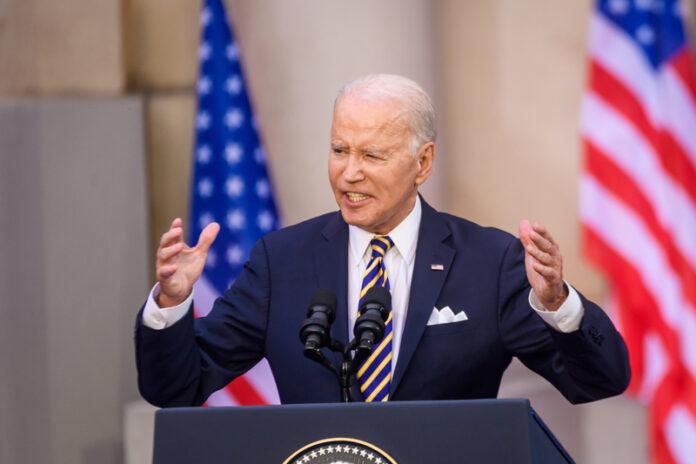
Former President Joe Biden is drawing sharp criticism after giving a politically oriented eulogy at civil rights leader Jesse Jackson’s funeral earlier this month, contrary to the family’s clear request to keep the service free of politics.
Political commentator Megyn Kelly fired a blistering response on “The Megyn Kelly Show” after Jesse Jackson Jr. publicly rebuked Biden, former President Barack Obama, and former Vice President Kamala Harris for turning the March 6 memorial at House of Hope in Chicago into a political forum.
On her March 9 broadcast, Kelly slammed the Democratic figures who spoke, accusing them of disregarding the family’s explicit instructions. “All these Democrats show up at his funeral, and they were asked not to get political,” she said. “Well, they couldn’t contain themselves.”
The dispute began after the Jackson family specifically asked guests to refrain from political remarks during memorials for the civil rights icon, who died February 17 at 84 after battling progressive supranuclear palsy, a rare neurological disorder. Despite this request, several Democratic officials delivered remarks that many perceived as critiques of President Donald Trump’s administration.
Biden’s meandering eulogy took an odd turn when the 83-year-old ex-president made a strange comment about his intelligence while recalling a childhood stutter. Biden told mourners, “I’m a **** of a lot smarter than most of you.” He said this while illustrating how speech impediments can be misinterpreted as a lack of intellect, then added: “Well, all kidding aside, it makes you feel really small.”
Kelly was blunt in her critique of Biden’s performance, ridiculing his delivery and questioning why he ignored the family’s request.
In his March 6 remarks, the former president moved from personal anecdotes to direct criticism of the current administration. “We’re in a tough time, folks. We have an administration that doesn’t share the values we have,” Biden told the audience, according to CNN’s live coverage of the funeral.
Obama likewise used his eulogy to level indirect criticism at President Trump, observing that Americans are experiencing “some new assault on our democratic institutions” every day. He cautioned that “greed and bigotry” are being praised while “bullying and mockery” are presented as strength.
The next day at the final memorial at the Rainbow PUSH Coalition headquarters on Chicago’s South Side, Jesse Jackson Jr. publicly reprimanded the Democratic politicians who had spoken at his father’s funeral.
“Yesterday, I listened for several hours to three United States presidents who do not know Jesse Jackson,” the former congressman said on Saturday, March 7. The younger Jackson, who is running in the March 17 Democratic primary to try to regain his old congressional seat in Illinois’ 2nd District, stressed that his father demanded “a consistent, prophetic voice that at no point in time ever sold us out as a people.”
Kelly supported Jackson Jr.’s criticism on her program. “But Jesse Jackson Jr. was not happy. And who could blame him?” she asked.
The commentator singled out Harris for particular scorn, calling the former vice president “insufferable” for swiftly shifting to political attacks after brief condolences.
Kelly predicted Harris would run again for president in 2028, criticizing her for reusing lines from earlier campaign speeches.
Former President Bill Clinton notably refrained from political remarks in his eulogy, instead concentrating on his personal friendship with Jackson. “I’m here more as a friend than a former president,” Clinton said. “He was my friend when I needed him.”
Jackson, who led civil rights efforts following Martin Luther King Jr.’s assassination in 1968 and launched presidential bids in 1984 and 1988, left a legacy that crossed party boundaries. His passing at 84 signaled the close of a significant chapter in American civil rights activism.
The funeral dispute underscores the tension between honoring a family’s wishes at memorials and politicians’ propensity to use high-profile events for political messaging. Kelly questioned whether “hubris” led the three Democratic leaders to override the Jackson family’s explicit plea for a politics-free service.
As criticism mounts, the episode serves as a reminder that even solemn tributes to national figures can quickly become flashpoints for partisan conflict in today’s highly polarized political climate.