


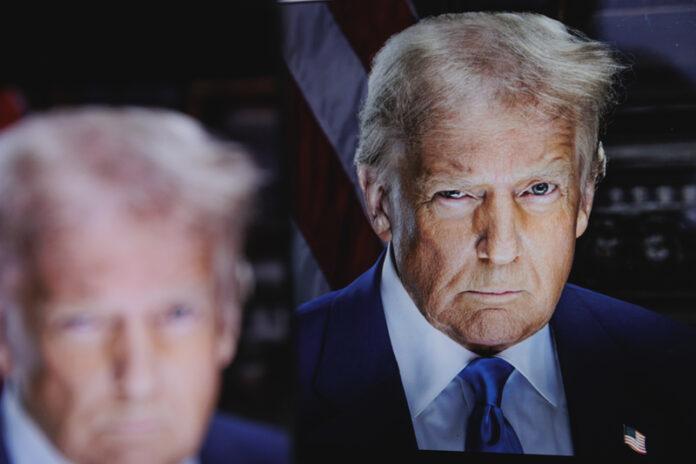
Jack Schlossberg, the 33-year-old grandson of President John F. Kennedy, laid out a pointed set of conditions under which President Donald Trump, 78 years old, could potentially receive the Profile in Courage Award during an appearance on MS NOW.
Schlossberg, who is running for Congress to fill the New York House seat being vacated by retiring Rep. Jerry Nadler after 34 years representing Manhattan, sits on the Profile in Courage Award committee. Host Jackie Alemany asked whether Trump’s well-documented affection for receiving awards and his tendency to embrace anything connected to the Kennedy name might ever warrant consideration for the honor.
The award, created by the Kennedy family and administered through the JFK Library, recognizes officials whose actions demonstrate politically courageous leadership in the spirit of President Kennedy’s book “Profiles in Courage.”
Schlossberg offered a blunt assessment of what it would take for Trump to be considered.
“If President Trump admitted to the many crimes and the grift that he has committed while president in office, stepped down and handed over the power of the presidency to somebody responsible and not somebody in his own cabinet,” Schlossberg began, outlining his criteria for the award.
He continued by connecting Trump’s potential path to recognition with questions about his cousin’s appointment to a key Cabinet position. Schlossberg said Trump would need to come forward with the true reasons behind his selection of Robert F. Kennedy Jr. as Secretary of Health and Human Services, and reveal who is paying for the words coming out of RFK Jr.’s mouth. Only then, Schlossberg suggested, might that constitute the kind of courage the committee would consider.
He concluded his assessment with a definitive statement: Schlossberg said Trump is not in the running anytime soon.
Schlossberg’s remarks about Trump extended beyond the award discussion. He described Trump as obsessed with the Kennedys, a fixation that has manifested in multiple ways throughout Trump’s public life. The Kennedy name carries significant weight in American political history, representing a legacy of public service that spans generations.
The congressional candidate has been particularly vocal in his criticism of his cousin, Robert F. Kennedy Jr., and his leadership at the Department of Health and Human Services. Schlossberg called RFK Jr. dangerous and criticized his performance in the position, pointing to concrete consequences of his tenure.
Under Kennedy’s leadership, a quarter of HHS workers have been cut, significantly reducing the agency’s capacity to carry out its mission of protecting public health. The staffing reductions have raised concerns among public health experts about the department’s ability to respond to health crises and maintain essential services.
The public health consequences of policy changes under RFK Jr.’s watch have been stark. A measles outbreak has swept across the United States, with record high measles cases. The situation has proven deadly, with 3 measles deaths reported—the first measles deaths in the country in about a decade.
Schlossberg directly confronted Kennedy’s wife, Cheryl Hines, asking if she could call the family of a child who died of measles and apologize to them. The comments referenced a measles outbreak in Texas at the time, highlighting the human toll of vaccine skepticism.
Schlossberg’s congressional campaign represents a generational shift in Democratic politics. He announced his candidacy on Nov 12 2025, revealing his decision first through an email to supporters before updating his social media presence to reflect his new role as a candidate for New York’s House seat.
The Profile in Courage Award has become something of an anti-Trump honor in recent years, recognizing officials who have stood up to the president at significant personal and professional cost. Former Sen. Mitt Romney of Utah received the award for his willingness to break with his party on matters of principle. Former Rep. Liz Cheney of Wyoming was similarly honored for her stance on constitutional matters.
Former Vice President Mike Pence received recognition for putting his life and career on the line to ensure the constitutional transfer of presidential power on January 6, 2021. The award citation specifically noted the personal risks Pence faced for fulfilling his constitutional duties during a moment of national crisis.
Federal Reserve Chair Jerome Powell received the Profile in Courage Award for resisting years of personal attacks and threats from the highest levels of government. The recognition highlighted Powell’s refusal to cave to Trump’s pressure on monetary policy, maintaining the Fed’s independence despite repeated public criticism from the president.
The people of the Twin Cities, Minnesota, also received recognition for protesting the president’s policies, demonstrating how the award extends beyond individual officials to honor collective acts of democratic resistance.
Caroline Kennedy has been a prominent figure in Democratic politics and diplomacy, serving in various ambassadorial roles. The Kennedy family’s legacy of public service continues to resonate in American political life, even as family members like RFK Jr. have departed dramatically from the family’s traditional Democratic alignment.
The congressional candidate has built a significant social media following, with 800000 followers. His online presence has mixed serious political commentary with more creative and sometimes controversial content, establishing him as a voice for younger Democrats navigating the modern media landscape.
Alemany’s question about Trump receiving the award touched on a core tension in contemporary American politics—the intersection of Trump’s desire for recognition and validation with his actions that many view as antithetical to democratic norms. The Profile in Courage Award represents values of integrity, principle, and willingness to sacrifice political advantage for the greater good, criteria that Schlossberg clearly believes Trump has not met.
Schlossberg’s appearance marked another chapter in his ongoing public critique of both Trump and his cousin’s role in the current administration. As he campaigns for Nadler’s seat representing the heart of Manhattan, Schlossberg has positioned himself as someone willing to speak directly about threats to democratic institutions and public health, carrying forward what he sees as his grandfather’s legacy of courageous leadership.
The contrast between the Kennedy family’s historical legacy and the current political moment remains a central theme in Schlossberg’s public statements. While Trump seeks association with the Kennedy name and brand, Schlossberg has made clear that he views the president’s actions as fundamentally opposed to the values his grandfather represented. The Profile in Courage Award discussion crystallized this tension, with Schlossberg outlining conditions for Trump’s recognition that amount to a fundamental reversal of his presidency—an outcome Schlossberg clearly considers highly unlikely.