


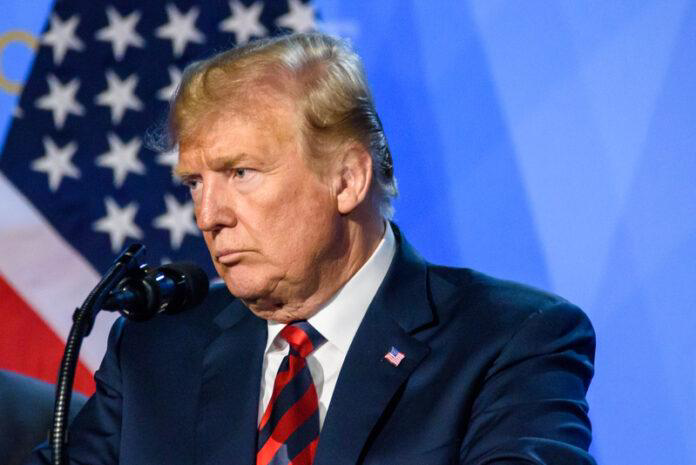
President Donald Trump faced mounting international scrutiny on Monday after a profanity-laced tirade against Iran raised serious concerns about his mental state among world leaders and critics. The 79-year-old commander-in-chief threatened apocalyptic strikes on civilian infrastructure during a rapidly escalating war now in its sixth week.
The controversy erupted following Trump’s expletive-filled rant during a high-stakes press conference on Monday at the White House, where he labeled Iranian leaders “bulls–t artists” while defending his Easter Sunday social media post threatening Tehran with catastrophic military action if they refuse to reopen the Strait of Hormuz.
“They’re very good bulls–t artists. That’s why for 47 years, they’ve been bulls–ting other presidents, and they haven’t done the job,” Trump told reporters, just hours after the Easter Egg Roll on the South Lawn.
The press conference followed an apparently Easter-themed social media post in which Trump issued stark warnings to Iran. “Tuesday will be Power Plant Day, and Bridge Day, all wrapped up in one, in Iran. There will be nothing like it!!! Open the F—-n’ Strait, you crazy b—–ds, or you’ll be living in **** – JUST WATCH!” the president wrote on Truth Social.
Since the Iran war began on February 28, NATO allies and world leaders have grown increasingly alarmed by Trump’s volatile social media outbursts and contradictory messaging.
French President Emmanuel Macron issued a pointed rebuke, telling reporters, “This is not a show. We are talking about war and peace and the lives of men and women,” and urging Trump to stop contradicting himself daily, adding, “maybe you shouldn’t be speaking every day. You should just let things quieten down.”
European leaders have openly struggled to make sense of Trump’s ever-shifting messaging on the war, which has included profanity-laced threats against Iran and insults directed at the very allies he was asking for help. Trump has branded NATO members “cowards,” called the alliance “a paper tiger,” and compared UK Prime Minister Keir Starmer to Neville Chamberlain, while Spain’s Prime Minister Pedro Sánchez fired back that his government “will not applaud those who set the world on fire just because they show up with a bucket.”
Germany’s defense minister, Boris Pistorius, stated bluntly, “This is not our war; we did not start it,” and even Trump’s former far-right allies in Europe have turned against him — Italian Premier Giorgia Meloni refused to let the U.S. use a Sicilian air base, and France’s Marine Le Pen described Trump’s war goals as “erratic.” Danish Foreign Minister Lars Løkke Rasmussen captured the mood when he said of the ceasefire: “Is the world a better place today than yesterday? Undoubtedly. Than 40 days ago? More than doubtful.” Finland’s President Alexander Stubb told Trump directly that a “more European NATO” is taking shape — a diplomatic signal that allies are preparing for a future without reliable American leadership.
While no sitting world leader has explicitly questioned Trump’s mental stability in public, the tone from European capitals — emphasizing seriousness, restraint, and coherence — makes clear they view his conduct as dangerously erratic.
CIA Director John Radcliffe, Defense Secretary Pete Hegseth, and Joint Chiefs of Staff Chairman Gen. Dan Caine joined Trump at the press conference—his first since the U.S. and Israel launched the war more than a month ago. When confronted by journalists about whether his mental health should be examined given the inflammatory rhetoric during an active military conflict, Trump dismissed the concerns entirely.
The war of words comes amid a dramatic rescue of a U.S. pilot downed inside Iran and escalating tensions in the region. Trump has threatened that U.S. forces will begin targeting civilian infrastructure, including power plants and bridges, if Tehran does not reopen the critical shipping lane through which 20% of the world’s oil is transported.
Adding to concerns about the president’s fitness for office, photographers captured what appeared to be substantial bruising and discoloration on Trump’s hands during his appearance at the Easter Egg Roll. The visible marks on his right hand seemed to have been concealed with makeup, according to multiple observers. Trump, 79, also appeared to hold onto First Lady Melania Trump for support while descending the White House steps.
Journalist Aaron Rupar highlighted the visible marks in video footage from the event. The prominent bruising sparked immediate speculation on social media, with users questioning the cause behind the recurring marks that have been appearing on the president’s hands for months.
Press Secretary Karoline Leavitt defended the president’s appearance, attributing the bruising to his work ethic and medical regimen. According to the White House, Trump’s bruising is “consistent with minor soft tissue irritation from frequent handshaking and the use of aspirin, which is taken as part of a standard cardiovascular prevention regimen.” Officials have also disclosed that Trump takes 325 milligrams of aspirin daily—four times the commonly recommended low dose—and has been diagnosed with chronic venous insufficiency, which causes swelling in his lower legs.
The physical concerns compound broader questions about Trump’s public schedule. The New York Times reported in November that Trump’s overall public appearances have dropped by 39% compared to his first term. On Saturday, the White House announced that the president would not be making any public appearances for the rest of the day, an unusual move for Trump, who typically visits Mar-a-Lago to golf on weekends. A White House spokesperson said Trump had been “working nonstop in the White House and Oval Office” during the Easter holiday.
Former Canadian Ambassador to Israel Jon Allen weighed in on Trump’s increasingly aggressive rhetoric toward Iran, suggesting the president may be “laying the ground” for a possible massive military strike. Critics have questioned whether Trump’s approach represents sound strategic thinking or evidence of instability at the highest levels of American government.
The president has confirmed he undergoes regular medical evaluations and insists he has “aced” them all. However, the combination of visible physical symptoms, reduced public appearances, and inflammatory language during a sensitive international crisis has amplified concerns among both domestic critics and international observers.
As the crisis enters its seventh week, world leaders are privately expressing alarm about Trump’s approach to the conflict. Iran’s foreign minister described the negotiations as the most intensive engagement between the two countries in 47 years, but accused Washington of “maximalism” and “shifting goalposts.” The combination of profanity-laced public statements, threats against civilian infrastructure, and visible health concerns has created an unprecedented situation in modern American presidential history.