


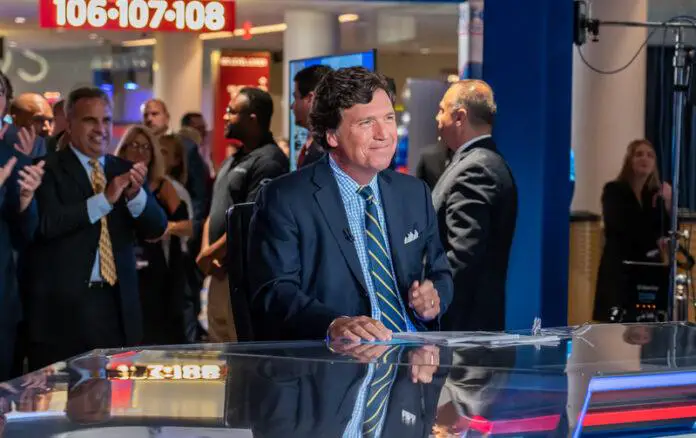
Tucker Carlson has publicly criticized President Donald Trump for celebrating the death of former FBI Director Robert Mueller—a rare break from one of the president’s most prominent media allies.
The conservative commentator addressed Trump’s inflammatory response during the March 25 episode of “The Tucker Carlson Show” featuring Iraq War veteran James Webb. Mueller, who led the special counsel investigation into Russian interference in the 2016 election, died March 20, 2026, at age 81. His family announced last August that he had been diagnosed with Parkinson’s disease in 2021.
Hours after news of Mueller’s death broke, President Trump posted his reaction on Truth Social: “Robert Mueller just died. Good, I’m glad he’s dead. He can no longer hurt innocent people!”
Carlson—who had opposed Mueller’s investigation throughout its duration—expressed deep discomfort with the president’s gleeful response. During his conversation with Webb, a third-generation Marine who fought in the Battle of Ramadi and co-hosts a podcast with his father, former Senator Jim Webb, Carlson connected Trump’s remarks to what he sees as a troubling shift in American rhetoric.
“When a man dies, even if it’s someone you disagree with or even hate, there’s a certain reverence in death that’s required if you’re going to have reverence for life,” Carlson said. “There’s something awful about that.”
The criticism marks a significant departure for Carlson, who has maintained close ties with Trump throughout his presidency. He linked Trump’s words to broader concerns about violent rhetoric in American political discourse, particularly since the conflict with Iran began.
Webb emphasized Mueller’s decorated military service and the impact of Trump’s words on the former FBI director’s surviving family. Mueller served as a Marine rifle platoon leader in Vietnam, where he earned a Bronze Star with “V” device for valor after rescuing a wounded Marine under enemy fire during an ambush. He was later shot in the thigh by an AK-47 round but continued fighting before receiving the Purple Heart. His military decorations also included two Navy Commendation Medals and the Vietnamese Cross of Gallantry.
The president’s comments drew sharp condemnation across the political spectrum. Even Trump supporters appeared stunned by remarks that shattered traditional norms of political civility regarding the deceased. Fox News notably never mentioned Trump’s comment on its television broadcasts, though Fox analyst Brit Hume criticized the post on social media, writing: “This is the kind of stuff Trump does that makes people not just oppose him but hate him.”
Mueller became a lightning rod in American politics after his 2017 appointment as special counsel. His investigation shadowed much of Trump’s first term and remained a source of intense frustration for the president, who attacked Mueller relentlessly and dismissed the probe as a “witch hunt.” According to Mueller’s own report, Trump “slumped back in his chair” upon learning of Mueller’s appointment and said, “Oh my God.”
The grudge persisted into Trump’s second term. In March 2025, he signed an executive order cutting ties between federal agencies and WilmerHale, Mueller’s former law firm—an order later struck down by a judge as unconstitutional.
Despite their political differences, Mueller’s career in public service spanned decades and earned bipartisan respect. He served as FBI director from 2001 to 2013, transforming the bureau in the aftermath of the September 11 attacks. When President George W. Bush nominated him just days before the attacks, the Senate confirmed him unanimously. President Barack Obama later asked him to stay beyond the traditional 10-year term, with the Senate confirming the extension 100-0.
Former President Bush said in a statement that he and Laura Bush were “deeply saddened” by Mueller’s death, crediting him with transitioning the FBI’s mission to protecting the homeland and “helping prevent another terrorist attack on U.S. soil.” WilmerHale called Mueller “an extraordinary leader and public servant and a person of the greatest integrity.”
Carlson’s willingness to break with Trump on this issue reflects what some observers see as growing comfort among conservative commentators to occasionally challenge the president on matters of tone, even while supporting his broader policy agenda. For at least some Trump allies, celebrating an adversary’s death crosses a fundamental moral boundary that transcends political loyalty.
The White House has not walked back the president’s statement. Vice President JD Vance has not commented publicly on the controversy.