


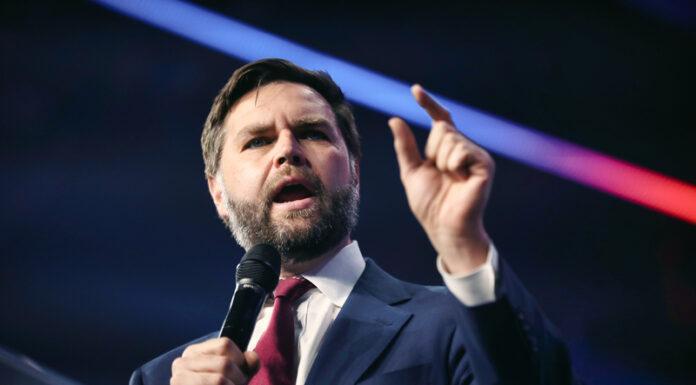
Vice President JD Vance found himself trapped in a rhetorical contradiction this week while attempting to defend President Trump’s relationship with convicted sex offender Jeffrey Epstein, offering an explanation that clashed directly with the historical record.
Speaking at a Turning Point USA event at the University of Georgia on Tuesday, Vance addressed mounting scrutiny over Trump’s documented friendship with Epstein, which spanned from the late 1980s until an apparent falling out in the 2000s. The vice president insisted that when Trump repeatedly called the Epstein files a “hoax,” he wasn’t denying the financier’s crimes or network of powerful associates — only rejecting what Vance termed a “Democratic idea” that the two men were close.
“When the president says, ‘This is a hoax,’ he’s not saying it’s a hoax that Epstein was a scumbag,” Vance told the audience. “He’s saying this Democratic idea that somehow he was Epstein’s best friend, that is a hoax.”
The vice president’s defense, however, runs headlong into Trump’s own words from 2002, when he told New York magazine about Epstein: “I’ve known Jeff for 15 years. Terrific guy. He’s a lot of fun to be with. It is even said that he likes beautiful women as much as I do, and many of them are on the younger side.”
That 15-year timeline, offered by Trump himself, would place the beginning of their relationship in the late 1980s — precisely when their friendship reportedly began. Photographs from a February 2000 event at Mar-a-Lago show the two men socializing with Melania Trump and Ghislaine Maxwell, and additional images from 1997 document their appearances together at social gatherings in Palm Beach.
Vance attempted to minimize these connections by suggesting proximity was inevitable in Palm Beach social circles. “If you look at those emails, they were the same; everybody in Palm Beach knew everybody,” he explained. But the relationship extended beyond casual acquaintance. In recordings made by author Michael Wolff in August 2017 and released in 2024, Epstein described himself as “Donald’s closest friend for 10 years.” Flight logs show Trump used Epstein’s private jet on multiple occasions, and The Wall Street Journal published what it reported was a sexually suggestive letter bearing Trump’s signature, included in a birthday album compiled for Epstein’s 50th birthday in 2003.
The 79-year-old president denied writing the letter and sued the Journal for $10 billion, but a federal judge dismissed the lawsuit the day before Vance’s appearance, ruling that Trump came “nowhere close” to meeting the standard for proving actual malice. The dismissal was without prejudice, allowing Trump to refile.
Vance pushed further during his appearance, claiming that emails from the Department of Justice’s release of Epstein files showed mutual antagonism between the two men. He cited one message he said documented “Trump narking on Jeffrey Epstein to the local sheriff, saying this guy is a scumbag.” The vice president went so far as to characterize this alleged hostility as evidence of Trump’s character.
“One of the best signs for whether you are a good person or not, for whether you are a decent human being, is if the worst people in the world hate your guts,” Vance said, suggesting Epstein’s purported dislike of Trump was “a pretty good thing” for the president’s reputation.
The timeline of the relationship remains disputed. Trump and Epstein reportedly had a falling out in the 2000s — allegedly over a real estate deal, according to former President Bill Clinton, who testified before the House Oversight Committee that Trump once told him they “fell out all because of a real estate deal” — though Trump has offered varying explanations over the years. What isn’t disputed is that Trump called the Epstein files a “Democrat hoax” on several occasions, a characterization Vance struggled to reinterpret for the University of Georgia audience.
The vice president insisted Trump’s “hoax” comments referred only to the characterization of their friendship, not to Epstein’s criminal conduct or extensive network of powerful associates. “The president has said he knew Jeffrey Epstein and he was a scumbag,” Vance maintained, attempting to thread a needle between acknowledging the connection and dismissing its significance.
Yet the documented evidence — photographs, flight records, Trump’s own effusive 2002 comments, and Epstein’s recorded 2017 statement about their decade-long friendship — paints a picture far more complex than the one Vance presented. The vice president’s assertion that criticism of this relationship stems from a partisan fabrication collapses under the weight of the historical record, much of it created by Trump and Epstein themselves.
The defense comes as Vance has positioned himself as a staunch protector of the president on multiple fronts. The 41-year-old vice president recently defended MAGA supporters after podcaster Joe Rogan called some of them “unintelligent” and “uninteresting,” saying that “we have many, many fewer dorks than the far left, but everybody’s got some dorks.”
During his University of Georgia appearance, Vance emphasized his opposition to powerful figures involved in what he called “disgusting behavior,” stating, “I don’t want powerful people, you know, being involved in this disgusting behavior.” The comment underscored the contradiction at the heart of his defense: condemning misconduct by the powerful while simultaneously downplaying documented connections between the president and one of the most notorious criminals in recent American history.
Critics quickly highlighted the disconnect between Vance’s explanation and the factual record, noting that Trump’s own words from 2002 directly contradict the vice president’s characterization of their relationship as one marked by mutual disdain.
The episode illustrates the challenges facing administration officials as they navigate the president’s past statements and associations. In attempting to reframe Trump’s “hoax” claims as narrowly targeted at partisan exaggeration rather than blanket denial, Vance created a new problem: his explanation required ignoring or reinterpreting Trump’s documented 15-year acquaintance with Epstein, a relationship the president himself once described in glowing terms.