


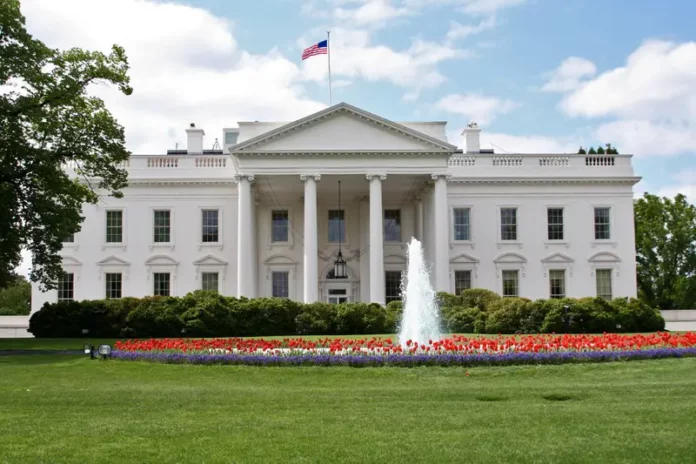
A towering mound of dirt hauled from President Trump’s White House renovation has transformed one of Washington’s most beloved public golf courses into the center of a federal lawsuit — and a flashpoint over the future of affordable golf in the nation’s capital.
Nearly 30,000 cubic yards of soil excavated from the East Wing demolition have been dumped at East Potomac Golf Links since October 2025, piled so high that golfers have nicknamed it “Mount Trump.” Now the DC Preservation League is suing in federal court, alleging the dirt may be laced with asbestos and other toxic materials from a building first constructed in 1902 and renovated in 1942 — eras when hazardous building materials were standard.
The Trump administration denies the allegations. The National Park Service, which approved the dumping last fall and classified the soil as routine landscaping fill, says the material has been repeatedly tested and found to be clean and safe. In court documents, the administration maintains every legal requirement was met before the first truckload arrived.
A Mound That Towers Over Tee Boxes
The pile rises so prominently from the middle of the historic municipal course that it dominates sightlines from several holes, fenced off and unreachable when errant shots find it.
“It’s definitely an eyesore,” Alex, a Georgetown resident who plays East Potomac regularly, told WJLA. “If you slice it off of like 4, it goes right into the dirt pile and there’s fences around it so you can’t get your ball.”
What that landscaping is ultimately meant to accomplish remains unclear — and that ambiguity sits at the heart of the legal fight. Plaintiffs argue the dirt pile is not landscaping at all but the opening move in a plan to tear out East Potomac’s century-old identity as an affordable municipal course and replace it with a high-end venue capable of hosting the Ryder Cup and the U.S. Open.
President Trump appeared to confirm that vision in January, telling reporters aboard Air Force One that he intended to make East Potomac “a beautiful, world-class, U.S. Open-caliber course” that would “bring a lot of business into Washington.”
The administration counters in court filings that no final decision has been made.
A Terminated Lease and an Uncertain Future
The dirt is only one piece of a much larger upheaval. In December, the Trump administration abruptly terminated the 50-year lease of the National Links Trust, the nonprofit that operated all three of D.C.’s public municipal golf courses under contract with the National Park Service. The administration accused NLT of failing to make required capital improvements. The nonprofit disputes that characterization.
Mike McCartin, co-founder of the National Links Trust, sees the consequences rippling outward.
“Our mission — what National Links Trust is about — is affordable and accessible golf,” McCartin said. “And so if the president is saying he wants to do something different, then you can only conclude that maybe it might change that fundamental mission.”
Renovation plans at Rock Creek Golf Course in Northwest Washington have been halted. Plans to rehabilitate Langston Golf Course in Northeast are in doubt. A National Park Service official said the Trump administration is considering renovation plans for all three courses, though every proposal remains in a “conceptual phase.”
Stakes Beyond a Single Course
The uncertainty surrounding Langston carries particular weight. During the segregation era, Langston was the only public course in Washington where Black golfers were allowed to play. Lee Elder, the first Black golfer to compete in the Masters, managed Langston from the late 1970s into the early 1980s and built its driving range — embedding the course deep in the history of Black golf in America.
The lawsuit filed by the DC Preservation League raises both immediate and long-term questions: whether the soil itself poses a public health risk, and what the dumping signals about the trajectory of municipal golf in Washington. Court filings press the administration to explain what the dirt is for, and whether its arrival presages the conversion of a public asset into private spectacle.
For now, the mound remains, fenced and unmoved. Trucks from the East Wing site have continued the trip across the Potomac, depositing what the government calls landscaping fill and what plaintiffs call demolition waste from the ballroom and East Wing renovations.
Whether the courts side with the preservationists or the administration, the dispute has already reframed a quiet patch of public land into a proxy battle over who Washington’s golf courses are for — the casual weekend player chasing a sliced drive on the fourth hole, or the championship galleries the president envisions filling the fairways someday soon.