


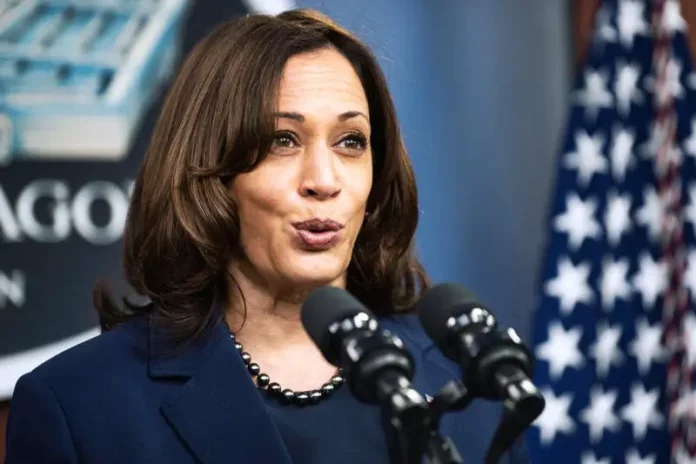
Former Vice President Kamala Harris continues to dominate the field of potential Democratic candidates for the 2028 presidential race, according to a national poll released on June 14, though her lead has narrowed since October 2025 as the race begins to take shape more than two years before the first primary votes are cast.
The latest Center Square Voters’ Voice Poll found Harris garnering 27% support from left-leaning voters, approximately twice the backing received by her closest competitor, California Governor Gavin Newsom, who came in second at 14%. The survey, conducted by Noble Predictive Insights between June 4 and June 6, polled 1,224 registered voters identifying as Democrats or left-leaning independents (1,013 Democrats and 211 independents), through online panel recruitment and mobile phone text-based web access.
While Harris maintains a sizable advantage over the rest of the Democratic field, the poll suggests her grip on the party’s electorate may be loosening somewhat. Her support has slipped from 33% in October 2025 to 31% in a March 2026 survey and now to 27% in the latest June polling. Newsom has also trended downward over the same period, falling from 21% in October 2025 to his current 14%.
The results suggest the Democratic field remains unsettled, with several prominent political figures starting to make inroads as the 2028 contest gradually develops. Former Transportation Secretary Pete Buttigieg registered the strongest increase among those surveyed, breaking into double-digit territory for the first time with 11% support in the June poll, up four percentage points from earlier surveys.
New York Representative Alexandria Ocasio-Cortez received 8% support in the latest survey, recovering from a dip in March 2026 when she fell from third to fourth place among the names provided. A considerable portion of Democratic voters has yet to make up their minds. Seventeen percent of those surveyed indicated uncertainty about their preferred candidate for a 2028 primary, reflecting the open nature of a contest still more than two years in the future.
Strong Support Among Key Demographics
Harris performed especially well among younger voters and Black voters in the June polling. Approximately half of Black respondents (49%) indicated they would support her, and 48% of voters aged 18 to 29 backed the former vice president. The California native also commanded 35% support among voters without college degrees in that demographic.
Harris led the field among white voters with 17% support, with Newsom close behind at 16% and Buttigieg at 15%. Her broad appeal across demographic groups has helped maintain her frontrunner status despite the gradual erosion in overall support.
Harris did not lead in every demographic category. Newsom commanded the strongest support among voters 65 and older, with 23% backing compared to 15% for Buttigieg and 11% for Harris. Among those holding postgraduate degrees, Newsom slightly outperformed Harris, 19% to 18%, suggesting the California governor retains strong appeal among older and more highly educated Democratic voters.
Comparing Recent Polls
The March 2026 Center Square poll, which surveyed 1,152 Democrats and left-leaning independents including 934 Democrats and 218 independents, found similar patterns. In that survey, Harris was the top pick for 32% of Democrats but only 18% of independents, down from 27% of independents in October 2025. Among Democrats specifically, her support remained relatively stable at 32% in March compared to 33% in October.
Gender dynamics also shifted between the fall and spring surveys. Thirty percent of males surveyed chose Harris in March 2026, compared to 28% in October 2025, while 33% of females polled selected Harris in March, compared to 36% in October. The March poll showed Newsom as the second-most popular candidate with 16% support overall, followed by Buttigieg at 7% and Ocasio-Cortez at 6%.
Harris demonstrated strong appeal across racial groups in the March survey as well. She garnered 55% support among Black voters, 29% among Hispanic and Latino voters, 25% among white voters, and 30% among other races grouped together. Newsom received his highest support from Latino respondents compared to other racial categories surveyed.
The March poll also revealed that 18% of Democrats and 21% of independents were unsure who they would choose, indicating substantial room for movement in the race. Pennsylvania Governor Josh Shapiro captured 5% support in that survey, while Arizona Senator Mark Kelly received 4%. Other names included in the polling were Illinois Governor J.B. Pritzker, Maryland Governor Wes Moore, and senators from New Jersey, Kentucky, and other states.
Harris Abandons California Governor Bid
The former vice president’s focus on a potential 2028 presidential run became clearer after she announced on July 30, 2025, that she would not run for California governor in 2026. That decision ended months of speculation following her loss in the November 2024 presidential election to President Donald Trump.
Before Harris ruled herself out of the gubernatorial race, an Emerson College poll conducted February 10 through 11, 2025, among 1,000 registered California voters found that 57% of registered Democratic voters in the Golden State would support her if she chose to enter the contest to replace Governor Newsom. Former Representative Katie Porter was a distant second in that scenario with only 9% support.
According to Spencer Kimball, executive director of Emerson College Polling, support for Harris in that California survey was strongest among women at 60%, Hispanics at 61%, and Black voters at 64%. Without Harris in the California governor’s race, the February 2025 Emerson poll found 45% of Democratic primary voters were undecided, with Porter leading at 21%, former California Assembly speaker Antonio Villaraigosa at 9%, and Lieutenant Governor Eleni Kounalakis at 5%.
By ruling out a gubernatorial bid and maintaining her strong position in presidential polling, Harris has signaled her intention to remain on the national stage. Whether her current lead in the 2028 Democratic field will hold as the election cycle intensifies remains an open question, particularly as nearly one in five Democratic voters remain uncommitted and other candidates continue to build their profiles.