


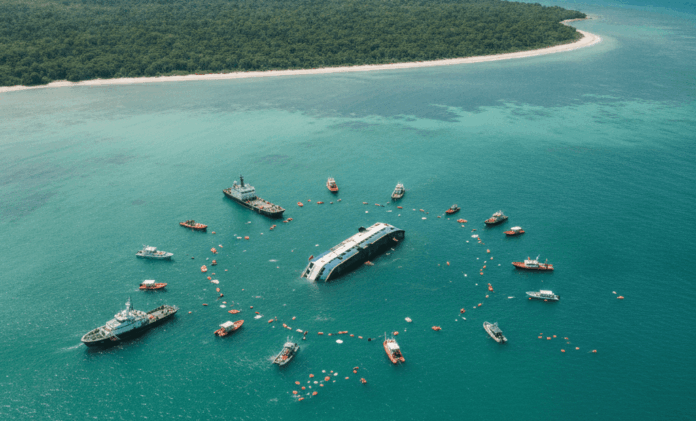
Guyanese authorities confirmed on July 22 that 76 individuals were pulled from the water alive following the capsizing of the MV Barima during the night of July 18. Recovery teams have retrieved 73 bodies from the wreckage, with 65 positively identified so far. Prime Minister Mark Phillips revealed that 179 people were actually aboard the vessel—a figure far exceeding what official documentation showed.
The ship’s manifest recorded just 133 souls: 116 passengers plus 17 crew members. Investigators have made that disparity between recorded and real passenger counts a central element of their probe into the tragedy.
The vessel departed Georgetown, the nation’s capital, on Saturday afternoon heading for Port Kaituma, a gold mining community deep in the Essequibo region’s rainforest interior. According to VesselFinder’s shipping database, the 40-meter (131-foot) craft was constructed in 1939—making it 87 years old at the time it went down.
Ships traveling that route move through ocean waters before turning into a river channel that reaches Port Kaituma, located in the northern rainforest. Emergency responders received the distress call shortly before midnight local time (just after 3 a.m. GMT on July 19), triggering a combined effort by government vessels and civilian watercraft.
Investigation and Arrests
An inquiry has been opened to determine what caused the sinking. Police took the captain and at least one additional crew member into custody after marijuana tests came back positive for both. At a July 19 press conference, Public Works Minister Juan Edghill voiced outrage, underscoring the government’s zero-tolerance policy on impaired navigation and calling the captain’s drug test result particularly disturbing.
Phillips warned that “where negligence, misconduct or criminal wrongdoing is established, those responsible will face the full force of the law.”
Both the discrepancy in passenger documentation and possible drug use among crew members are being examined as potential factors in the disaster.
Public Works Minister Juan Edghill called the catastrophe Guyana’s most severe maritime disaster in recent decades. He emphasized that authorities were taking all possible steps to locate those still missing. At least 15 children were brought to shore by rescue teams.
The ferry was headed toward Essequibo, a territory at the center of a continuing border dispute between Guyana and Venezuela concerning oil-rich lands. The small, English-speaking country in northeastern South America has consistently challenged assertions from its larger neighbor over control of Essequibo.
On July 21, officials revised the death toll sharply upward, raising the count from 41 dead to 53. Prime Minister Mark Phillips announced the toll had grown to 65 fatalities the next day. By July 23, recovery operations employed 19 vessels and three aircraft, backed by dive teams from Brazil, Trinidad and Tobago, and France, along with local divers. Private boats proved critical, pulling survivors from the sea.
A Survivor’s Account
Elena Moonsammy, who lived through the ordeal, told Kiskadee Watch that a massive wave slammed into the ferry, forcing it to lean steeply. Floodwaters poured in within moments, she said.
Moonsammy held onto a floating box among the debris. She had been gripping her two-year-old child’s hand but lost her grasp in the chaos. Even so, she managed to rescue another woman, calling to her to seize the same box.
French Guiana dispatched a team of 12 divers along with two medical personnel and one mechanic to aid the operation, coordinated through French military channels.
Family members and friends of the missing have assembled along the shoreline, waiting in anguish for updates. Recovery teams have retrieved 73 bodies—65 of which have been positively identified—while 76 people were rescued alive. With an estimated 179 individuals aboard, many passengers are still unaccounted for, and prospects for finding survivors fade as time moves forward.
No additional bodies have been found since July 24, and officials say hazardous conditions within the sunken hull have rendered further diving too perilous.