


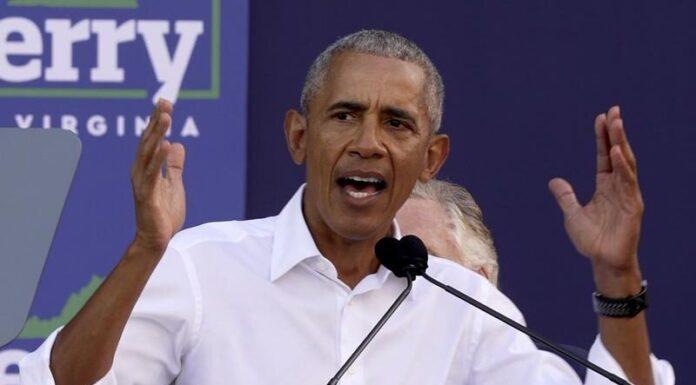
Former President Barack Obama said on Tuesday that a fractured media environment has made it far harder for a transformative Democratic political figure to emerge the way he did nearly 20 years ago — and suggested that plenty of talented potential stars are out there, just waiting for their moment.
NBC “Today” co-host Craig Melvin sat down with Obama on his “Glass Half Full” podcast to discuss the newly opened Obama Presidential Center in Chicago, but the conversation quickly turned to a broader question about Democratic politics and whether the party could ever produce another candidate with Obama’s particular brand of crossover appeal.
Melvin told the former president that one of his former aides had argued on cable television that Democrats should stop searching for an “Obama 2.0,” calling the idea a fantasy. Melvin then asked Obama whether someone with his biography could break through today the same way.
Obama Points to a Divided Media Landscape
“I do think it’s harder because of the nature of your business, the media, it’s more splintered,” Obama said. He then walked Melvin through the circumstances that turned a relatively unknown state politician into a national phenomenon almost overnight.
Obama recalled that his 2004 Democratic National Convention speech was broadcast across every major network and splashed across magazine covers, introducing him to the entire country at once. That kind of singular cultural moment, he argued, no longer exists in today’s fractured information environment.
Obama also acknowledged that gifted individuals who might rival or even surpass his own abilities are active today — they just cannot find the platform. He said people “who are just as gifted or in some cases more gifted” than him are failing to break through because no single spotlight exists anymore to illuminate them the way network television and national print magazines once could.
A Transition Period for Democratic Talent
Rather than sounding an alarm, Obama said he believes many people comparable to himself and Michelle Obama are doing impressive work, but that politics and media have not yet created the conditions to elevate them. He described one of the core missions of the Obama Presidential Center as helping to direct attention toward those individuals.
The presidential center itself opened on June 19, 2026, in Chicago, with Barack and Michelle Obama marking the occasion by reading to schoolchildren in John Lewis Plaza. The center’s opening drew national attention both for its cultural significance and for the remarks Obama delivered there, in which he took a candid look at America’s founding promise on the eve of the nation’s 250th anniversary on July 4.
Speaking at the dedication, Obama said the country’s democratic experiment was never guaranteed to succeed. He argued that while the founders fell profoundly short of the ideals they put to paper — permitting slavery and restricting voting rights to property-owning white men — they nevertheless built a constitutional framework flexible enough for each generation to improve upon.
The Media’s Role in Obama’s Own Rise
The irony of Obama’s media critique is not lost on those who have studied his own career closely. His 2008 presidential campaign was, at the time, among the most sophisticated users of emerging digital tools in political history, deploying social media and online organizing platforms in ways no major candidate had attempted before. His team constructed fundraising and field operations around digital communications while legacy outlets still dominated the broader national conversation.
Once in office, his administration also experimented aggressively with new formats — producing its own audio, video and written content distributed directly to the public, and reaching audiences through unconventional means. Obama famously sat for an interview on the web comedy series “Between Two Ferns” with comedian Zach Galifianakis specifically to encourage younger Americans to enroll in health insurance under the Affordable Care Act.
Transparency Promises and Their Complications
Obama’s complicated relationship with the press extended beyond communications strategy. Before taking office, he pledged to run the most transparent and accountable administration in American history — a promise that drew intense scrutiny as his tenure progressed. As journalists documented during his presidency, reporters faced significant obstacles obtaining information from federal agencies, with Freedom of Information Act requests frequently delayed or forwarded to political appointees, sources pressured to stay silent and access to military operations dramatically restricted compared to previous administrations.
That history adds a layer of complexity to Obama’s current observations about media fragmentation. Whether the barriers facing the next generation of Democrats are structural — rooted in a changed media landscape — or political remains a matter of debate. What is clear is that Obama believes the talent is there, and that the challenge now is building the kind of shared cultural attention that once made a single convention speech capable of launching a presidency.