


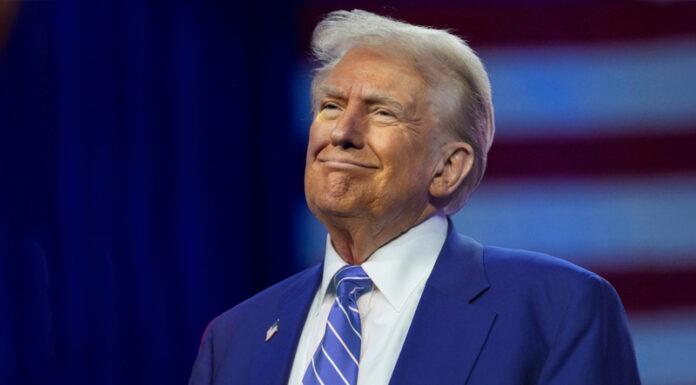
President Donald Trump offered a head-turning explanation for arriving an hour late to a meeting, telling Real America’s Voice on Tuesday that daylight saving time was entirely to blame — and using the moment to call on Congress to make the time shift permanent once and for all.
Trump, 80, described showing up late to what he characterized as an appointment with “a big person from a big country.” He recounted being told upon arrival that he was late, only to discover the clock change had caused his tardiness. The president did not identify the meeting, the country involved, or when it took place.
Trump Blames the Clock, Not Himself
Trump told the outlet he arrived an hour behind schedule for an important appointment with a major foreign leader. Upon entering, he was informed of his lateness and expressed confusion before learning he had failed to adjust for the time change.
It was not immediately clear which meeting Trump was describing. His most recent documented tardiness involved a gathering of world leaders in France in June 2025, where he arrived almost an hour behind schedule and quipped, “I’m the boss.” The White House did not clarify whether Tuesday’s anecdote referred to that episode or a separate incident, instead directing questions to a Truth Social post Trump made in May 2026.
Legislation Advances but Stalls in the Senate
In May 2026, the House Energy and Commerce Committee approved a bill by a 48-1 vote to make daylight saving time permanent across the country. Trump took to Truth Social afterward, calling the twice-yearly clock ritual an unnecessary burden and a political opportunity for Republicans.
The bill passed the House but stalled in the Senate, where opponents raised safety concerns about workers commuting in darkness during winter mornings if clocks were permanently set to daylight saving time.
Trump’s interview went beyond policy. He claimed more daylight hours in the evening hurt criminals because, in his telling, wrongdoers prefer operating under darkness. He said extended afternoon light benefits sports, safety, and quality of life — though he acknowledged some people prefer morning light, a preference he does not share.
Trump cited polling to argue that eliminating the biannual switch enjoys overwhelming support, saying people hate changing their clocks.
Polling Shows Broad Public Agreement
A YouGov survey in February 2026 found that 64 percent of Americans support eliminating the requirement to change clocks twice a year. Only 16 percent opposed the idea, while 21 percent were unsure. Among those wanting to end the clock change, a majority preferred permanent daylight saving time over permanent standard time — aligning with Trump’s position.
Despite that sentiment, senators from states with large agricultural communities and those representing workers with early schedules have been the most vocal critics, arguing that dark winter mornings create real hazards for commuters and laborers starting their days before sunrise.
Reaction Pours in Over Trump’s Excuse
Trump’s daylight saving explanation drew mockery online, with observers noting the irony of a president whose daily schedule frequently includes lengthy blocks of unstructured “Executive Time” in the mornings blaming a time change for a failure to appear on schedule. Reporting on the White House found that Trump was observed in public in Washington, D.C., before 11 a.m. on only three occasions during June 2026.
Separately, Trump erupted in a lengthy Truth Social post — running to 190 words and published just after 10:30 p.m. ET on Monday — targeting the Center for American Progress (CAP) after the liberal think tank released findings suggesting his administration’s National Guard deployments to cities including Los Angeles and Washington, D.C., cost taxpayers more than $1.7 billion while producing no measurable reduction in violent crime. Trump threatened legal action against CAP and named dozens of the organization’s donors in his post. CAP stood by its July 2026 report, with a spokesperson accusing the president of attempting to silence independent research through intimidation.
As for the clock debate, Trump shows no sign of dropping it. His anecdote about the mystery meeting may have been intended as a colorful argument for legislative action — but for much of the public, it landed as something else: a sitting president explaining, with apparent sincerity, that he forgot to set his clocks.