


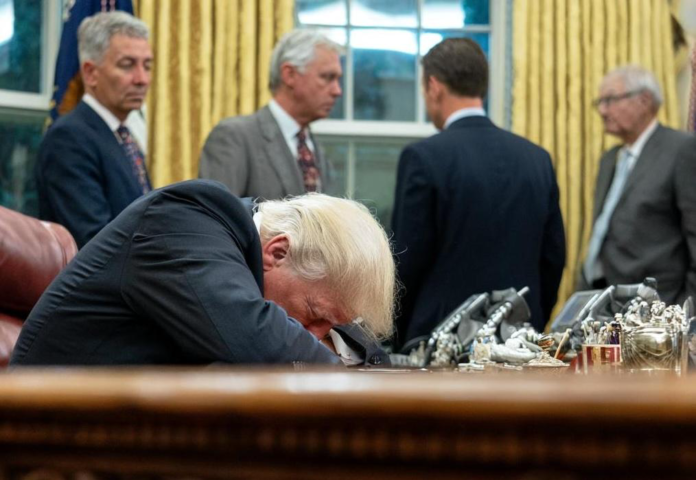
A psychiatrist who shared in a Nobel Peace Prize awarded to an anti-nuclear physicians’ group says he has grown more alarmed about President Donald Trump’s fitness for office in recent months, warning in a radio interview that the president could order the use of a nuclear weapon during an emotional outburst without grasping the scale of destruction it would unleash.
Radio host Dean Obeidallah asked Dr. Henry Abraham, an acclaimed psychiatrist who shared in the 1985 Nobel Peace Prize awarded to International Physicians for the Prevention of Nuclear War (IPPNW) as a member of the group, whether anything had changed in his conclusion about the president.
“Yeah, if anything, it’s worse,” Abraham replied.
A Psychiatrist’s Escalating Assessment
The exchange revisited a step Abraham took earlier in the year. In April, he joined dozens of other doctors in a public demand that the president step down, on the grounds — as those physicians contended — that he was not mentally fit for the job, a striking move by medical professionals into an active political dispute.
Trump has not been diagnosed with any cognitive condition. But his mental acuity has drawn more scrutiny steadily, fueled by the frequency with which he has appeared to doze off in public, by the series of cognitive tests he has taken and by how often he has been seen by doctors — a pattern that has kept questions about the president’s health in circulation among commentators, physicians and political opponents.
Abraham told Obeidallah that the shift he perceives is not dramatic on its face, describing what he sees as largely a continuation of behavior he has flagged before. He argued that when the same kind of evidence keeps accumulating in one direction, a clinician eventually reaches a point of recognizing both what is in front of him and what ought to be done about it.
The Pilot and the Surgeon
To press his point about occupational fitness, the psychiatrist reached for two comparisons drawn from high-stakes professions. He said a commercial airline pilot exhibiting even half the symptoms he attributes to the president would never be allowed into a cockpit, and that no one would want to be a passenger on that flight. The same logic, he argued, would apply to a neurosurgeon walking into an operating room to begin a procedure.
Yet the American system, Abraham said, wraps a president’s health in secrecy rather than subjecting it to the kind of scrutiny that governs pilots and physicians. That gap between how the country treats safety-critical jobs and how it treats the presidency ran through his argument in the interview.
Fears Over Nuclear Command
Abraham said the danger is compounded by the sheer scope of presidential power, including command of the U.S. military. He said it makes no sense for one person to hold sole access to the nation’s nuclear arsenal, and that this is precisely the arrangement the country has.
He then put the risk in stark terms.
Abraham said the chance that Trump would reach for a nuclear weapon amid a flash of irritation, fury, disorientation or failed self-restraint is greater now than at any earlier point, and that the president is, on that basis, a bigger threat than before.
The warning circles back to the subject that brought his organization international recognition, when the Nobel Peace Prize went to IPPNW in 1985 for its work highlighting the medical consequences of nuclear war.
Claims of the sort Abraham is making remain contested terrain within his own profession. Psychiatrists have argued for years over whether it is ethical to assess a public figure they have not personally examined, and the physicians’ call in April for Trump’s removal was itself framed by its signatories as an allegation about mental fitness rather than a clinical diagnosis. Abraham, for his part, has cast the debate as a matter of public safety rather than of politics, comparing the presidency to jobs where fitness is routinely verified before anyone is handed the controls.
His comments land as the midterm election cycle heats up and as arguments about the president’s health, stamina and decision-making continue to run through both parties’ messaging. The full conversation between Abraham and Obeidallah was posted on YouTube.