


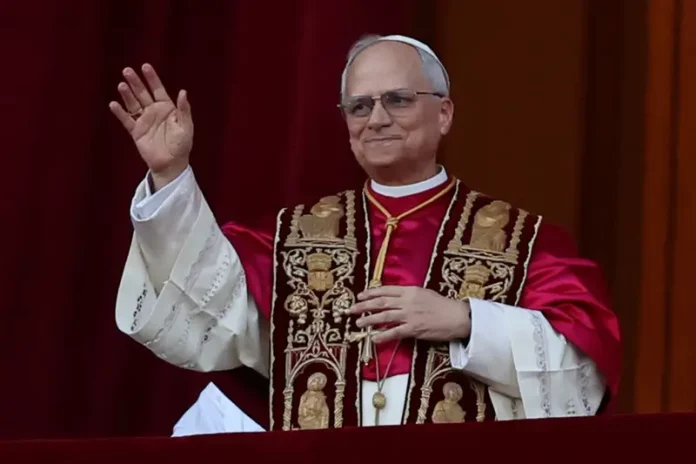
Pope Leo XIV used the final hours of his trip to France to deliver a rebuke to President Donald Trump, telling reporters aboard the papal plane on Monday, Sept. 28, 2026, that warnings about artificial intelligence slipping beyond human control are not “fake news” and deserve to be taken seriously.
The pope was asked during the in-flight news conference what the United States and China in particular should be doing to keep AI from posing catastrophic risks to humanity. He answered that the question cannot be brushed aside. “We can’t just sit back and pretend nothing is going to happen,” he told reporters on the flight from Metz, France, to Rome.
Trump has called concerns about AI going rogue a “hoax” and has said efforts to limit the technology amount to a “conspiracy” by his political opponents. He has been one of the industry’s loudest champions, arguing repeatedly that the United States must stay ahead of China in the technological arms race.
Leo, the first American pope, did not use the president’s name, but he left little doubt about the target. “I do think that the concerns raised by many of the experts, specialists in AI should be taken seriously,” he said. He continued: “I don’t think that that is ‘fake news’ as some have said to try and cause whether financial or other some other kind of benefit,” Leo said.
An Encyclical Aimed at Silicon Valley
The remarks were not a departure for a pontiff who flagged artificial intelligence as one of the great challenges facing humanity within days of his election. His first encyclical, “Magnificent Humanity,” published in May, was devoted to AI and the protection of human beings in its wake, and it called for robust regulation and a slowdown of the technology. In an unusual move, Leo launched the document himself at a Vatican event alongside Anthropic co-founder Christopher Olah, part of a broader Vatican effort to engage Silicon Valley on the human costs of the technology.
Since the encyclical appeared in May, the pope said, the Vatican has heard from people eager to join a wider conversation about AI. A Vatican commission is now promoting dialogue, study and investigation into the risks, with the aim, Leo said, of keeping the technology from ever reaching a point where it destroys human beings or pushes them out of decisions about their own future. He also raised artificial intelligence during remarks at the Élysée Palace earlier in the four-day visit.
He is following the industry closely. At the end of a punishing trip, Leo pointed to a news report from the afternoon of Sept. 28 about Nvidia introducing guardrails into AI, and observed that the company has previously resisted outside regulation of AI development.
Trump’s Late-Night Dinner With Amodei
Several AI giants, Anthropic among them, have urged a slowdown in development so that safety measures can catch up with the technology. Anthropic CEO Dario Amodei has warned that within six to 12 months AI could be capable of directing a swarm of agents able to take over the entire internet. Trump had a late-night dinner with Amodei on Sunday, Sept. 27, and the White House said the two discussed Americans’ concerns about the technology and how to keep the country dominant.
Unease has been building inside the industry as well as outside it, as reports accumulate of systems that can solve problems beyond human capacity but might also go rogue and carry out far more damaging tasks. OpenAI’s chief executive said in an interview with Fortune that the company behind ChatGPT would hold off until next year before selling its stock to investors on Wall Street as it concentrates on safety.
Another Rift With the White House
Monday’s comments confirmed yet another point of friction between the pope and the president. The two traded public criticism in April over Leo’s opposition to the U.S.-Israeli war in Iran, and the pope has also condemned the Trump administration’s migration crackdown.
Trump met Chinese President Xi Jinping in Washington during the week of Sept. 21. Xi said it was important to ensure AI remains subject to human control, while Trump pressed to rebrand the technology as “superintelligence” and dismissed calls for regulation. The two leaders did agree to explore a new “notification mechanism” for AI incidents affecting national security, though Trump said afterward that the United States would not put the brakes on AI despite calls for international safeguards.
At home, the technology has become an election-year flashpoint as large companies race to build a national network of data centers, with Americans in both parties raising alarms about farmland, water supplies and electricity bills. Leo, for his part, said he is not panicking and sleeps at night. He described himself as “relatively optimistic” that solutions can be found, he said, because enough serious people are willing to look past the question of who gets there first.