


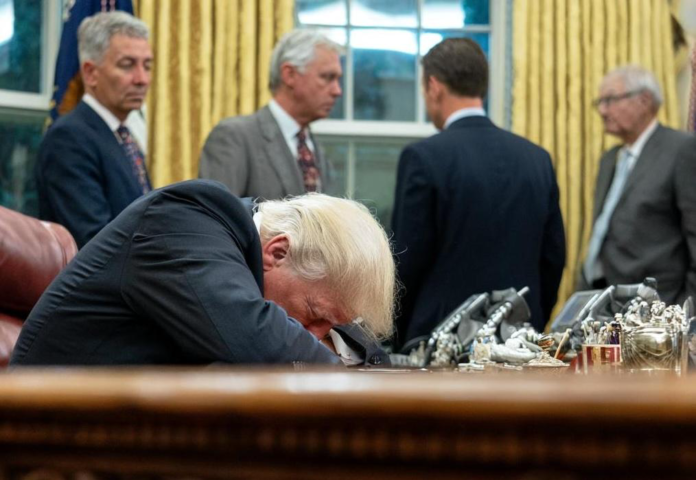
President Donald Trump appeared to nod off in the Oval Office on Monday, August 31, 2026, roughly 15 minutes into an hour-long event he had called to tout a new round of drug-pricing agreements with pharmaceutical companies.
The 80-year-old president had summoned Cabinet members, drug company executives and reporters for the announcement. His eyelids drooped shut as Health and Human Services Secretary Robert F. Kennedy Jr. began praising his boss.
“This could not have happened under any other president except for this one,” Kennedy said.
A Losing Fight With Drowsiness
The president nodded along now and then and cracked his eyes open, but they stayed mostly shut through the compliments from Dr. Mehmet Oz, who runs the Centers for Medicare and Medicaid Services, and from Howard Lutnick, the commerce secretary.
Trump perked up for the drug executives’ remarks. Kennedy has repeatedly seemed to have a sedating effect on the president in Oval Office meetings, and the secretary was seated nearby on August 10 when Trump slumped in his chair and fought to keep his eyes open while signing an executive order on childhood vaccines.
Monday’s episode marked at least the 20th time Trump — the oldest person ever inaugurated as president — has seemed to drift off in public. He also appeared to struggle to stay awake at the White House Correspondents’ Dinner on July 24, seated beside press secretary Karoline Leavitt.
What the White House Says
White House spokesman Davis Ingle called the president’s energy unmatched and accused critics of pushing baseless conspiracy theories, aiming a string of insults at the outlet that reported the episode. Ingle said Trump’s sharpness, work ethic and accessibility stand in stark contrast to the previous administration, which he argued had covered up former President Joe Biden’s mental and physical decline with help from Democrats and the media.
When video has caught the president seeming to fall asleep, the White House Rapid Response account on X has insisted in the past that he was only blinking. Trump, for his part, has said he closes his eyes during Cabinet meetings because they bore him. The man who pinned the “Sleepy Joe” nickname on Biden now draws a similar brand of scrutiny himself, on top of his regular verbal slips and moments that look like memory gaps.
A Long Run of Oval Office Naps
Trump also seemed to let his eyes fall shut on November 6, 2025, during a separate Oval Office announcement, that one about cheaper weight-loss drugs for people covered by Medicare and Medicaid. At the same event, a man positioned behind him wobbled and went down, having apparently fainted. Pictures from the appearance spread rapidly online, and Taylor Rogers, a White House spokesperson, said the president had not dozed off and had been speaking and fielding questions the entire time.
Comparable episodes had stacked up earlier: an “Antifa roundtable” in October 2025 that drew heavy criticism, an energy and innovation event that July, and sessions of his hush money trial. That October, Trump had an MRI at Walter Reed National Military Medical Center and afterward told reporters the scan came back perfect. During the summer of 2025, the White House said physicians had looked into swelling in his legs and diagnosed chronic venous insufficiency. His aides and Cabinet officials habitually talk up his stamina and describe getting calls and texts from him around the clock. He took the oath at 78 years and seven months of age and will have turned 82 by the time this term wraps up.
What the Drug Deals Actually Do
Lost behind the president’s drooping eyelids was the actual business of the day: deals with nine mid-sized drug manufacturers and biotech firms, a group that included Astellas, BeOne Medicines, CSL, BridgeBIO, Sun Pharmaceutical, Teva and UCB. Those companies have committed to selling to state Medicaid programs at what are known as most-favored-nation prices — “a tremendous discount, which should bring down the cost of your medical care by tremendous amounts,” Trump said.
The new deals build on arrangements reached beginning in 2025 with 17 of the biggest pharmaceutical companies on the planet, Pfizer, Eli Lilly and Amgen among them. Those firms agreed to cut some prices for federal health programs and to sell certain medicines directly to patients through a Trump-branded website in exchange for tariff relief. American patients pay far more for prescription drugs than people in other wealthy countries, often nearly three times as much.
Smaller and midsize manufacturers have been slower to sign on. A report in June found that Astellas, the Japanese firm, was the only company that had verified filing an application for the Medicaid pricing program as of then, and executives at companies such as Ionis Pharmaceuticals saw little financial upside in joining. How much the agreements will save taxpayers or patients remains unclear: Medicaid programs already secure deep discounts by law, and most enrollees pay little out of pocket. The administration says its broader drug-pricing effort might trim $64.3 billion from federal and state spending across the coming ten years, a figure it concedes is speculative, and it has staged several high-profile events with drug executives this year to spotlight affordability ahead of the midterm elections that will decide control of Congress.