


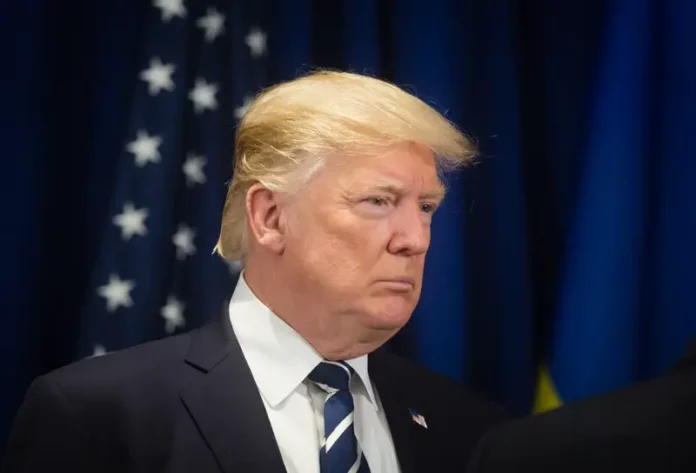
President Donald Trump’s own lawyers have handed a federal judge an explanation for the Kennedy Center’s abrupt shutdown that leaves out the fate the president keeps dangling over the building. In a Justice Department status report, Kennedy Center Executive Director Matt Floca described ceiling panels that could fall, water reaching electrical equipment and theater machinery that may not be safe. His declaration did not say the memorial to slain President John F. Kennedy, closed since the board voted on Tuesday, September 15, 2026, needs to be demolished.
That is not the message the president carried home on Air Force One. On Wednesday, September 16, returning from campaigning in North Carolina, Trump, 80, was photographed through the plane’s windows after landing at Joint Base Andrews, Maryland, studying a large printout. The image, taken by photographer Brendan Smialowski, shows the words “Kennedy Center” and, in red capitals, “DEMOLIS” — the rest of the word blocked by the window frame. A close-up appears to read “DEMOLISHED.” The lettering matched the font Trump uses in many of his Truth Social posts.
Bill Pulte, director of U.S. Federal Housing and one of the Trump loyalists installed atop the Kennedy Center’s leadership, seemed to be standing next to the president as he studied the poster, and was photographed hauling large poster boards off the aircraft, their contents concealed. Natalie Harp, 35, special assistant to the president and his executive assistant, was also aboard. She is paid $150,000 a year and is nicknamed the “Human Printer” for the material she prints out for him.
The Threat Behind the Poster
Trump has described the center as a money-loser and pointed to falling steel and plaster inside it. Pressed on why attaching his name to a memorial honoring Kennedy mattered so much, he said, “It’s a very easy question to answer, because it’s a mess.”
“For the Trump administration, for me, to get involved, and to take on long-term, and to carry it, or to raise money to carry it, I think that the Trump administration should certainly have recognition,” Trump said, days after his hand-picked board voted to close the venue for renovations. “Because frankly, if we don’t do that, it’s going to close; it will end up being ripped down.”
White House spokeswoman Liz Huston said in a statement that Democrats had let the building rot for years and that without the president’s intervention its decline will continue.
Bankruptcy Warnings and a Judge’s Order
The board’s closed-door virtual vote came hours after U.S. District Judge Christopher Cooper blocked it from putting Trump’s name back on the facade. On Thursday, September 17, Cooper ordered the center to give 30 days’ notice before making any major physical change to the building, including demolition.
Board resolutions filed in court documents warned that the center faced fiscal collapse within weeks and possible bankruptcy, arguing it could not meet payroll or routine maintenance contracts unless Trump’s name went up; one laid out 10 options for placing it on the marble facade beneath the center’s own name. In an earlier vote, the board had decided 23-3 to shutter the venue for two years while a $285 million overhaul is carried out. Congress has appropriated $257 million, and the board argued Trump would raise another $100 million. Programming would continue offsite or in an adjacent building. Rep. Joyce Beatty, whose legal fight has so far blocked the renaming, urged the judge to intervene before another vote to shut the center.
Thousands Rally in Foggy Bottom
On Friday evening, September 18, thousands of demonstrators massed outside the building for the “Hands Around the Kennedy Center” protest, crowding Foggy Bottom streets and locking down traffic beneath a facade still hidden by scaffolding and tarps. Signs read “You’re no Jack Kennedy” and “Hands off the arts,” Baby Trump balloons floated overhead, and one man wore a golden Trump mask and a crown. Chris Raleigh, co-founder of Hands Off the Arts, which organized the gathering, said he is concerned Trump could tear the building down without notifying the court. “Look at the East Wing,” Raleigh said. “We got up one morning and there was a giant hole there.”
The Kennedy Center opened in 1971. Conceived as the National Cultural Center under President Dwight Eisenhower and championed by Kennedy, it was renamed by Congress after his assassination in 1963 and required to operate as a living memorial. Trump has reshaped Washington since 2025, from a triumphal arch to the demolition of the White House East Wing. At the Kennedy Center, he fired the board’s public members and replaced them with supporters, who elected him chairman and ordered his name onto the facade. Richard Grenell, whom Trump installed as the center’s head, stripped out most of its artwork to make room for pieces Trump selected. Performing artists canceled, the Washington Opera decamped, donors fled and ticket sales plummeted. His name went up in December 2025 and came down in June after a court ruling.
What the Engineers Found
A severe storm on September 4 brought down a section of Grand Foyer ceiling plaster weighing roughly 150 pounds from about 60 feet onto the floor below. No one was injured. A September 22 inspection by WB Engineers+Consultants found water apparently entering the electrical transformer vault and contacting the transformers, with concrete fragments and other debris resting on the equipment. Former project managers have complained that a rush to spruce up the building before Trump’s FIFA Peace Prize ceremony led to shortcuts that backfired and left costly problems behind.
Floca, the center’s facilities director until Trump named him executive director in March 2026, said the temporary closure has been extended another week because of the safety concerns, and he stressed that the emergency shutdown is separate from the board’s broader plan to keep the main building closed.