


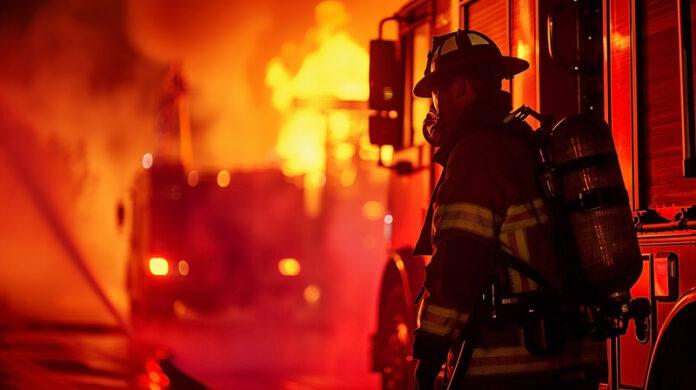
A grass fire that raced a kilometer in under a minute overran a military training exercise, killing four Canadian soldiers and leaving 19 others fighting for their lives.
The flames swept into live-fire combat training at Canadian Forces Base (CFB) Wainwright in Alberta, about 200 kilometers (124 miles) southeast of Edmonton, on Saturday, Oct. 17, 2026. Officials gave the toll on Sunday, Oct. 18: four Canadian Armed Forces members killed, 39 people injured, 19 of them critically. Maj. Gen. Wade Rutland, commander of the 1st Canadian Division, said the military had known about the grass fire for hours. Commanders believed it was contained enough for training to continue.
Then the wind shifted. Rutland said at a news conference in Edmonton that the fire was a kilometer away at that moment and that it was “not normal” for flames to cover that distance in under a minute.
A commander at the scene told him the soldiers saw no fire at all, and then the fire was on top of them, inside a minute. Rutland said he had never seen a fire behave that way.
Grenades on One Range, Flames on Another
About 84 soldiers from Charlie Company were spread across two ranges that afternoon. On one, soldiers threw hand grenades. On the other, they ran a section attack, in which 10 soldiers move on a simulated enemy position. The fire swept into the section attack area. The grenade range was untouched.
The soldiers were from the 3rd Battalion, Princess Patricia’s Canadian Light Infantry (PPCLI), based in Edmonton, taking part in Exercise APOLLO SHOOTER, live-fire training by members of 1 Canadian Mechanized Brigade Group. Range control had known about the fire for several hours and decided the exercise could keep running. Investigators have not determined what ignited the grass, and several training activities were underway across the area at the time.
The battalion was preparing for rapid deployment and for a mission to reinforce Canadian troops in Latvia next spring.
The Sudden Wind Shift That Turned Deadly
Gusts stayed below 50 kph (31 mph) for most of the day, within standard procedures for training, Rutland said. Environment and Climate Change Canada had issued a wind warning that day for large parts of Alberta, predicting gusts up to 90 kph. A windstorm then hit large areas of the province with gusts reaching 100 kph (62 mph).
A cold front moved through Wainwright between 3 and 4 p.m. The wind turned from southwesterly to northwesterly and hit 69 kph by 4 p.m. The fire crossed established firebreaks before municipal firefighters helped contain it. By 11 p.m. that night, the Municipal District of Wainwright said the fire was being held, property and critical infrastructure were protected, and no evacuation order was in place for residents.
The Royal Canadian Mounted Police (RCMP) said officers were called shortly after 4 p.m. on Oct. 17 and are part of the investigation. The military said there were no signs of terrorism or outside interference, and that reports of explosions were not believed to come from the fire reaching oil and gas infrastructure. A formal board of inquiry is typical.
A Mass-Casualty Rescue Across Two Provinces
Alberta Premier Danielle Smith said 39 people were receiving care. Sayeh Zielke, CEO of Acute Care Alberta, said 19 were critical, eight were stable and 12 were ambulatory with less serious injuries. Patients were taken to the University of Alberta Hospital and the Royal Alexandra Hospital in Edmonton, Foothills Medical Centre in Calgary and Red Deer Regional Hospital.
The response used 22 ground ambulances, six airplanes and two helicopters, with help from Saskatchewan. Military search-and-rescue technicians parachuted into Wainwright.
“This number of patients would overwhelm the city of Edmonton,” said Dr. Warren Thirsk, an emergency department physician at the Royal Alexandra Hospital, speaking Saturday, Oct. 17. He said health care facilities around the base were completely overwhelmed.
A Nation in Mourning
Prime Minister Mark Carney ordered Canadian flags lowered to half-mast at federal buildings across the country and asked for a detailed account and a formal briefing. He said the loss ranks among the worst the Forces have suffered in peacetime in Canada. Defense Minister David J. McGuinty offered condolences to the families, friends and colleagues of the four.
The military identified the dead as Sgt. Morgan Wong of Edmonton, of the Loyal Edmonton Regiment and serving with 3rd Battalion PPCLI; Pvt. Shaun Farrell of Prince Albert, Saskatchewan; Pvt. Aidan Goulding of North Vancouver, British Columbia; and Pvt. Hayden Lykkemark of Langley, British Columbia. Conservative leader Pierre Poilievre, who represents the Wainwright area, visited the town Sunday, Oct. 18.
Smith said some of the injured suffered severe burns and could face weeks or months of intensive treatment.
Flowers were laid at the foot of the Memorial Clock Tower in Wainwright on Sunday, Oct. 18.