


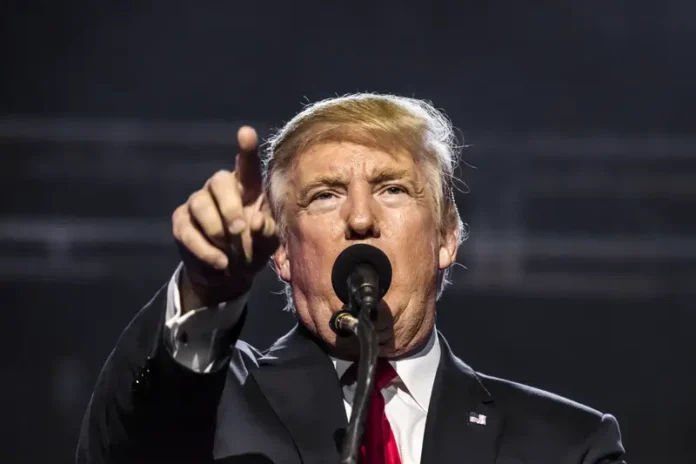
Four countries got swept into a single line at a Georgia rally, and one of them has summoned America’s top diplomat in its capital.
Libya’s Foreign Ministry called in U.S. Chargé d’Affaires Inga Heemink on Sunday, Oct. 25, 2026, and delivered a formal protest over remarks President Donald Trump made a day earlier at a rally in Perry, Ga. The ministry called the comments “offensive.” Trump answered that evening with a Truth Social post praising Libyans that stopped short of an apology.
Trump, 80, was attacking Sen. Jon Ossoff, a Georgia Democrat, over immigration measures put forward in the Senate in June when he told the crowd that Ossoff had “personally sponsored a bill to bring armies of migrants from terror-infested countries like Libya, Yemen, Haiti, Somalia.” “Remember what I called them? S–thouse countries,” he said, a reference to comments he made in the Oval Office in 2018.
Both of Libya’s Rival Governments Agreed
Libya has been split between rival governments in the east and west since the 2011 uprising that toppled longtime leader Moammar Gadhafi, and years of war and instability followed. Both administrations condemned Trump that same day. The foreign ministry of the Tripoli-based Government of National Unity said it rejects any statements that “undermine the dignity of its people or diminish their standing,” and objected to Libya being pulled into American “electoral debates.”
It was the Presidential Council that ordered the summons of the top U.S. diplomat in Tripoli, and the council demanded an “explicit apology and correction.”
The rival Government of National Stability, seated in the eastern cities of Tobruk and Benghazi, demanded a formal apology. A committee of the House of Representatives, the eastern parliament, asked Washington for an official clarification, saying the remarks diminished Libya’s standing. Prime Minister Abdul Hamid Dbeibah, who heads the Tripoli government, wrote on social media that Libya’s sovereignty and its people’s dignity should not become material for American election fights, and that his government values the relationship with the United States “on the basis of mutual respect.”
The Bill Was About Haitians
The legislation Trump attacked did not concern Libyan migrants at all. He appeared to be referring to S. 4814, a measure that would shield only qualifying Haitian migrants already living in the United States from deportation under his immigration crackdown. It would bring no one into the country.
The Perry rally was one of his campaign stops before the Nov. 3 midterm elections, where he was supporting Republicans including Rep. Mike Collins, who is challenging Ossoff for his Senate seat.
Then He Brought Up Greenland
At the same Georgia event, Trump said Denmark had given Greenland to the United States. He repeated it Sunday, Oct. 25, at a rally in Michigan, telling supporters the U.S. owns the Arctic territory and works it with Denmark.
The agreement his administration signed with the Danish government on Sept. 22 expands American military access to Greenland. It explicitly reaffirms Denmark’s sovereignty and Greenlanders’ right to self-determination, and transfers no ownership — a point Danish Prime Minister Mette Frederiksen has been adamant about. Trump has repeatedly threatened to annex the island since taking office for a second term in 2025.
The Post That Stopped Short
“The Libyan people are proud, resilient, hospitable, and deserving of peace and prosperity,” Trump wrote on Truth Social on Sunday evening. He said Washington respects the sacrifices brave Libyans made fighting ISIS, which he called the “common enemy” of both peoples, then added, “Libya cannot remain a corridor for illegal migration, and this must end now.” He also reaffirmed his commitment to stronger ties with Libya.
Trump backed efforts to unify Libya’s institutions and move the country toward national elections. He gave no timetable and announced no initiative. He did not apologize.