


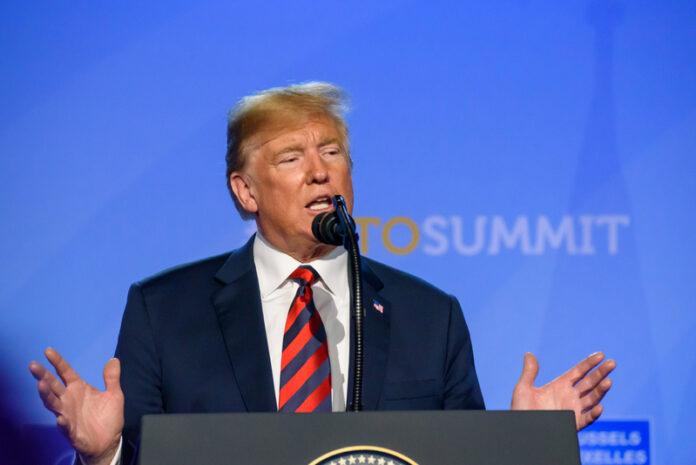
President Donald Trump dismissed a CNN reporter’s question as “stupid” during a press briefing aboard Air Force One on January 12, marking the latest in a series of heated exchanges between the 79-year-old president and female journalists who cover him.
The confrontation occurred as Trump returned from Mar-a-Lago and discussed the situation in Iran, where the regime has threatened to attack U.S. military bases if the president intervenes. Trump warned that Iran would face severe consequences if it followed through on its threats.
“If they do that, we will hit them at levels that they’ve never been hit before,” Trump said, promising “a very, very powerful force” in response to any Iranian aggression against U.S. targets.
When the CNN reporter asked whether Iran takes his threats seriously, Trump erupted. He launched into a sarcastic response, pointing to past military actions including the 2020 killing of Revolutionary Guard Corps commander Qasem Soleimani and the 2019 strike that eliminated ISIS leader Abu Bakr al-Baghdadi. He also referenced the recent U.S. military operation that removed Venezuelan President Nicolás Maduro.
“She says, CNN, ‘Do you think they take your threat seriously?'” Trump repeated mockingly. “Wouldn’t you say they do after all of the things we’ve done? What a stupid question.”
The Iranian government has responded aggressively to protests, which have grown into one of the most serious challenges to the clerical regime in years. Iranian authorities have implemented a severe security crackdown, arresting large numbers of demonstrators, while the death toll has climbed into the hundreds. Tehran has accused the United States and Israel of fueling the unrest and has warned that any American military action would be met with retaliation, including strikes on U.S. military installations and other interests throughout the region.
The Iran crisis represents a significant escalation in Middle Eastern tensions. Trump has claimed that Iranian leaders are signaling interest in talks with the United States, even as the violent suppression of protesters continues. The president has said he is weighing “very strong” military responses if the violence reaches what he described as an unacceptable threshold, though he has not specified what that threshold might be.
The tense exchange with the CNN reporter was not the only noteworthy moment from the Air Force One flight. The aircraft hit severe turbulence while traveling over the Atlantic coast, causing Trump to nearly lose his balance. He responded by making a joke about looking for something to grab that was not his 28-year-old press secretary, Karoline Leavitt, who was standing beside him during the briefing.
Trump’s confrontational approach with female journalists has become a defining feature of his media interactions, particularly in recent months. The pattern includes personal attacks and dismissive comments directed at women who ask challenging questions or report stories he finds unfavorable.
Trump attacked CNN’s Kaitlan Collins on his Truth Social platform, calling her “always Stupid and Nasty” while misspelling her name. He has repeatedly targeted ABC reporter Rachel Scott, calling her “the most obnoxious reporter in the whole place” and describing her as a “terrible reporter.”
NBC News correspondent Yamiche Alcindor faced similar treatment when Trump labeled her as “aggressive” and told her to take it “nice and easy.”
The president’s harsh treatment of female journalists extends to print reporters as well. He called New York Times reporter Katie Rogers “ugly” after she co-authored an article about his lighter second-term work schedule. He berated ABC’s Mary Bruce for asking what he characterized as a “horrible, insubordinate, and just a terrible question.”
In one of the most widely circulated incidents, Trump shouted “Quiet, piggy!” at Bloomberg correspondent Catherine Lucey. When CBS News White House correspondent Nancy Cordes attempted to ask a question, Trump responded by asking if she was “stupid” and questioning whether she was a “stupid person.”
The president’s confrontational style with female journalists dates back years. In 2015, during a Republican presidential debate, Trump attacked then-Fox News host Megyn Kelly after she challenged him.
Media analysts note that while Trump frequently clashes with journalists of all genders, his attacks on female reporters often include personal insults about their appearance, intelligence, or demeanor that he does not typically deploy against male journalists. The pattern has drawn criticism from press freedom advocates who argue that such attacks create a hostile environment for women covering the White House and discourage tough questioning of those in power.
The incident occurred as Trump faces multiple complex foreign policy challenges. Beyond Iran, his administration is dealing with the aftermath of the military operation in Venezuela and managing relationships with allies concerned about American intervention in the region. The president’s reference to the killings of Soleimani and al-Baghdadi was intended to demonstrate his willingness to use military force against adversaries, a message clearly directed at Iranian leadership as tensions continue to escalate.
The Iranian protests represent a significant challenge for the clerical regime, which has maintained power through a combination of religious authority, security forces, and economic control. The current unrest, driven largely by economic grievances, has spread across multiple cities and drawn participants from various segments of Iranian society. The government’s violent response has attracted international condemnation, but Tehran has shown no signs of backing down from its crackdown or softening its rhetoric toward the United States.
As the situation develops, the White House faces difficult decisions about how to respond to both the humanitarian crisis unfolding in Iran and the regime’s threats against American interests. Trump’s warning on Air Force One made clear that he views military options as viable responses, though the potential consequences of strikes against Iran could be severe, including wider regional conflict and disruption of global oil markets.