


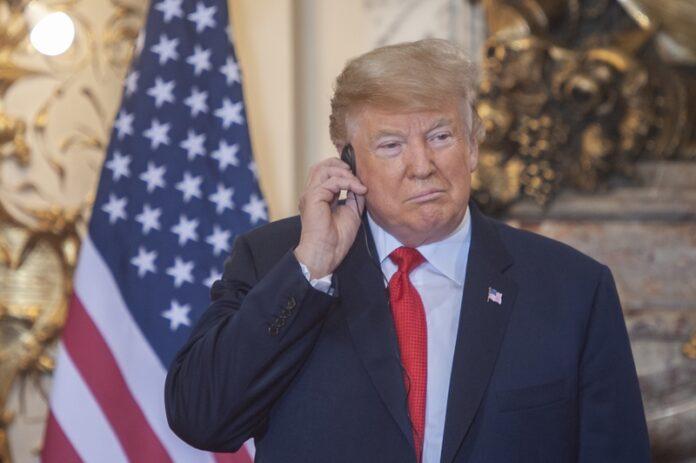
President Donald Trump appeared to leak disappointing economic data in a typo-riddled social media post Friday morning, Feb. 20, 2026, revealing weak GDP numbers 40 minutes before their official release while launching a fresh attack on Federal Reserve Chair Jerome Powell.
“LOWER INTEREST RATES. ‘Two Late’ Powell is the WORST!!!” Trump posted on Truth Social at 7:50 a.m. ET, in what appeared to be a misspelling of his usual “Too Late” nickname for the Fed chair. The post dropped as the Commerce Department prepared to release fourth-quarter economic data showing growth had slowed dramatically to just 1.4%.
The president’s early morning message also blamed Democrats for the economic slowdown, writing that the shutdown “cost the U.S.A. at least two points in GDP” and warning against future funding lapses.
When the official numbers arrived at 8:30 a.m., they confirmed Trump’s grim preview. The economy grew at an annualized rate of 1.4% in the fourth quarter of 2025, a sharp drop from the previous quarter’s 4.4% pace and well below the 2.5% to 3% economists had expected. The figure represented a decline of 3 percentage points from the prior three-month period.
The premature disclosure marks at least the second time Trump has revealed economic data before its scheduled release. Office of Management and Budget policy bars executive branch officials from commenting on such data early and forbids public statements until at least 30 minutes after official publication. In January, Trump indirectly revealed forthcoming nonfarm payrolls data, prompting the White House to acknowledge an “inadvertent public disclosure of aggregate data.”
The weak GDP report delivers a significant blow to Trump’s economic messaging ahead of his State of the Union address next week. The president has repeatedly claimed credit for what he calls a “booming” economy, even telling a Georgia audience Thursday that he had “solved” affordability concerns.
The economic slowdown stemmed partly from the record 43-day government shutdown that began on Oct. 1 and dragged through mid-November. The Bureau of Economic Analysis estimated the shutdown subtracted about 1 percentage point from real GDP growth. The Congressional Budget Office projected the closure would shrink annualized growth by up to 2 percentage points.
But the shutdown tells only part of the story. Consumer spending, which drives much of the U.S. economy, rose just 2.4% in the fourth quarter, down from a healthy 3.5% gain in the third quarter. The pullback signals Americans are feeling financial strain despite the administration’s optimistic rhetoric.
Joel Kan, vice president and deputy chief economist at the Mortgage Bankers Association, warned that households with sufficient income continue driving most consumer spending while pressure builds on lower-income Americans struggling with higher costs and elevated credit balances.
Adding to the administration’s challenges, a separate Commerce Department report showed inflation accelerated in December. The PCE price index rose 2.9% year-over-year, nearly a full percentage point above the Federal Reserve’s 2% inflation target. The persistent inflation pressures make it unlikely Powell will lower interest rates as quickly as Trump demands.
The timing could hardly be worse for Trump politically. His approval rating hit 38% in the latest Reuters/Ipsos poll, down from 50% at his January 2025 inauguration. Consumer confidence collapsed to 84.5 in January 2026, the lowest level since May 2014 and below even the depths of the COVID-19 pandemic recession.
For the full year 2025, the economy grew 2.2%, down from 2.8% in 2024. Despite the steady growth, employers added just 181,000 jobs throughout 2025, the weakest annual total outside of recession years since 2003. The unemployment rate stood at 4.3%.
White House spokesperson Kush Desai attempted to spin the numbers positively, claiming GDP growth “smashed” expert predictions and crediting the president’s agenda of tax cuts, deregulation, and tariffs for setting up an accelerating comeback in 2026.
Some measures showed underlying resilience. Real final sales to private domestic purchasers, which combines business investment and consumer spending, grew at 2.4%, consistent with post-pandemic recovery levels. Budget Lab executive director Martha Gimbel described consumer and company spending as “reasonably solid,” adding: “This is not a disastrous report.”
The Federal Reserve released minutes on Wednesday from its January meeting showing policymakers are increasingly reluctant to cut interest rates this year. Several officials even suggested the central bank may need to raise rates if inflation remains stubbornly high. Chris Zaccarelli, chief investment officer for Northlight Asset Management, noted the weak growth and persistent inflation create a dilemma between the Fed’s inflation hawks and doves.
As Trump prepares to address Congress next week, he faces the challenge of explaining why the economy has slowed dramatically on his watch while inflation remains stubbornly above target. His Friday morning social media post, complete with its apparent typo, suggested the president understands the economic news creates political headwinds heading into the midterm election year.