


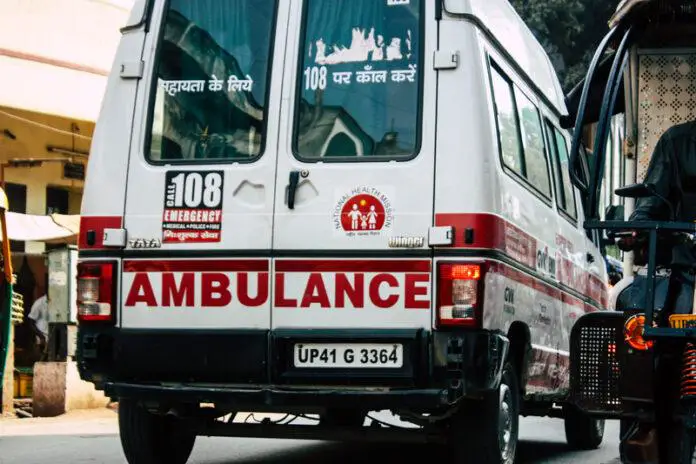
A woman in Uttar Pradesh declared brain-dead by doctors miraculously regained consciousness after the ambulance carrying her home for cremation struck a pothole on a highway, her family reported this week.
Vineeta Shukla, 50, a senior assistant in the copy section at the judicial courts in Pilibhit, collapsed while doing household chores on February 22. After doctors at a Bareilly hospital found her completely unresponsive with no brainstem reflexes and declared her brain-dead, her devastated family prepared for her funeral.
But as the ambulance traveled along the Bareilly-Haridwar NH-74 near Hafizganj on February 24, the vehicle struck a large pothole. The violent jolt produced an unexpected result—Shukla suddenly started breathing normally again.
“After the jerk, her breathing suddenly returned to normal. We were stunned. I immediately called my family and told them to stop the cremation preparations,” said Kuldeep Kumar Shukla, her husband.
The family rushed her to Neurocity Hospital in Pilibhit, where doctors admitted Shukla for intensive care. Dr. Rakesh Singh, a neurosurgeon at the hospital, reviewed her medical records from Bareilly and discovered her Glasgow Coma Scale had dropped to three points against the normal score of 15. She had shown complete unresponsiveness, absence of brainstem reflexes, and dilated pupils—all indicators of severe neurological failure.
Dr. Singh and his team deployed the entire ICU staff and began an unconventional treatment approach. During the physical examination, doctors noticed a mark on her leg suggesting a bite from a venomous snake or insect. Suspecting neurotoxin poisoning rather than the high blood pressure her family initially believed caused the collapse, they administered anti-snake venom alongside standard critical care protocols.
Within 24 hours of starting treatment, Shukla showed some movement. After a week, she slowly regained consciousness, and doctors eventually removed her breathing tube. The remarkable recovery unfolded over nearly two weeks.
Shukla, who initially had no memory of the incident, gradually regained consciousness and mobility. She returned home following her treatment, stunning relatives and colleagues who had already begun mourning her death. Her husband described her recovery as having “conquered death.”
The dramatic turn of events caused confusion at the Pilibhit Bar Association, where Shukla worked. The association issued a condolence motion after receiving news of her death at 11 a.m., only to withdraw it 30 minutes later when word spread that she had revived after the pothole incident.
“At 11 am, we got the news that our employee had passed away. The condolence was sent, but by 11:30 the news came that when her body was being brought back, she started breathing, and then the condolence motion was withdrawn,” said Advocate Rajiv Awasthi, president of the Bar Association.
Kuldeep Kumar Shukla recounted how his wife complained of blood pressure problems on February 22 and fainted 15 minutes after taking medication. The family rushed her to a government hospital, which referred her to Bareilly. After treatment there with no improvement, doctors discharged her and told the family there was no hope.
Medical experts say the pothole itself likely did not revive Shukla. Dr. Singh told reporters the case was “not a miracle” but rather the result of treatment for a suspected toxic bite. The jolt may have coincided with the beginning of her neurological recovery—or simply made her faint breathing noticeable—rather than causing it. Tests at the Pilibhit hospital revealed heavy neurotoxins in her bloodstream and lymphatic system.
The incident has drawn attention to the condition of India’s highways. The National Highways Authority of India issued a statement denying the presence of potholes on the route, noting that the Bareilly-Sitarganj section is currently under construction and existing stretches are maintained according to prescribed standards.
However, the Shukla family credits the pothole near Hafizganj with saving Vineeta’s life. What locals typically curse as a road hazard became, in this extraordinary case, a life-saving intervention.
Shukla, now recovering at home, remembers little of her brush with death. She recalled taking her blood pressure medication and fainting, but everything afterward remains blank until she regained consciousness in the hospital. Her case has sparked discussion in medical circles about the challenges of accurately diagnosing brain death and the potential for misdiagnosis in cases involving rare neurotoxic conditions.
For now, the Shukla family celebrates what they consider a miracle, crediting both divine intervention and an unlikely hero—a pothole on a highway in Uttar Pradesh.