


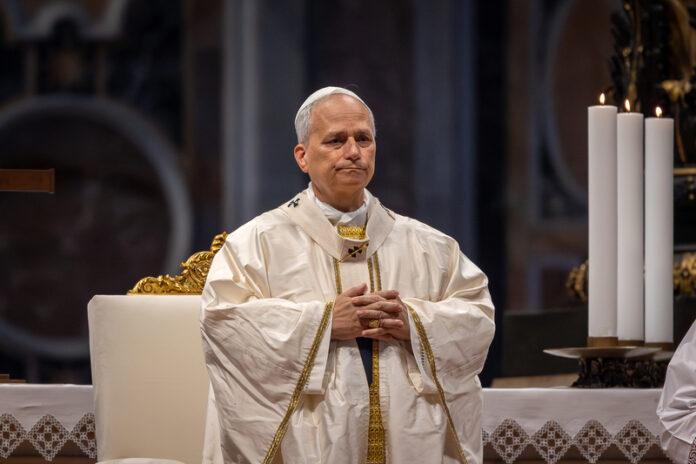
Pope Leo XIV delivered his most forceful condemnation yet of the escalating Middle East conflict Sunday, calling for an immediate ceasefire and warning that violence can never achieve lasting peace. The 70-year-old pontiff, history’s first American pope, made pointed reference to the devastating missile strike on an Iranian elementary school that killed more than 165 people, the majority of them children.
Speaking from the Vatican, Pope Leo XIV addressed tens of thousands gathered in St. Peter’s Square after his Sunday noon blessing. Without directly naming the United States or Israel, he made clear his message targeted world leaders with the power to end the bloodshed. “Cease fire so that avenues for dialogue may be reopened,” he declared. “Violence can never lead to the justice, stability, and peace that the people are waiting for.”
The emotional address marked the strongest intervention yet from the Chicago-born pontiff, who has grown increasingly vocal about international conflicts since his election on May 8, 2025. For the two weeks since the start of the U.S.-Israeli war on Iran, Leo had limited his comments to muted appeals for diplomacy—an apparent attempt to avoid positioning himself as an American political counterweight to President Donald Trump.
The Pope’s words resonated beyond the Middle East crisis, touching on broader themes of human dignity that have defined his brief papacy. Born Robert Francis Prevost in Chicago, Illinois in 1955, he spent decades as a missionary in Peru before serving as Bishop of Chiclayo and later as Prefect of the Dicastery for Bishops under Pope Francis. His unique background as both an American and a longtime resident of Latin America has positioned him as what one expert called “a bridge builder” with global perspective.
The Minab school strike has sparked international outcry and intensified calls for diplomatic intervention. The February 28 attack occurred during morning classes at Shajareh Tayyebeh Primary School in southern Iran, leaving families across the country devastated and prompting emergency sessions at the United Nations. Preliminary U.S. military investigations have determined that a Tomahawk cruise missile likely struck the school due to outdated intelligence that mistakenly identified it as a military target.
The Vatican has not issued specific policy recommendations, but the Pope’s remarks Sunday left little doubt about his position. He expressed prayerful closeness to families who lost loved ones in attacks “which have hit schools, hospitals and residential centers.” The Vatican newspaper L’Osservatore Romano featured an aerial image of mass graves for young victims under the headline “The Face of War.”
Dr. Charlie Gillespie, professor at Sacred Heart University, told PEOPLE magazine shortly after the papal election that Leo XIV’s selection sent “a clear signal that the College of Cardinals felt the calling of the spirit to elect someone for the whole globe.” That global perspective has become increasingly evident as the Pope addresses international crises with growing boldness.
The Pope’s choice of the name Leo XIV honored Pope Leo XIII, the late-nineteenth century pontiff known as a champion of the poor and social justice, whose encyclical Rerum novarum established modern Catholic social teaching. Vatican officials described the name choice as “clearly a reference to the lives of men and women, to their work—even in an age marked by artificial intelligence.” Another earlier pope, Leo I—known as “Leo the Great”—famously persuaded Attila the Hun to turn back from invading Italy in 452, demonstrating the potential for moral authority to influence geopolitical events.
Sunday’s address comes as Pope Leo XIV approaches his first year in office. Since his election, he has maintained connections to his Midwestern roots while embracing the global responsibilities of his office. The White Sox fan still does the Times’ Wordle puzzle each morning and has kept his straightforward communication style, addressing cardinals in his flat-voweled English and staying in touch with family through regular phone calls.
His brother Louis Prevost, a self-described “MAGA type,” previously said his brother is “much more liberal” but predicted he would lead the papacy “down the middle.” That assessment appears increasingly complicated as the Pope tackles divisive issues ranging from Middle East violence to immigration policy to capital punishment.
The Pope’s intervention carries implications for U.S. foreign policy under President Trump. While Leo has sought to keep his messaging indirect and apolitical, some U.S. cardinals and the Vatican secretary of state have spoken more directly. Cardinal Robert McElroy of Washington called the war morally unjustifiable. Chicago Cardinal Blase Cupich said it was “sickening” how the White House was incorporating video game imagery into war-related social media posts.
As the first American pope, Leo XIV occupies a unique position. His words carry special weight in the United States, where millions of Catholics must reconcile their faith with their nation’s military actions abroad. The Pope’s message Sunday challenged Americans to consider whether their country’s policies align with the values of life and human dignity that many claim to champion.
Vatican observers expect Pope Leo XIV to continue pressing for peace in the Middle East through diplomatic channels. Cardinal Pietro Parolin, the Vatican secretary of state, said the Holy See continues to engage in dialogue with all parties. “When necessary we speak also with the Americans, with the Israelis,” Parolin said, “and show them what to us are the solutions.”