


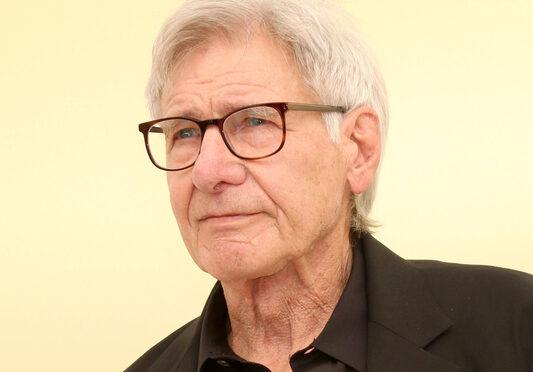
Harrison Ford, Hollywood’s legendary leading man behind Han Solo and Indiana Jones, has made a surprising admission: he never wanted to be a leading man at all.
The 83-year-old actor opened up about his career aspirations and personal struggles during a 90-minute conversation on The Hollywood Reporter’s Awards Chatter podcast, released Thursday. Speaking with host Scott Feinberg at the Barker Hangar in Santa Monica, Ford revealed that his true ambition was always to be a character actor rather than the box office titan he became.
“I always wanted to be a character actor. I had never thought that I would be a leading man. That doesn’t make any sense. I don’t look like a leading man, it just wasn’t in the cards for me,” Ford said.
The revelation comes as Ford promotes the third season of Apple TV+’s “Shrinking,” which concluded its season finale on April 8. In the series — already renewed for a fourth season — Ford plays Dr. Paul Rhoades, a senior psychotherapist battling Parkinson’s disease alongside co-star Jason Segel. The role earned Ford his first Emmy nomination last year for the show’s second season.
Ford pointed to his 1985 film “Witness” and 1986’s “The Mosquito Coast” as turning points where he finally got to play leading characters that weren’t traditional leading men. More recently, he cited his performances in “42” and “K-19: The Widowmaker” as the strongest character work of his career over the past two decades.
The actor explained the distinction between leading man roles and character parts with characteristic bluntness. Leading men, he said, carry certain responsibilities: making audiences happy to be with them and often providing easy answers to difficult dilemmas with soft solutions. Character actors, by contrast, get to dig deeper into human complexity.
Ford’s career trajectory tells a different story than his original aspirations. After moving to Los Angeles in the 1960s and working as a carpenter to supplement his income, he broke through with roles in “American Graffiti,” “The Conversation,” and the 1977 original “Star Wars.” Those performances launched him into superstardom, cementing his status as one of cinema’s most bankable names.
His films have grossed more than $10 billion worldwide. Cinema United selected him as the Star of the Century, and Empire magazine placed him at number one on its list of the top 100 movie stars of all time. The Wall Street Journal described him as “a living reminder of shared movie moments that perhaps billions of people across generations and continents hold deeply.”
Ford acknowledged the role of fortune in his success. He explained that he got to play leading parts because the films he was in had success, and that success carried him along — but a big part of that success was being in the right place at the right time, luck, and persistence.
The podcast interview also revealed darker chapters from Ford’s early life. He discussed experiencing clinical depression during his time at Ripon College in Wisconsin, describing himself as “socially ill, psychologically not well.” He spent days in his dorm room, ordering pizza and rarely attending classes. When he did venture out, he would sometimes touch the classroom door and turn back without entering.
Acting accidentally became his salvation. In an attempt to boost his grade point average, Ford enrolled in a drama class without reading the full course description. He expected to read and analyze plays but discovered too late that students had to perform in them as well. He found the people he’d considered fellow geeks and misfits were actually some of the most interesting people he knew — storytellers who changed his world and his life.
Ford’s current role in “Shrinking” holds special significance. Playing a character with Parkinson’s disease has brought him full circle in unexpected ways. Reflecting on sitting beside Michael J. Fox, who appeared on the show and has lived with Parkinson’s for decades, Ford noted the weight of the moment with characteristic understatement: “This is serious ****, man. This is not insignificant for me.”
In March, Ford received the Life Achievement Award at the 2026 Actor Awards (formerly the SAG Awards). During his acceptance speech, he reflected on his craft, noting that actors sometimes make entertainment, sometimes make art, and are lucky when they get to make both at the same time — and truly fortunate if they can make a living doing it.
From depressed college student to reluctant leading man to Emmy-nominated character actor, Ford’s journey spans more than five decades. He may never have looked like a leading man in his own eyes, but audiences around the world would disagree.