


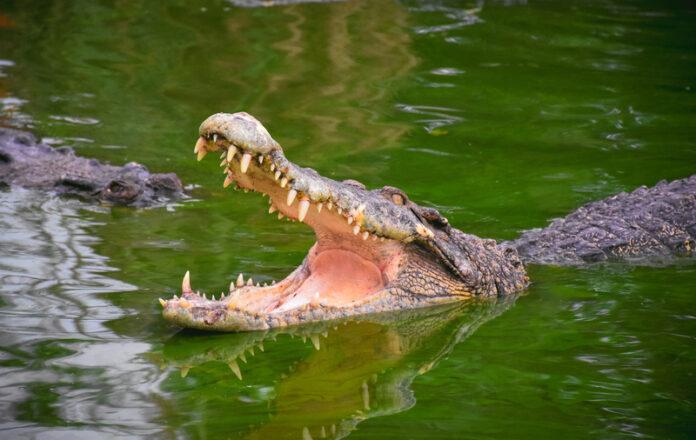
A 13-year-old boy was fatally attacked by a crocodile in Indonesia after wading into a river to fetch a soccer ball that had floated away during an evening game with friends.
Muhammad Abidzhar, who friends call Habi, went into the water near the Kutai Lama harbor pier in Anggana District, Kutai Kartanegara Regency, on March 29, 2026, at about 5:30 p.m. local time. The children had been swimming and playing when the ball landed in a crocodile-infested channel; Abidzhar offered to retrieve it and never returned.
His terrified friends heard only one scream before he disappeared beneath the murky water, dragged under by a predator that had been lurking below. The children ran back to the village to alert authorities.
Meiry Sulindra, head of the Anggana Fire and Rescue Post, said her team received the call just before maghrib prayers. “The incident happened around 5:30 p.m.,” Sulindra told reporters. Anggana Fire and Rescue personnel immediately began a search using rubber boats to comb the area around the harbor pier.
The search went on through the night and into the next day, complicated by strong currents and tidal changes. Rescuers observed several crocodiles surfacing during the operation, underscoring the danger in those waters.
Abidzhar’s body was found around 8 p.m. on Monday, March 30, drifting about 1.6 kilometers downstream from where he entered the water. Rescue teams recovered his remains from the middle of the river and took them straight to his family.
An examination showed multiple injuries consistent with a crocodile attack, including wounds to his jaw and back.
The episode highlights the increasing risk of human-crocodile encounters in East Kalimantan and across Indonesia. Four crocodile species are recognized in the archipelago, and the saltwater crocodile (Crocodylus porosus) accounts for most attacks on people. These top predators can grow beyond six meters and are highly territorial, inhabiting rivers, mangroves, and coastal areas in the region.
Indonesia leads the world in crocodile attacks by a wide margin. From 2015 to 2024, 1,167 people in Indonesia were attacked by crocodiles, with 556 deaths, more than any other country, according to the CrocAttack database. East Kalimantan recorded 102 attacks and 54 deaths during that time, making it one of the most dangerous provinces.
Conservationists cite several reasons crocodiles are moving closer to human settlements. Overfishing has reduced their natural prey, pushing them to forage in areas they once avoided. Coastal development and conversion to agriculture have destroyed habitat, and palm oil plantation canals and other waterway changes have created new crocodile-friendly environments near people.
Extensive tin mining—especially in provinces like Bangka-Belitung—has also driven villagers into closer contact with crocodile habitats. Many residents in developing regions still depend on rivers for bathing, fishing, and daily tasks, which raises their exposure to attacks.
This tragedy is one of several recent fatal crocodile incidents in Indonesia. In March 2025, 10-year-old Fikri Qurniawansyah was mauled while in a makeshift canoe with friends in Riau province. The boy put his hand in the water before a crocodile bit his arm and dragged him under.
Searchers found and killed a crocodile suspected in that attack, but its stomach was empty when cut open. Fikri’s body was later recovered by a local farmer, face-down in the river. A postmortem showed multiple bruises consistent with a “death roll,” the violent spinning crocodiles use to subdue prey.
The rising number of incidents has alarmed authorities and wildlife experts. Crocodile populations have rebounded since large-scale hunting was banned in the late 1990s, but insufficient warning systems and safeguards make it hard to prevent conflicts.
Attacks are especially common in East Kalimantan on Borneo and in Bangka-Belitung off Sumatra. Illegal tin mining in Bangka-Belitung has created many artificial water bodies that provide ideal habitat for crocodiles seeking new hunting areas.
The waterways near Kutai Kartanegara Regency, where Abidzhar was killed, are essential habitat for crocodiles while also serving local communities for transport, fishing, and daily life. That overlap creates inevitable clashes between people and these powerful predators.
Local officials have warned residents to be extremely cautious near waterways, especially at dawn and dusk when crocodiles are most active, and have urged the public to report any sightings so preventive measures can be taken.
Abidzhar’s death underscores the tragic toll of Indonesia’s human-wildlife conflicts and the urgent need for coordinated efforts to protect both communities and the crocodile populations that share their environment.