


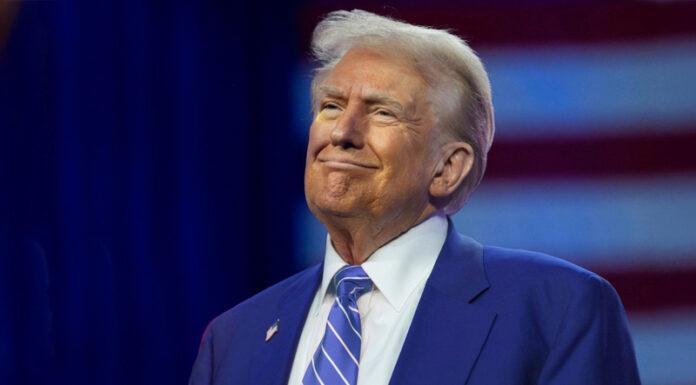
A private gathering at the Donald J. Trump Institute of Peace in Washington turned into an embarrassing spectacle for President Trump on April 23, 2026, when attendees — including Oracle co-founder Larry Ellison, CBS News Editor-in-Chief Bari Weiss, and multiple CBS News correspondents — booed him at a venue bearing his own name. The jeers came not from adversaries but from journalists, executives, and dignitaries who represented media and tech circles thought to be increasingly aligned with the administration.
The icy reception marked another public humiliation for Trump in what has become a recurring pattern throughout his second term. Even in carefully curated settings where the president might expect warmth, the gap between staged adulation and genuine reaction has grown more pronounced as the 2026 midterms draw near.
Trump’s State of the Union address on February 24, 2026, became a flashpoint of resistance inside the U.S. House chamber itself. The speech ran one hour and 47 minutes — the longest in American history, which the Northwest Progressive Institute described as a “raw, divisive, ugly” tirade. About 40 Democrats boycotted entirely, including Senator Patty Murray and roughly half of Washington state’s House delegation, with many staging a People’s State of the Union on the National Mall.
Democrats who attended the address confronted Trump directly. Rep. Rashida Tlaib of Michigan shouted back, “That’s a lie,” when Trump claimed, “I ended eight wars.” When he said the Russia-Ukraine war “never would have happened if I were president,” Tlaib demanded, “What are you talking about?” Rep. Ilhan Omar of Minnesota interjected over the deaths of Renee Nicole Good and Alex Pretti in Minneapolis, telling the president, “You’ve killed Americans.” Trump responded, “You ought to be ashamed of yourselves.”
Senator Maria Cantwell, whose guest was Secretary Steve Hobbs, pushed back on Trump’s call to nationalize voting and end mail-in ballots, noting that under the Constitution, states run elections. “There is no role for the president,” she said.
On November 9, 2025, Trump attended the Washington Commanders’ game against the Detroit Lions at Northwest Stadium in Landover, Maryland — the first appearance by a sitting president at a regular-season NFL game since Jimmy Carter in 1978. Despite elaborate pageantry including an Air Force One flyover, a ceremonial military oath of enlistment, and House Speaker Mike Johnson at his side in the suite, large sections of fans booed when the videoboard cut to Trump late in the first half. The booing repeated at halftime when the stadium announcer introduced him, and continued as he administered the oath to military members on the field.
Videos of the moment spread rapidly online, with one widely shared post calling the scene “brutal” and “humiliating.” Trump left before the game ended.
At the Kennedy Center on Tuesday, March 24, 2026, President Trump and the first lady were greeted with a mix of cheers and boos when they appeared in the presidential box for the opening night of “Chicago.” The couple attended one of the final productions before the venue — which Trump renamed the Trump-Kennedy Center after taking it over last year — closes in July for a two-year renovation. While White House spokesperson Liz Huston insisted Trump was “warmly welcomed by the crowd,” video clips circulated online captured audible jeers alongside the applause.
Eugene Ramirez, a former Sinclair national news anchor, said he was briefly detained by security after booing and giving the president a thumbs-down. Ramirez told the Washington Blade that a security official told him, “They don’t want booing,” and held him in a separate area until the house lights dimmed before allowing him to return to his seat.
The reception echoed Trump’s June 2025 appearance at the opening night of “Les Misérables” at the same venue, where he was also met with a mix of cheers and protests — and reflected the broader backlash to his takeover of the Kennedy Center, which has prompted a wave of artist cancellations and ongoing legal challenges over both the renaming and the planned closure.
Before Trump returned to the White House, he faced similar rejection at the Libertarian National Convention in Washington on May 25, 2024, where he was booed and heckled by a raucous audience. That night was punctuated by jeers, scattered cheers from a smaller pro-Trump faction, and one attendee who shouted that Trump “should have taken a bullet.”
Inside the hall a day before Trump’s speech, NBC News reported that one party member proposed the assembly “go tell Donald Trump to go f— himself,” drawing applause. Trump pressed on anyway, telling the crowd, “If I wasn’t a Libertarian before, I sure as hell am a Libertarian now.”
The Institute of Peace event was meant to be friendlier ground than a stadium or a libertarian convention floor. Ellison’s presence reflected Silicon Valley’s warming posture toward the administration. Weiss, recently installed atop CBS News, represented a media establishment that Trump allies have argued is realigning. The boos suggested otherwise — that even rooms designed to flatter the president can turn, and that the gap between staged adulation and unscripted reaction continues to widen as the 2026 midterms approach.