


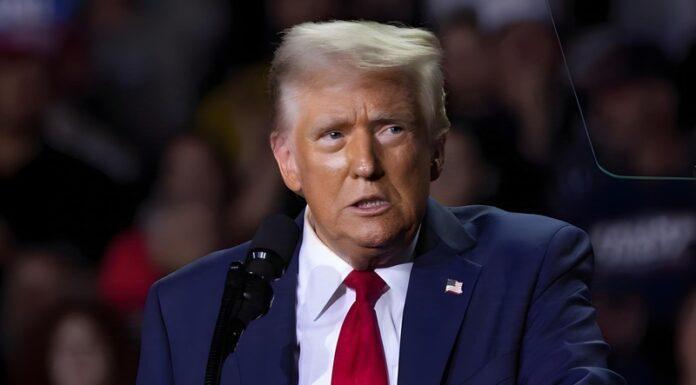
President Trump sparked confusion and widespread mockery Thursday, April 16, 2026, when he paused during remarks about tax relief to ask aloud what a corner store actually is, raising fresh questions about the commander-in-chief’s grasp of everyday American life.
The comment came as Trump promoted his signature legislative achievement, the One Big Beautiful Bill Act, which he signed into law on July 4, 2025. “The great big beautiful bill also slashed taxes on millions of Americans, small businesses, including restaurants, dry cleaners, corner stores,” the president said during prepared remarks at a Tax Week roundtable in Las Vegas, before pausing to add an aside. “What is a corner store?”
The moment, captured on video and instantly shared across social media platforms, drew sharp criticism from political opponents and bemusement from supporters who scrambled to defend the president’s question as rhetorical or misunderstood. By Friday morning, “corner store” had become a top trending topic on multiple platforms.
The gaffe overshadowed what the administration had hoped would be a victory lap for the tax legislation, formally known as Public Law 119-21 and marketed as the Working Families Tax Cut. The sweeping overhaul, which extends and expands provisions from the 2017 Tax Cuts and Jobs Act, represents one of the most significant rewrites of the federal tax code in recent years.
According to the IRS website, the legislation provides substantial relief to working-class families. Americans earning under $50,000 will see their taxes cut by 14.9 percent, while those making between $15,000 and $30,000 will experience a 21 percent reduction—the largest of any income group.
The average family of four making less than $100,000 receives an additional $600 in tax cuts compared to previous law, according to House Ways and Means data. The tax cuts and projected economic growth are expected to increase take-home pay for a family of four by up to $10,900.
Among the bill’s most publicized provisions are tax breaks for tipped and overtime workers. Approximately 4 million tipped employees—including waitresses, barbers, hairstylists and taxi drivers—can now deduct up to $25,000 in tip income, boosting their income by up to $1,300. Similarly, hourly workers who put in overtime can deduct up to $12,500 of qualified overtime premium pay from their federal taxable income—$25,000 for married couples filing jointly—increasing their take-home earnings by as much as $1,400.
The legislation also increases the standard deduction to $15,750 for single filers, $23,625 for heads of household and $31,500 for married couples filing jointly. An additional $6,000 deduction is available for taxpayers 65 and older, though it begins phasing out at $75,000 for single filers and $150,000 for joint filers. These provisions run from 2025 through 2028.
According to House Ways and Means data, 66 percent of the law’s tax cuts benefit families making less than $500,000, while 90 percent of American taxpayers receive relief through the boosted standard deduction.
Yet the fiscal impact remains substantial. The Tax Foundation estimates the major tax provisions will reduce federal revenue by nearly $5.2 trillion between 2025 and 2034 on a conventional basis. After accounting for projected economic growth of 0.7 percent, the dynamic score falls to $4.3 trillion, meaning growth covers approximately 16 percent of the tax cuts. Combined with nearly $1.1 trillion in net spending reductions, the legislation represents a significant fiscal gamble.
The law is projected to protect or create up to 7.2 million jobs, including 1.4 million manufacturing positions, and deliver up to 4.9 percent higher real GDP in the first four years—translating to roughly 1.2 percent higher average annual growth. Real wages could increase by up to $7,200 per worker, according to administration estimates.
Despite these figures, attention since Thursday has remained fixed on the president’s puzzling question about corner stores—small, typically family-owned retail establishments that have served as neighborhood anchors in American communities for generations. The stores stock everyday items like milk, bread and newspapers, and often serve as social gathering points in urban and suburban areas alike.
White House staff did not immediately respond to requests for clarification about the president’s comment. Vice President Vance, who has championed the tax package as delivering for forgotten Americans, made no public statements Thursday.
As the legislation’s provisions begin taking effect—some retroactive to 2025, others phased in through 2029—millions of Americans will file returns under the new rules. Tax preparers at H&R Block have already begun updating their systems to accommodate the changes, which affect everything from itemized deductions to clean energy credits.
For now, though, the substantive policy debate has been eclipsed by three words that encapsulate the disconnect some Americans perceive between their president and their daily lives. What is a corner store, indeed.