


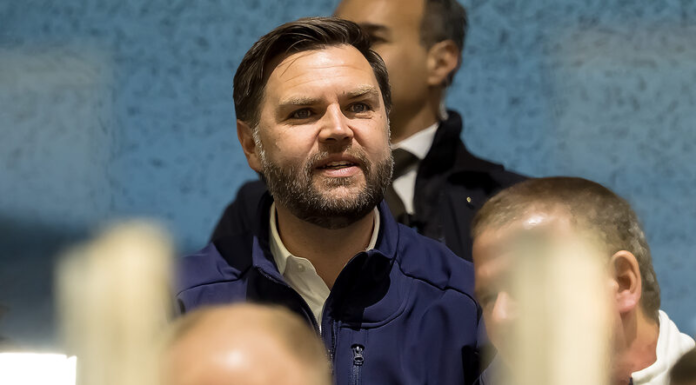
In what may be a first for political messaging, Vice President JD Vance spent his April 29 appearance on Fox News calling a magazine story false, then immediately validated its central claim. The contradictory performance played out on The Will Cain Show and underscored the political tightrope Vance is walking as he tries to preserve his anti-interventionist credentials while serving a president who launched an unpopular war with Iran on Feb. 28, 2026.
A Confirmation Wrapped In A Denial
The whiplash began when Vance attacked a report claiming he had privately raised concerns about Pentagon transparency regarding U.S. missile stockpile depletion. The magazine attributed its information to two senior administration officials and unnamed “Vance advisors,” a sourcing detail Vance latched onto in attempting to discredit the piece. Yet when the host asked directly if he worried about munitions depletion, the vice president shifted gears entirely. “Of course I’m concerned about our readiness, because that’s my job to be concerned,” he said, noting President Trump shared this emphasis on military preparedness — precisely what the story reported.
Vance’s worries about Defense Department candor regarding missile inventories have gained independent support. A report by the Center for Strategic and International Studies found the Pentagon exhausted roughly half its advanced interceptor and standoff munition stockpiles in just the first five weeks of fighting, including nearly half its Patriot interceptor inventory.
After confirming the substance he’d just denied, Vance praised Secretary of Defense Pete Hegseth and Joint Chiefs Chairman General Dan Caine for doing “an amazing job,” then concluded with another swipe at journalists: “Don’t believe everything you read, especially in papers like The Atlantic.” The remark fell flat given the outlet is a magazine, and one where Vance himself published an article in July 2016 portraying himself as a thinker capable of resisting Trump’s populist appeals.
Navigating An Unpopular War
Skepticism toward foreign interventions has been among the rare constants throughout Vance’s ideologically flexible political career. When the Iranian conflict began on Feb. 28, the vice president made himself scarce while Secretary of State Marco Rubio frequently appeared with Trump. His eventual defenses of the military campaign were lukewarm enough that Trump publicly called him “maybe less enthusiastic” than other advisers. Iran, recognizing this opening, specifically requested Vance as an interlocutor for negotiations.
The conflict itself has proven deeply unpopular and risks destabilizing the world economy, strengthening Tehran’s strategic position, and undermining U.S. influence across the region for generations. The truce that was negotiated allowed Iran to maintain its control over the Strait of Hormuz and preserve its nuclear capabilities—outcomes that many Washington officials consider a significant strategic setback.
Vance’s diplomatic assignment ended in embarrassment. He traveled to Islamabad, Pakistan, for more than 20 hours of face-to-face talks with Iran’s negotiating team, but returned without an agreement, telling Fox News that Iran “didn’t move far enough.” A second round collapsed entirely when Iran’s delegation simply did not show up, prompting Iranian State TV to announce that no delegates had “arrived or even flown to Islamabad.” The Iranian Embassy in Indonesia compounded the humiliation by posting a Mr. Bean meme with Vance edited in. Trump subsequently sidelined Vance from the lead diplomatic role, dispatching special envoys Steve Witkoff and Jared Kushner instead, with Vance placed on standby pending progress.
By raising questions about munitions, Vance is attempting to quietly influence the war’s trajectory from within the administration. His concerns echo those of others inside government and voices in Congress warning about American military readiness. Yet if he seeks a political future after Trump leaves office, he must protect his long-held identity as an anti-war politician — while remaining publicly deferential toward a president who demands loyalty and vitriolic attacks on the press.
The Pence Problem
Writer David A. Graham noted that the vice president’s “confirmation-denial” — calling reporting false in one breath and verifying it in the next — may be entirely new in the annals of political spin. Public figures occasionally deliver “non-denial denials,” throwing cold water on a claim without saying it’s false. Vance went further, saying the claim was false and then acknowledging it was true.
His insistence that “nobody who actually knows what I think — nobody who is close to me — was speaking to that reporter” was undercut by his own admission moments later that he and the president are “very focused” on readiness concerns. That, of course, was the entire point of the original story.
The faded careers of Mike Pence, Mike Pompeo, and Paul Ryan stand as cautionary tales for those attempting to balance loyalty to Trump with independent political survival. Vance, on the evidence of his April 29 interview, has not yet mastered the balance.
For now, Vance remains caught between competing imperatives: defending an unpopular war he privately questions, attacking journalism that accurately reports his concerns, and preserving a political brand built on skepticism of the very interventions he is now publicly fronting. As Wednesday’s interview demonstrated, that balancing act would challenge even a skilled communicator — and on this evidence, the vice president is not one.