


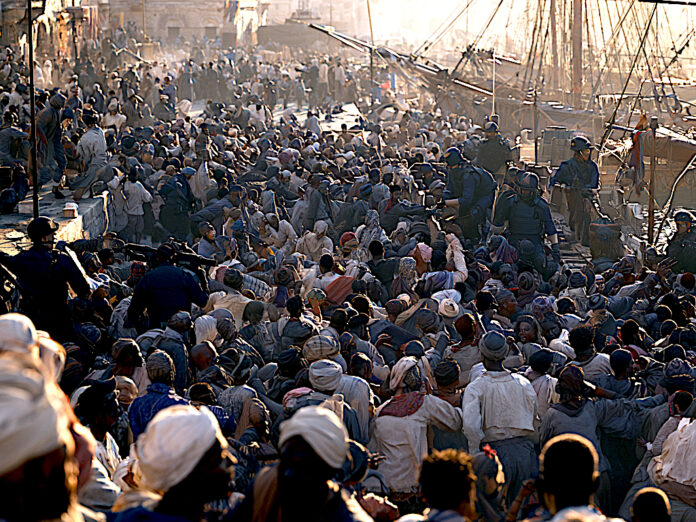
At least 57 migrants died trying to reach the Spanish enclave of Ceuta from Morocco on Friday, July 31, 2026, the Spanish government confirmed Friday evening, as tens of thousands of people surged across the land and sea border in one of the largest single influxes Europe has faced in years. Roughly 60,000 migrants entered the North African territory in the past 24 hours — a figure equivalent to 70% of the city’s regular population — according to Juan Jesús Vivas, the regional president of Ceuta.
The crisis erupted Thursday and intensified Friday, with security forces clashing with crowds on the Moroccan side of the frontier. Earlier in the day, Vivas had told reporters that 34 people had perished, though he offered no details on how they died. He described conditions in the city as untenable, calling the situation “absolutely unsustainable.”
Spanish Prime Minister Pedro Sánchez traveled to Ceuta on Friday and said the government was deploying all available resources to manage the crisis.
A Humanitarian Crisis on the Streets
The scale of the arrivals overwhelmed the small enclave. According to Rachid Sbihi, head of a local labor group for Civil Guard personnel in Ceuta, the situation amounted to a grave humanitarian emergency. Thousands of people, including children traveling alone, spent the night in public parks and on streets, he said, while others roamed aimlessly through the city. Military units sent as reinforcements concentrated exclusively on treating casualties and providing emergency aid, he added, characterizing conditions as disorderly and desperate.
Many of the dead drowned, Sbihi said, but some were killed in a stampede as people rushed to cross the breakwater fence at Tarajal beach, an urban stretch of sand near a border checkpoint with Morocco. By Friday morning, the waters near the border fence were strewn with buoys, shoes and other belongings abandoned in the crush.
To reach Ceuta, which sits on the northern African coast, migrants typically swim about 5 kilometers from the Moroccan town of Fnideq, rounding a border barrier that juts into the Mediterranean Sea. Others attempt the shorter crossing from the nearby town of Belyounech. Ahmed Karim, a 33-year-old Moroccan who crossed because of a lack of work in his country, said many people dream of reaching Europe or America but never get the chance.
Confrontations on the Moroccan Side
Moroccan police deployed additional officers, used water cannons and fired warning shots into the air to stop migrants from crossing, according to rights groups. At the gates leading into Ceuta, authorities positioned water cannon trucks and pushed people back. Nearby, the charred remains of a bus and seven cars pointed to the violence of earlier clashes with the crowds.
Video footage from Thursday captured large crowds, predominantly Moroccan nationals, navigating the breakwater structures to reach local streets. The majority seemed to be young men, but families with women and young children were visible as well. Live footage Friday showed hundreds of migrants gathered on a hill overlooking Ceuta being dispersed with tear gas by Moroccan forces, while others kept swimming toward Spanish soil.
Even as some pushed forward, large groups walked back from Ceuta toward Morocco to return home. Spain’s Interior Ministry said about 25,000 people had been returned from Ceuta to Morocco earlier Friday, a figure that later climbed to more than 48,000 as of 6 p.m. Achraf Maimouni, a human rights activist in Fnideq, said people were still crossing through the waterway despite the heavy police presence.
Europe Scrambles to Respond
Ceuta authorities linked the surge to a Spanish Supreme Court ruling earlier this month that barred officials from immediately returning migrants who arrive by sea without due process. That ruling does not apply to those who enter by land or climb the border fence. Sánchez said trafficking mafias had seized on a self-serving reading of the decision that spread rapidly. But activists in Morocco doubted the ruling drove the influx, arguing most migrants would have been unaware of such legal developments.
Morocco’s ambassador to Spain, Karima Benyaich, called the situation difficult and said it had unfolded against her country’s wishes, adding that Rabat has consistently favored legal and orderly migration. Ceuta, along with the autonomous city of Melilla, forms the European Union’s only land border with Africa.
The influx drew sharp reactions across Europe. European Union chief Ursula von der Leyen called the images from Ceuta “unacceptable” and demanded that dangerous crossings stop and smuggling networks be dismantled. France tightened checks along its border with Spain, with Interior Minister Laurent Nunez activating a rapid intervention force for in-depth inspections. German Chancellor Friedrich Merz welcomed Spain’s intent to keep undocumented migrants off the European mainland, while France said it stood ready to assist, including through Frontex. Germany, Italy and Finland criticized Madrid’s handling, and Italy and Denmark called for Spain’s barring from the Schengen area. French far-right leader Marine Le Pen accused the Spanish government of encouraging the crossings.
Sources:
https://www.huffpost.com/entry/migration-spain-ceuta-morocco_n_6a6c8e34e4b0ea7db0fc2baf
https://apnews.com/article/spain-ceuta-migration-66839d113f24ba80d08b36d2b337201c
https://www.aljazeera.com/news/2026/7/31/spain-pm-to-visit-ceuta-after-19-migrants-die-breaching-border-from-morocco
https://www.lemonde.fr/en/international/article/2026/07/31/european-leaders-react-as-60-000-migrants-cross-border-into-spanish-enclave_6756044_4.html?srsltid=AfmBOorjvoNRYT5w4RN6b0SJt23DJdYjbCFVZsjX3_sz4nmLm65M6YHr