


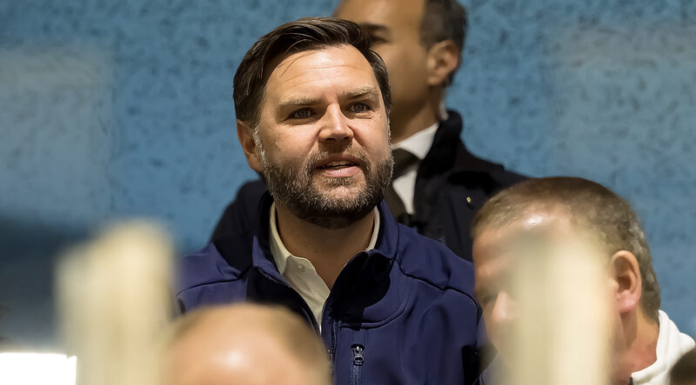
Vice President JD Vance drew sharp ridicule from Morning Joe host Joe Scarborough on Friday after Vance appeared at the Richard Nixon Presidential Library in California on Thursday to promote a recent publication and delivered a series of sweeping claims about Watergate, the deep state, and his own personal parallels to the disgraced former president.
Vance Dismisses Watergate as a Non-Event
During his Thursday appearance at the Nixon Library, Vice President Vance told the audience that he has long been fascinated by Richard Nixon’s presidency and that Nixon’s historical legacy is experiencing a renaissance. He then made the eyebrow-raising assertion that the Watergate scandal, which ultimately forced Nixon from office, would barely register in today’s fractured media environment. Vance said, “If Watergate happened tomorrow, it would be a 12-hour news story,” adding that “the idea that it would have taken down a presidency is crazy.”
Vance went further, contending that institutional forces rather than presidential misconduct brought Nixon down. He connected what he characterized as a coordinated campaign against Nixon to similar alleged operations targeting President Donald Trump. In remarks that sparked widespread online ridicule, Vance drew parallels between his own career as a young elected official and bestselling author facing press criticism and Nixon’s political path, citing these similarities as a source of his long-standing interest in the former president. The vice president provided no evidence to support his assertion that government institutions orchestrated Nixon’s removal from office.
Scarborough Fires Back on Morning Joe
When Morning Joe aired the footage from the Nixon Library the following morning, host Joe Scarborough wasted no time. He opened the segment by drawing a self-deprecating contrast between his own educational background at what he described as a southern state school and Vance’s prestigious Ivy League credentials, before delivering a blunt verdict on the vice president’s historical analysis: “Listen, I know he didn’t go to his southern state school like me but what he’s saying is ahistorical and stupid.”
Scarborough acknowledged that Nixon achieved genuine diplomatic and environmental milestones, including opening relations with China, establishing the EPA, and pursuing détente with Russia. However, he argued that invoking Nixon’s record to excuse current political behavior represented “defining deviancy down” and served to minimize whatever actions the present administration might be taking by suggesting they were no worse than Watergate-era conduct.
Scarborough Reverses the Deep-State Narrative
Scarborough directly challenged Vance’s assertion that institutional forces had targeted Nixon, arguing that history demonstrates the opposite. Nixon himself weaponized the FBI, CIA, and Justice Department against adversaries, Scarborough said. He catalogued the administration’s abuses: operatives burglarizing Democratic headquarters and medical offices seeking damaging personal information, maintaining an enemies list, and conducting illegal surveillance. Scarborough noted the parallel conduct by Vance’s own administration involving these same agencies, questioning whether the vice president recognized the similarity. He concluded by pointing to Vance’s Yale law degree and questioning how a graduate of one of the country’s most elite institutions could offer such a distorted reading of a well-documented chapter of American history. “Where did you go to school, man? Where did you go to school? Like, did you really get a degree from Yale?” he asked. The mockery resonated far beyond the studio, as critics online called the vice president’s revisionist take on Watergate both factually wrong and politically transparent.
Backlash Spreads Beyond the Broadcast
The vice president’s remarks at the Nixon Library landed in an already turbulent news cycle for Vance. His comments about Nixon reinforced a narrative among his critics that he is willing to rewrite history in order to cast the current administration’s conduct in a more flattering light. The suggestion that Watergate — a scandal involving obstruction of justice, abuse of power, and the cover-up of a criminal conspiracy that led to Nixon’s resignation — would amount to little more than a passing headline in the modern era struck many observers as not merely wrong but deliberately misleading. Whether Vance intended the Nixon Library appearance as a calculated political message or a genuine exercise in historical revisionism, the fallout made clear that the comparison had not landed as intended.