


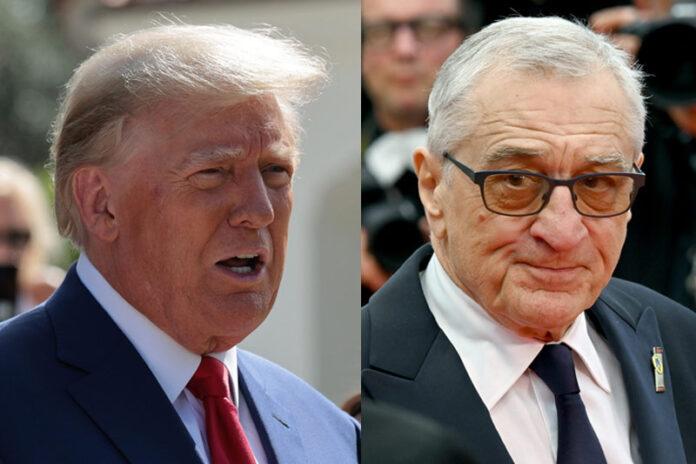
There is a particular kind of American theater that unfolds when a movie star with two Academy Awards climbs onto a stage and invites a crowd to curse at the president of the United States.
It is not subtle, and it is not meant to be.
On Sunday, June 15, 2026, at a New York event called Rise Up, Sing Out: A Concert for the First Amendment, Robert De Niro turned a celebration of free speech into a call-and-response denunciation of President Donald Trump, leading the audience through a repeated, unprintable four-word refrain.
The moment played as comedy, but it was built on something darker: a growing conviction among the president’s most visible critics that ordinary political language has become inadequate to the moment, and that only blunt-force contempt can register at all.
De Niro, 82, is not a new entrant to this fight. He has spent years positioning himself as one of Trump’s most persistent celebrity adversaries, and he has, by most measures, succeeded in getting under the president’s skin.
What makes the New York performance worth examining is not that a Hollywood liberal insulted a Republican president — that is nearly a genre unto itself — but the specific vocabulary he chose, the cultural machinery he drew on, and what his escalating rhetoric reveals about the exhaustion of conventional dissent in the second Trump term.
A Movie Line Weaponized
The rallying cry itself was a piece of pop-culture engineering. When De Niro opened by describing himself as close to a free-speech absolutist and explaining that he uses his own speech to answer speech he dislikes, the setup felt almost genteel. Then he delivered the payoff. Citing a recent Trump remark that he doesn’t think about Americans’ financial situation, De Niro responded, according to his account at the event, “Shut the f*** up!” The audience erupted — not merely at the insult but at the recognition. The phrasing invokes a famed scene from the 1988 comedy “Midnight Run,” in which De Niro’s character bats away Charles Grodin’s relentless questions.
De Niro repeated the routine three times, targeting Trump’s remarks on finances, inflation, and the 2020 election. Each time he cued the crowd to chant back the expletive in unison, creating what resembled a political liturgy more than a traditional speech.
There is a cynical reading available here, and it is not entirely wrong. Celebrity outrage is a renewable resource, and De Niro has monetized his in the currency of viral clips for years. But the “Midnight Run” callback does something more interesting than merely entertain. It collapses the distance between the actor and the character, between the fictional tough guy who suffered no fools and the octogenarian who now claims to suffer a president he regards as a fool. De Niro has, after all, called Trump exactly that in the past, a description that the president took considerable offense to.
From Insult to Indictment
Had the evening ended with the chant, it would have been a footnote. What elevated it — and what suggests De Niro is reaching for something beyond a punchline — was the extended meditation on patriotism that followed. Loving the country under its current leadership, he argued, has begun to resemble an abused spouse professing love for an abuser. It is a jarring analogy, and a deliberate one, designed to reframe civic loyalty as a form of psychological captivity.
De Niro then catalogued his grievances, saying he could not love a country that starts inhumane wars, strips healthcare from millions to enrich the Trump-Epstein class, deploys masked militias against citizens, and separates families. He described the nation as led by a racist, misogynist, xenophobic tyrant enabled by a sycophant Congress, closing with “I want my country back.”
These are not the claims of a man doing a bit. They are the language of someone who has decided the ordinary vocabulary of opposition — the op-ed, the endorsement, the polite disapproval — has failed. The rhetorical arc of the evening moved from a comedy line to a catalog of grievances that would not be out of place in a courtroom summation. That shift matters, because it marks the distance American political culture has traveled: from disagreement expressed through argument to disagreement expressed through anathema.
The Cycle of Contempt
De Niro’s antagonism did not begin in June. Earlier this year, he delivered a counter-speech to Trump’s State of the Union address, an act of televised counter-programming that drew a swift response. The president called him a “sick and demented person.”
When De Niro later called Trump an idiot in a podcast conversation with Nicole Wallace, saying the country needed to remove him from office, Trump responded by calling the actor “deranged” with “an extremely low IQ.”
This is the essential dynamic, and it is worth naming plainly: the two men are locked in a loop that flatters both. De Niro’s insults generate presidential rebuttals; the presidential rebuttals generate more attention for De Niro; the attention incentivizes the next escalation. Each participant supplies the other with proof of his own thesis. To the actor, every Trump insult confirms the president’s vulgarity and thin skin. To the president and his supporters, every De Niro tirade confirms that his opponents are, as Trump frames them, unhinged elites who traffic in profanity because they have run out of arguments.
The venue itself sharpens the irony. De Niro’s “shut the f*** up” was delivered at an event convened to honor the First Amendment, and he prefaced it by describing himself as nearly a free-speech absolutist. There is a genuine coherence to this — the whole point of robust speech protections is that they cover the crude and the confrontational as much as the elegant. Telling a president to be quiet is, in its way, a demonstration of the very freedom the concert celebrated. Yet there is also a tension the evening never quite resolved: a defense of open discourse conducted primarily through the mechanics of a chant, in which the crowd’s role was not to argue but to repeat.
That tension is the real story of the night, and it extends well beyond one actor and one president. American political speech is drifting toward the condition of a sporting event, where the goal is not persuasion but participation, not to change a mind but to feel the collective charge of shouting the same thing at the same time. De Niro is a master of the form, and his “Midnight Run” flourish shows he knows precisely what he is doing. The question his performance leaves hanging is whether contempt, however cathartic, can ever double as a strategy — whether telling the other side to shut up has ever, in the long history of self-government, actually made it do so. When the applause fades, that is the line no one on either stage seems eager to say out loud.