


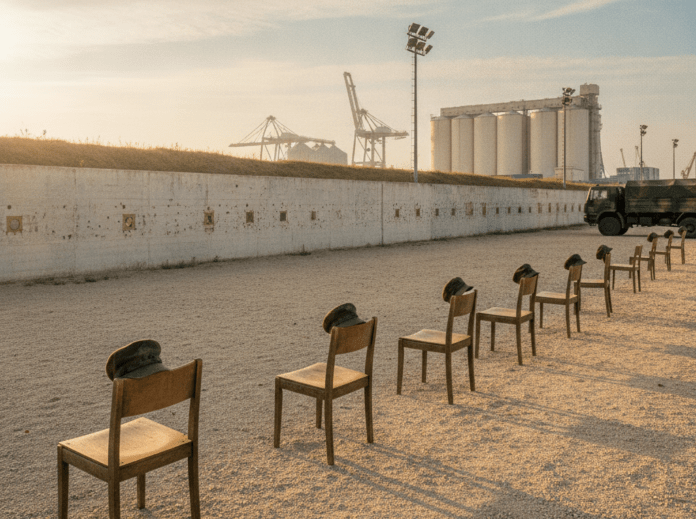
A senior colonel in North Korea’s military was executed by firing squad on July 12 in front of his own unit for allegedly embezzling state reserve grain, according to reports emerging from inside the country. The officer, who commanded a coastal guard unit based in the port city of Nampo, was put to death in a public killing that left fellow officers stunned and terrified.
The colonel was accused of secretly removing several dozen tonnes of the military’s reserve grain from a warehouse under his own command. He allegedly took advantage of lax nighttime security last month and attempted to transport the grain by vehicle to Nampo port, where sentries guarding the facility spotted him first.
How the Scheme Unraveled
The guards who caught the officer had reportedly long resented corruption among the ranks and grew suspicious after noticing a large quantity of grain being moved in the middle of the night, according to a Daily NK source in South Pyongan province. It appeared the warehouse’s security chief had allowed the movement to take place. The sentries immediately reported what they had witnessed to their unit’s security department.
Military authorities detained the senior colonel and brought him to the Military Security Bureau, where interrogators questioned him extensively. As investigators uncovered his network of accomplices and additional crimes, he was swiftly sent to face a court martial. The tribunal handed down a death sentence for his theft of reserve grain amid a severe national food shortage and his attempt to illegally remove it from the storage facility.
Soldiers were gathered at a shooting range near Nampo port to watch the killing. The case drew unusually strong condemnation, in part because the military is already unsettled by food shortages, and a senior officer had tried to profit personally from the state’s grain reserves at exactly that moment.
Officers Left Shaken
The officers ordered to witness the execution were deeply rattled by what they saw. “Their faces turned pale. They left without making eye contact with each other,” a source in the region reported.
Following the execution, top officials from the party’s central leadership and the military’s General Political Bureau released stern warnings promising to eliminate corruption within the armed forces. The crackdown has reportedly created unprecedented levels of anxiety among high-ranking military officers.
Military authorities have since put the Nampo port area under heightened security measures. A special inspection team sent by the party’s central leadership has taken up position at the port, where it maintains direct control over all vessel movements and cargo operations. Authorities have placed full restrictions on even standard shipments of construction materials and seafood, reportedly making daily life harder for people living near the port.
A History of Brutal Purges
Public executions have been used as instruments of fear under leader Kim Jong-un throughout his rule. One of the most notorious cases came in 2015, when North Korea’s defense minister, Hyon Yong-chol, was reportedly executed by anti-aircraft fire in front of hundreds of witnesses. South Korea’s National Intelligence Service told parliament at the time that Hyon was killed on April 30, 2015, after allegedly falling asleep during an event attended by Kim Jong-un and failing to carry out instructions.
According to testimony from the agency’s Han Ki-beom, the execution was carried out at the Kang Kon military academy in northern Pyongyang. Intelligence sources reported that Hyon was killed with 14.5mm calibre ammunition — a technique said to be reserved for senior officials the leadership wishes to make examples of.
Mike Madden of North Korea Leadership Watch told the BBC in 2015 that the execution was “entirely a demonstration of power and authority” and “indicative of Kim Jong-un’s impulsive decision-making.”
Hyon’s death came weeks after the reported execution of 15 senior officials, with the South Korean spy agency saying at the time that officials were being put to death at a rate of roughly one per week. The most high-profile purge of Kim’s rule remains that of his uncle, Jang Song-thaek, once the country’s second-most powerful figure, who was arrested in December 2013 and immediately executed after being found guilty of treason. Also reportedly executed in 2015 was Ma Won-chun, a lieutenant-general and architect said to have overseen the regime’s finances.
The US-based Committee for Human Rights in North Korea released satellite imagery from October 2014 that experts interpreted as depicting a firing range equipped with anti-aircraft weapons seemingly prepared for use in an execution, offering rare visual evidence of the regime’s use of heavy weaponry to dispense with those it deems enemies.