


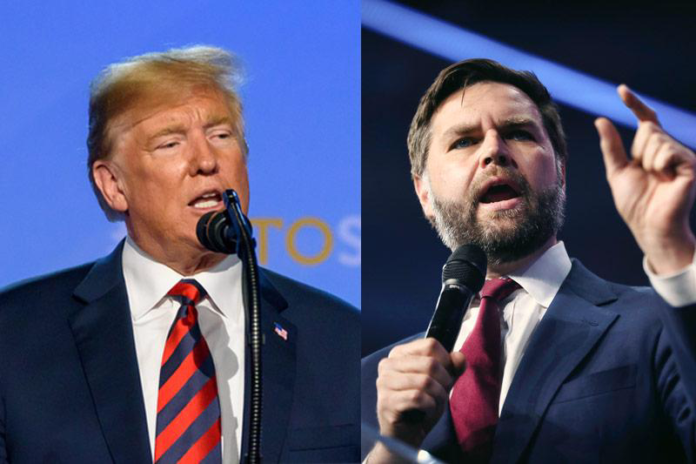
As Vice President JD Vance spent Saturday sharing clips of President Donald Trump’s Fourth of July speech on social media, a decade-old essay Vance himself wrote savaging Trump went viral — embarrassing the nation’s second-highest official on America’s 250th birthday.
The piece, titled “Opioid of the Masses,” was originally published in The Atlantic on July 4, 2016, just days after Vance released his memoir “Hillbilly Elegy,” which sold approximately three million copies. On its 10-year anniversary, The Atlantic republished the essay, inviting readers to judge whether its author had correctly sized up the man he now serves. The answer, for much of the internet, was an uncomfortable yes.
A 1,300-Word Takedown From the Past
The essay, running some 1,300 words, portrayed Trump as a deceptive comfort to struggling Americans. Vance contended that Trump “exploits” real problems facing voters while offering promises he has no plan to keep, calling the dynamic a “great tragedy.” Vance described Trump’s appeal as something consumed through the senses — relief that couldn’t solve underlying problems.
“Trump is cultural heroin,” Vance wrote. “He makes some feel better for a bit. But he cannot fix what ails them, and one day they’ll realize it.”
Vance also warned that Trump’s promises amounted to nothing more than hollow relief for a country in pain, describing voters as reaching for the candidate the way a person in crisis reaches for a painkiller — seduced by the promise of a quick escape and easy answers to problems that had been building for decades.
The Irony Goes Viral
The timing of the republication proved devastating for Vance’s public image. Even as he dutifully amplified Trump’s holiday address online, social media users were circulating his own words against him. The essay climbed to the top of The Atlantic’s “Popular” list, prompting a wave of mockery directed at the vice president.
Atlantic writer Tom Nichols noted the irony publicly, observing that Vance was “still holding the top spot of most-popular articles” on The Atlantic’s site the morning after Trump’s Independence Day celebrations in Washington. One X user sarcastically congratulated Vance on the article’s popularity, calling it “huge.”
The viral moment landed at a particularly sensitive time. Atlantic writer Peter Wehner characterized Trump as entering the second half of his second term in a weakened position, with one poll from July 4 placing his approval rating at just 30%. Republican members of Congress are beginning to break with him, and his MAGA base is showing signs of fracture. Even Tucker Carlson, once a reliable champion of the Trump movement, has been openly mocking the president.
Wehner’s Verdict on Vance’s Transformation
Wehner used the essay’s anniversary to contrast Vance’s 2016 position with his current stance. Vance had privately called himself a “Never Trump guy,” labeled Trump an “idiot,” and reportedly went back and forth with a friend over whether Trump was a cynical opportunist or something far more dangerous. The backdrop for that private reckoning was a man who had written, in his own memoir, that nothing compares to the fear of becoming the very monster you once dreaded.
Wehner argued that what drove Vance away from those convictions was ambition. The Senate came first, then the vice presidency — and with each step, Vance moved further from the sharp-eyed analyst who had diagnosed Trump’s appeal with such precision. Wehner called Vance “a teller of hard truths” in 2016 and suggested he had since become “a peddler of lies” he was surely clever enough to recognize.
The broader context Wehner laid out painted a bleak picture of the Trump presidency’s second term. Gas prices rose from below $3 to above $4 per gallon during a 100-day conflict with Iran that ended poorly for America. Robert F. Kennedy Jr., placed atop the nation’s health agencies, reduced the recommended childhood vaccine schedule by nearly half, and the country is now enduring the worst measles outbreak in 30 years. Billions in research funding have been cut from the National Institutes of Health, which Wehner called the crown jewel of American biomedical science. The dismantling of the President’s Emergency Plan for AIDS Relief — the bipartisan initiative that saved over 25 million lives — has already led to hundreds of thousands of deaths according to reliable estimates, with forecasts suggesting up to 14 million additional deaths by 2030 if current policies continue.
The Comedown Vance Predicted
In Wehner’s framing, the viral resurfacing of Vance’s essay was not just an awkward moment for the vice president — it was a kind of verdict. The man who once understood Trump’s appeal as a dangerous illusion built on borrowed hope had himself become part of the machinery he once condemned. Every talking point Vance delivers, every clip he posts in cheerful support of a president he once compared to hard drugs, is measured now against what he wrote a decade ago.
Vance wrote in 2016 that one day, Americans would realize Trump could not fix what ailed them. Wehner’s argument, amplified by the essay’s viral return on July 4, 2026, was simple: that day has arrived — and the man who saw it coming most clearly is the one standing closest to the flame.