


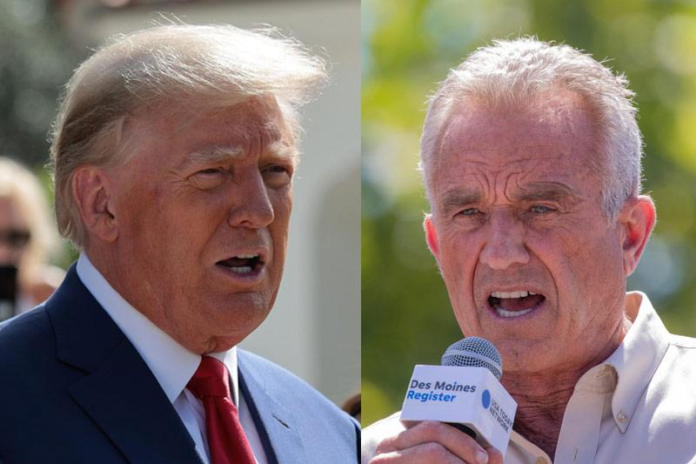
Health and Human Services Secretary Robert F. Kennedy Jr., the fermented-food devotee leading President Donald Trump’s wellness agenda, revealed on a podcast released Wednesday, Aug. 12, 2026, that boarding the president’s plane means encountering a familiar sight: fast food stacked high from floor to ceiling. Kennedy said the scene aboard the president’s plane during travel is dominated by the golden arches — a striking contrast to the administration’s own public health messaging.
Boxes of McDonald’s at 30,000 Feet
Kennedy made the disclosure during an episode of the “Net Positive” podcast hosted by comedian and media personality John Crist. “When you get on his airplane, it’s just boxes and boxes of McDonald’s,” Kennedy said. Crist pressed the secretary on whether he had ever pushed back on the president’s in-flight dining habits. “I’m not like a scold,” Kennedy responded, adding that Trump gravitates toward national chain restaurants while traveling because of concerns about food poisoning from unfamiliar kitchens.
Kennedy was careful to offer a fuller picture of the president’s overall eating habits. He said Trump’s diet at his Mar-a-Lago estate and at the White House is considerably closer to the standards Kennedy champions — fresh produce, much of it locally sourced. The fast food, Kennedy suggested, is largely a travel phenomenon driven by the president’s preference for the predictability and safety of national chains rather than a wholesale rejection of healthy eating.
Trump’s Well-Known Love of Fast Food
President Trump’s appetite for McDonald’s is hardly a secret. Republican National Committee Chairman Joe Gruters described the president’s go-to order in colorful detail during an October 2024 podcast appearance, saying Trump had hot fries waiting, followed by a Filet-O-Fish, a Quarter Pounder, a Big Mac, and a combination of two of the sandwiches. The fondness for the chain long predates his return to the White House. During his 2024 presidential campaign, Trump staged an event at a McDonald’s location in Pennsylvania, where he worked a station as a fry attendant to the delight of supporters.
A photo from around that same period captured the contrast between the president’s tastes and his incoming health team in memorable fashion. Kennedy appeared in a widely circulated image seated aboard Trump’s private plane, a tray of McDonald’s in front of him, surrounded by tech billionaire Elon Musk, House Speaker Mike Johnson, and Trump’s eldest son, Donald Trump Jr. The younger Trump accompanied the photo with a post on X that read, “Make America Healthy Again starts TOMORROW,” a line that drew no shortage of wry commentary given the setting.
Kennedy’s Own Diet and MAHA Push
Kennedy has cultivated a high public profile for his personal health habits since taking over HHS. His regimen, built around fermented foods and grass-fed meat, has attracted significant attention, and he has credited it with helping him shed 20 pounds in 30 days. The visibility of his dietary choices has reinforced his position as the administration’s most prominent voice on food and nutrition policy — even as images of him surrounded by Big Macs occasionally complicate that narrative.
Kennedy has not shied away from frank assessments of the national diet. He has stated publicly that nearly 60% of the American diet consists of ultra-processed foods and that childhood obesity now affects more than one in five American children — statistics he has cited as central to the Make America Healthy Again (MAHA) movement he leads. President Trump signed an executive order soon after his January 2025 inauguration establishing the Make America Healthy Again Commission, which set out objectives including reducing chronic disease rates among both adults and children.
Policy Actions Behind the Rhetoric
The MAHA movement has produced concrete regulatory activity in addition to the podcast commentary. The Food and Drug Administration (FDA) issued a proposed rule requiring food manufacturers to notify the agency when they determine that a substance added to food qualifies as “Generally Recognized as Safe.” Separately, HHS and the Department of Agriculture (USDA) submitted what they described as the federal government’s first proposed formal definition of ultra-processed food — a step advocates say is necessary before meaningful restrictions can be crafted. HHS has also announced a broader set of food policy reforms focused on reducing Americans’ exposure to ultra-processed ingredients.
Kennedy had previously raised eyebrows with an earlier podcast appearance in which he said he does not know how Trump is still alive, given the president’s well-documented taste for soda and fast food. His latest comments on the “Net Positive” episode land in a similar vein — blunt, candid, and laced with the tension of a health secretary who has staked his legacy on changing American eating habits while traveling alongside a president whose in-flight snack of choice comes in a paper bag stamped with familiar red and yellow branding.