


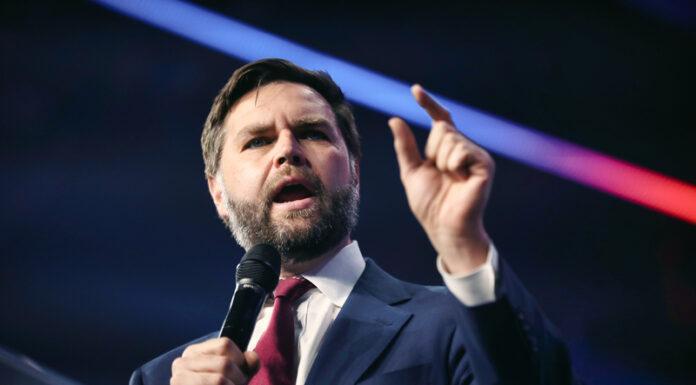
Vice President JD Vance appeared on Fox News’ “Saturday in America” on August 8 to offer a progress report on the ongoing war in Iran — and in doing so, offered a candid window into the administration’s broader calculus that extended well beyond the stated goal of nuclear nonproliferation.
Vance told host Kayleigh McEnany that the Trump administration was engaged in ongoing diplomacy with Tehran aimed at producing a lasting peace, describing the effort as a balancing act between military pressure and economic necessity. He said the U.S. was working to determine whether Iran was prepared to make the kind of durable changes required for a healthier bilateral relationship. Vance said, “And if not, that’s fine too.”
Oil Takes Center Stage in Iran Strategy
What followed raised further eyebrows. Vance outlined the administration’s objective to restore maximum oil and gas shipments through the Strait of Hormuz, presenting cheaper energy costs for Americans as a key priority. He characterized the approach as a “delicate dance” — a phrase that resonated given that President Donald Trump launched the war in February on the stated grounds of preventing Iran from acquiring nuclear weapons, with no mention of oil access as a primary driver.
The Strait of Hormuz is one of the world’s most critical energy chokepoints, with roughly a fifth of the world’s oil passing through it. After Iran closed the strait in response to U.S. military action, American consumers felt the effects almost immediately in the form of elevated gas and food prices. As of mid-July, global crude oil prices had climbed to near $80 a barrel, up from around $69 in June.
The Iran conflict is not the only front where the administration has been accused of conflating military objectives with resource extraction. Trump ordered an operation in January to capture then-Venezuelan President Nicolás Maduro and subsequently acknowledged that the U.S. was taking billions of barrels of oil from Venezuela, framing the outcome with the phrase “to the victor belong the spoils.”
Conflicting Signals on Negotiations
The diplomatic picture surrounding the Iran conflict has grown increasingly murky. Trump said Monday that talks with Tehran were actively underway and issued what he described as Iran’s final opportunity to reach an agreement. Iranian officials, however, flatly denied that any negotiations were taking place — a contradiction that has left analysts and allies struggling to assess the true state of the conflict.
On Friday, Iranian Foreign Minister Seyed Abbas Araghchi praised Tehran’s armed forces and called for greater solidarity among Muslim-majority nations, signaling no imminent softening of the Islamic Republic’s posture. That same week, Iran laid out six formal demands it said must be met before the Strait of Hormuz could reopen. Those demands include ending U.S. strikes on Iran and its partners across Lebanon, Palestinian areas, Yemen, and Iraq; the lifting of the U.S. naval blockade; the withdrawal of American sea and air forces from the region; compensation for damages sustained across two wars; and the removal of sanctions. Iranian official Mohammad Baqer Zulqader stated the strait would not reopen “until America corrects its behavior.”
Meanwhile, U.S. Central Command announced that American forces have redirected 51 commercial vessels as part of a renewed naval blockade targeting Iranian ports and coastal areas. The State Department also announced penalties targeting six organizations and one person for allegedly facilitating Tehran’s transfer of illegal money using cryptocurrency, linking the action directly to Tehran’s attacks on commercial shipping.
A Conflict With No Clear End in Sight
The war’s trajectory has been turbulent. After an initial period of intensive U.S. bombing campaigns aimed at pressuring Iran into reopening the strait, Iran held firm. Trump declared in July that a temporary ceasefire between the two nations was finished. In mid-July, U.S. Central Command launched strikes on Iranian military targets for five consecutive days, focusing on degrading Iran’s capacity to attack commercial vessels in the strait. Iran launched retaliatory strikes on U.S. allies Kuwait, Bahrain and Jordan.
Iran has also warned that any expansion of U.S. strikes could trigger widespread military attacks across the region, with commanders from the Khatam al-Anbiya Central Headquarters insisting the strait represents what they called an invincible region that Washington would not be permitted to control under any circumstances.
On June 20, Vance had appeared on “Fox & Friends Weekend” to provide an upbeat update on nuclear talks being held in Switzerland, noting that 16 million barrels of oil had recently moved through the strait — a figure the administration cited as evidence of incremental progress. The tone on Saturday was considerably more measured, with Vance acknowledging that “this thing is not over” while maintaining confidence that a resolution remained achievable. Polls show growing public dissatisfaction with the war’s costs and duration, a trend that could prove damaging for Republicans heading into the midterm elections.
Trump has also demanded that Iran pay reparations for what the administration describes as decades of damage caused by the Islamic Republic — a demand Iranian officials have not acknowledged as a legitimate basis for negotiation. The administration says it remains committed to securing a lasting peace deal, though the precise shape of any agreement, and whether Tehran and Washington are even in contact, remains a matter of sharp dispute between the two governments.