


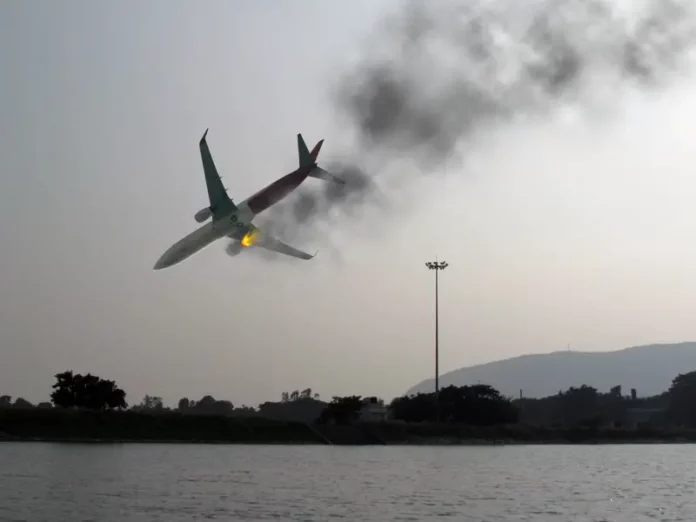
A military plane went down in bad weather in northern Malawi on June 10, 2024, killing Malawi’s Vice President, Saulos Klaus Chilima, and eight others — among them former First Lady Shanil Dzimbiri.
Reported missing that morning, the Dornier 228-202K aircraft was located completely wrecked in the Chikangawa Forest, according to President Lazarus Chakwera’s announcement at the time.
Two years on, the case has been reopened. A parliamentary inquiry is now taking testimony that has revived questions about what officials knew, and when they knew it.
Chilima, widely seen as a potential candidate in the 2025 presidential election, had recently come back from South Korea, where he attended the Korea-Africa summit. He was on his way to the funeral of former justice minister Ralph Kasambara in Nkhata Bay when the crash occurred. Departing Lilongwe at 9:17 a.m., the aircraft could not put down at Mzuzu airport, the nearest to the funeral, because of low visibility. It was redirected to Lilongwe, then lost contact with air traffic control and disappeared from radar.
In a national address, President Chakwera confirmed that the search and rescue operation was over. “I’m deeply saddened, I’m sorry to inform you all that it has turned out to be a terrible tragedy,” he said. “The search and rescue team has found the aircraft near a hill. They have found it completely destroyed with no survivors.” He further confirmed that the military had begun transporting the remains of the victims back to the capital.
The aircraft had an established record of reliability and the crew was experienced, yet something went fatally wrong on the flight to Lilongwe.
Paying tribute, Chakwera said: “Dr. Saulos Klaus Chilima was a good man, a devoted father and husband, a patriotic citizen who served his country with distinction, and a formidable vice president.”
Pictures circulating online showed security and rescue personnel at the crash site, with aircraft debris scattered around the plane’s tail section.
Chilima, 51, had come into politics from business, having served as managing director of Airtel Malawi, and he led the United Transformation Movement party. His partnership with Chakwera produced the ruling Tonse Alliance, and he was Chakwera’s running mate in their successful 2020 election campaign. That relationship had grown tense as the 2025 presidential election drew closer, with Chilima expected to mount a challenge against him.
Corruption allegations led to Chilima’s arrest in 2022. The charges were later dropped after the Director of Public Prosecutions filed a notice to discontinue the case, and Chilima asserted his innocence throughout the legal process.
To honor those who died, President Chakwera declared a national day of mourning. The remains of Chilima and the other victims were transported back to Lilongwe.
Specialized equipment supplied by the United States, the United Kingdom, Israel and Norway made international assistance a crucial part of the search and rescue effort. The U.S. Embassy in Lilongwe voiced deep concern about the crash and offered all available aid, including a Defense C-12 aircraft.
Condolences poured in as the crash plunged Malawi into mourning. AFP news agency reports stated that Chilima was widely loved, particularly among the youth.
His wife, Mary, and their two children, Sean and Elizabeth, survived him.
A fresh investigation into the military aircraft accident that claimed Chilima’s life was ordered by Malawian President Peter Mutharika more than a year and a half after the tragedy. Previous reports had failed to adequately address critical questions about the June 2024 crash, which was why a new inquiry was needed, Minister of Justice and Constitutional Affairs Charles Mhango told Parliament in February 2026.
Poor visibility was the cause identified by the original investigation, released in May 2025 by the German Federal Bureau of Aircraft Accident Investigation: it made the Dornier 228-202(K) aircraft collide with rising terrain, leaving no chance of survival. Human and environmental factors were also blamed by a separate commission established by then-President Lazarus Chakwera, which likewise found no evidence of foul play. Neither set of findings satisfied many Malawians.
Parliament moved on Mutharika’s directive in late March 2026, when Speaker Sameer Suleman appointed a 13-member Parliamentary Ad Hoc Committee drawn from across the political spectrum and chaired by Walter Nyamilandu Manda. Getting there took some doing: the Malawi Congress Party initially withdrew from the process over impartiality concerns, then rejoined after negotiations brokered by the Speaker. The committee was given 90 days to report back, a deadline the scale of the inquiry has since overtaken.
Terms of reference, the scope of the inquiry and a structured investigative roadmap were the panel’s business during the preparatory phase, which wrapped up by late April 2026. Full-scale investigations were set to begin by mid-May 2026, following three parallel tracks: a health, safety, security, and environmental audit; a forensic audit; and autopsy and post-mortem examinations. That last track required the exhumation of all nine victims, because no post-mortem examinations were conducted when the bodies were recovered in June 2024.
Thoroughness was being prioritized over speed and an extension might be sought, Nyamilandu said on July 3, 2026.
Decomposition and embalming could reduce the reliability of toxicological tests and soft-tissue analysis, Forensic specialists have noted, so the extended delay may limit what investigators can learn.
More than 150 witnesses are expected to appear before the committee, which has asked members of the public to come forward with any relevant information.
“The Parliamentary Ad Hoc Committee established to conduct a fresh inquiry into the Chikangawa Plane Crash has successfully concluded its preparatory work and is now ready to commence investigations,” said the committee’s chairperson, Walter Nyamilandu Manda, who pledged that fairness, professionalism, and transparency would guide the process. Running more than two years after the crash shook the nation, the inquiry has been welcomed by many Malawians who have long demanded definitive answers. On the second anniversary, United Transformation Movement officials joined Mary Chilima at a memorial mass at Nsipe in Ntcheu District.
Evidence-taking has since started. The first witnesses have revived doubts over both the decisions that placed Chilima aboard the aircraft and the government’s conduct after contact was lost. Chakwera assigned Chilima to represent him at Kasambara’s funeral and approved the use of the Malawi Defence Force (MDF) Dornier 228 for the trip, former Defence Minister Harry Mkandawire told the inquiry. A K5 million payment was also arranged by State House for Chilima to hand to Kasambara’s family as a condolence message, according to testimony before the committee.
A new detail about the flight’s timeline emerged from Mkandawire’s account. Weather had forced the aircraft to turn back to Lilongwe: that was the message then-MDF Commander General Paul Valentino Phiri delivered to him by phone at about 10:02 a.m., minutes ahead of the 10:16 a.m. landing the plane was scheduled to make in Mzuzu. It is now for General Phiri to explain who told him the plane had returned and who reported the crash in Chikangawa Forest, Mkandawire said.
Questioning drew an admission from Mkandawire that he continued with the funeral program, went home, bathed and slept, traveling to the crash site only on June 11, 2024. Claims that the search had been suspended overnight were disputed by him: MDF soldiers searched through the night even though police stopped, he said, and the mission was never officially called off. An account of his own has since come from General Phiri.
The request for an aircraft reached him on June 8, 2024 from Lucky Sikwese, he told the committee, and Kasambara’s remains had already been flown to Mzuzu aboard the only machine available. Chakwera was the one he put the question to when asked whether it could come back to Lilongwe, Phiri said, and permission was granted. The search, he also told the inquiry, drew 172 soldiers, with 30 more from Zomba.
The most damaging technical evidence heard so far came from Colonel Alex Mwachande, the Zomba Air Base commander. The same aircraft’s crew had reported “very bad weather” on a June 9 flight to Mzuzu, he said, and that warning never reached the vice president’s office before the plane was assigned to Chilima the next morning. Mwachande also testified that the aircraft’s emergency locator transmitter had been dead for years — its battery expired in 2006 and the manufacturer had stopped making replacements — so nothing on board was transmitting a position once it went down. He described a defence force stretched thin, fielding competing demands for aircraft that included a troop rotation from the Democratic Republic of Congo on June 10.
More than 40 witnesses had appeared by the time phase one closed in August 2026, among them serving and retired military officers, government officials and relatives of the victims. The committee reconvened on August 10 and 11 to hear its final two witnesses of that stage — former National Intelligence Service director general Dokani Ngwira and retired Lieutenant General John Msonthi — and to prepare what comes next.
Two South African pathologists, Dr. Robert Gabriel Ngude and Dr. Wilson Sibusiso Ntsele, have been engaged to lead the pathology work on the forensic track. As of early August 2026, the exhumations had not taken place; the committee described them as subject to legal clearances and consultation with the families.
Phase two opened on Monday, August 24, 2026 and runs through Friday, September 11. Its focus is the day of the flight itself, and those due to give evidence include airport flight-planning, meteorology and fuelling staff, weather specialists, pilots experienced on the Dornier 228, and eyewitnesses from the Nthungwa Forest near the crash site.