


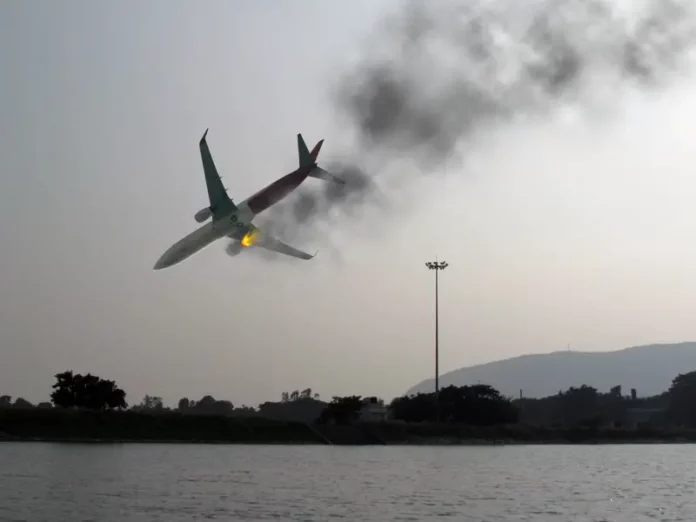
A Russian Tu-95 “Bear” strategic bomber crashed during a training flight over the Far Eastern Amur region on Tuesday, Sept. 29, 2026, killing six of the seven crew members aboard and costing Vladimir Putin an aircraft Moscow has not built since 1992.
The bomber was flying without ammunition when it went down, Russia’s Defense Ministry said. “The plane crashed in an uninhabited area,” the ministry said, adding that preliminary reports indicated six crew members were killed and that one was injured and evacuated to a medical facility.
Witnesses said the aircraft had been flying perilously low shortly before the crash, passing overhead at roughly treetop height. The ministry dispatched a commission from the Russian Aerospace Forces to investigate. A technical malfunction was reported as the preliminary cause, while unconfirmed Russian reports claimed fuel exploded aboard the plane.
A Bomber Moscow Can No Longer Build
The Tupolev Tu-95, code named Bear by NATO, is a four-engine turboprop designed in the 1950s as a Soviet answer to the U.S. B-52. It has intercontinental range — about 9,300 miles — carries a missile payload of 33,000 pounds and can haul eight long-range cruise missiles armed with conventional or nuclear warheads. It is also one of only two Russian aircraft able to fire Kh-101 long-range cruise missiles at Ukrainian cities.
Justin Bronk, a senior research fellow for airpower and technology at the Royal United Services Institute (RUSI), told The Telegraph that the bombers form part of Russia’s nuclear triad — the long-range bomber force, land-based intercontinental ballistic missiles and atomic-powered submarines — and have flown intensive missile raids against Ukraine for four and a half years. Putin, 73, has leaned on the aircraft throughout the full-scale invasion he launched in February 2022.
Replacing one is not an option. Production ended for both the Tu-95 and the supersonic Tu-22M after the 1991 collapse of the Soviet Union. Russia keeps fewer than 20 of its newer Tu-160 bombers in service and has only recently begun building a modernized version.
Air Losses Piling Up Since February 2022
Russia’s air force has absorbed punishing losses over the course of the war, a number of them self-inflicted, including Tuesday’s crash. Oryx, the Dutch open-source intelligence defense analysis website, has visually confirmed 166 Russian aircraft destroyed and another 30 damaged since February 2022, a tally that includes eight Tu-95 strategic bombers destroyed and three damaged. Ukraine’s own aviation losses have been heavy: Oryx counts 116 Ukrainian aircraft destroyed, four damaged and one captured.
Kyiv’s military, which publishes its own estimates, said Wednesday, Sept. 30, that Moscow had lost 443 aircraft since the war began. Russia rarely releases figures for its wartime equipment or personnel losses.
The Shadow of Operation Spider’s Web
The deepest cut came on June 1, 2025, when Ukraine launched Operation Spider’s Web, an 18-month project that smuggled 117 drones into Russia aboard trucks parked near four air bases, then popped the lids of their cargo containers and sent swarms aloft. The strikes reached as far as Belaya air base in the Irkutsk region of eastern Siberia, some 3,000 miles from Kyiv near Lake Baikal, and Olenya air base on the Arctic Kola Peninsula near Murmansk.
Ukraine said 41 aircraft — Tu-95s, Tu-22Ms and A-50 radar planes — were damaged or destroyed, about a third of Russia’s strategic bomber fleet. Moscow said only several planes were struck. One tally put the damage at nine Tu-95s, three Tu-22M3s, an A-50 “Mainstay” radar plane and an An-22 transport. Russian military bloggers compared the raid to Japan’s 1941 surprise attack on Pearl Harbor.
Moscow had already resorted to improvisation to shield its bombers. Satellite imagery posted in 2023 showed car tires laid across the wings of a Tu-95 at the Engels military airfield, some 900 km (559 miles) south of Moscow near Saratov on the Volga — a measure a self-described Ukrainian military reserve officer said was meant to deter drone attacks. Repeated strikes on Engels pushed the Kremlin to move bombers to bases farther from the front.
Fewer Bombers, Fewer Missiles
Ukrainian military analyst and weapons expert Ivan Kyrychevskyi has estimated that Russia entered the war with roughly 60 Tu-95s and is now down to about 45, with no more than 36 of those able to get off the ground. Robert Tollast, a researcher on RUSI’s land warfare team, said the arithmetic translates directly into the threat over Ukrainian cities: “So the fewer Tu-95s Russia has, the fewer of these missiles can be fired with the devastating warheads and the long range.”