


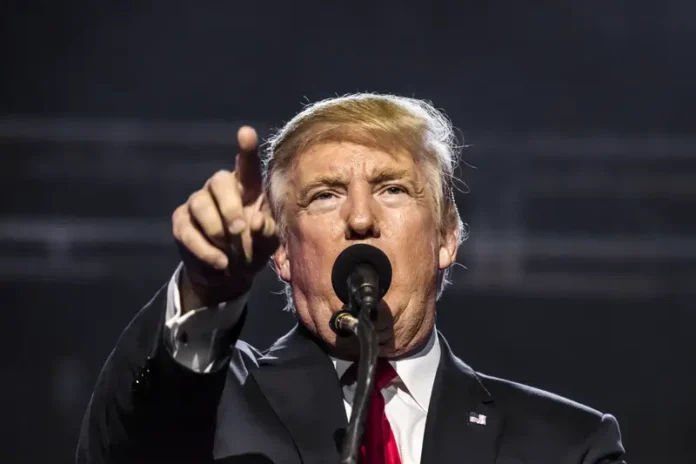
Taxpayer-funded television ads promoting President Donald Trump aired about 570 times after a federal judge ordered them off the air on Sunday, Oct. 11, 2026, according to a count by the nonpartisan watchdog Common Cause.
Common Cause put 32 of those post-order airings on Monday, Oct. 12. U.S. District Judge Jennifer L. Rochon, of the Southern District of New York, had issued the order at about 6:45 p.m. ET the night before.
Rochon found that the coalition behind the lawsuit was likely to win its case and that an injunction served the public interest. She ordered the administration to cancel any remaining airings, including spots already booked for that Sunday night, and directed the contractor handling the buys, LMD Agency Inc., to follow the ruling. The original order was set to last 14 days.
A Justice Department lawyer apologized on Monday, Oct. 12, for the delay in complying. Agency lawyers only found out about the order that morning, the department told the court in a filing.
Two ads, “Final Battle” and “Maduro,” logged hundreds of airings after the 6:45 p.m. deadline, according to AdImpact data reviewed by CNN. A third spot, “The Country He Loves,” aired most recently at 12:17 p.m. Monday, Oct. 12.
Rochon extended her order on Wednesday, Oct. 14, through Nov. 8, after the Nov. 3 election. She set a Nov. 4 hearing on a longer-lasting order.
A Union and an Alabama Candidate
Robert Hunter, a Democratic candidate for a seat in the Alabama state House, joined Common Cause in bringing the suit. So did Service Employees International Union Local 32BJ and the union’s political action committee, Empire State 32BJ SEIU PAC. Democracy Forward, Campaign Legal Center Action and Public Integrity Project Action represent them.
Named as defendants in the suit are the Department of Homeland Security (DHS), the Office of Management and Budget and the Executive Office of the President. The complaint argues that the administration used public money to tilt the Nov. 3 midterm elections. Rochon is an appointee of former President Joe Biden.
The Justice Department had told the court on Saturday, Oct. 10, that a restraining order was unnecessary because the ads were set to stop the next day, and it sidestepped the question of whether the ads were legal in the first place. The department’s filing conceded that the ads “(attack) a generic list of ‘villains,’” while emphasizing that they did not “address any specific race, electoral candidate, or party.”
Common Cause told the judge that a promise to stop soon was an attempt to run out the clock, and that the department ignored her request for details on the roles Trump and the White House played in the campaign. “We won’t stop until this administration is held fully accountable,” Common Cause CEO Virginia Kase Solomón said.
A separate suit from the Democratic National Committee landed on Oct. 7. It asks a judge in Washington, D.C., to bar the president from promoting himself with taxpayer money.
A $20 Million Border Purchase Order
LMD Agency Inc. received a $20 million purchase order from U.S. Customs and Border Protection (CBP) on Sept. 20. The money came from funds available for, among other things, “commemorating efforts and events related to border security.”
LMD had bought about $19 million in media buys through Sunday, Oct. 11, according to a sworn declaration from Holly Mehringer, a senior Homeland Security official, filed Saturday, Oct. 10. Mehringer also said the agency had no plans to buy more.
Trump personally drove the ad campaign and helped select the imagery and videos used, according to a source familiar with the matter. Two Trump advisers said the White House video team created the ads in-house, with at least one produced by a pro-Trump meme group.
Trump directed OMB Director Russell Vought to find government funds for the ads, according to reporting on the campaign. Budget office counsel Mark Paoletta and White House counsel Will Scharf both said using DHS funds would be legal, and Trump and chief of staff Susie Wiles each spoke with Homeland Security Secretary Markwayne Mullin about the ads.
Lions, Maduro and “God Made Trump”
CBS, ABC, ESPN, CNN, MS NOW, Fox News, Fox and Newsmax all carried the spots, which turned up during NFL games and shows including “Jimmy Kimmel Live.” The administration classified them as public service announcements, and each closed with a disclaimer saying the U.S. government paid for it.
In one ad, Trump discusses the threat of communism. Another simply replays a commercial from his last presidential campaign. The administration’s capture of Venezuelan leader Nicolás Maduro got its own spot, which began airing Tuesday, Oct. 6. The administration created at least 13 campaign-style ads.
Among the spots that had not yet aired, one recapped the UFC fight Trump hosted at the White House and another carried the title “God Made Trump.” A third showed lions hunting alongside images of former Presidents Barack Obama and Joe Biden.
Singer JSMN wrote on Instagram that the song “Love Me” was used “illegally” in one of the spots. “I don’t have a publicist or anything, so being forced in a situation like this and having to comment is ridiculous. I am looking at lawyers and handling this internally,” JSMN wrote.
Trump’s Offer to Pay It Himself
The campaign drew complaints from Republicans as well as Democrats. “It shouldn’t be paid for with taxpayer dollars,” Senate Majority Leader John Thune, R-S.D., told reporters.
Trump posted on Truth Social on Oct. 5 that the commercials were good promotion for the country and that using government money to pay for them was a normal thing to do. The same post offered an alternative: he would cover the cost himself, out of money he raised for his super PAC, MAGA Inc.
Future ads would be paid for by MAGA Inc., the White House said. Reimbursing the government for ads already run is not an immediate plan, according to a White House official.
Mullin, asked on CBS News’ “Face the Nation” on Sunday, Oct. 11, whether taxpayer dollars would be refunded, gave no indication the money would be returned. “Anytime we can do a public service announcement and brag about America, I’m all about it,” he said.
The White House has defended the spots as public service announcements like those of past administrations. Many such announcements help people use a specific government program; these did not. Legal experts have said the spending may violate a federal statute barring money appropriated by Congress from being used for publicity or propaganda.