


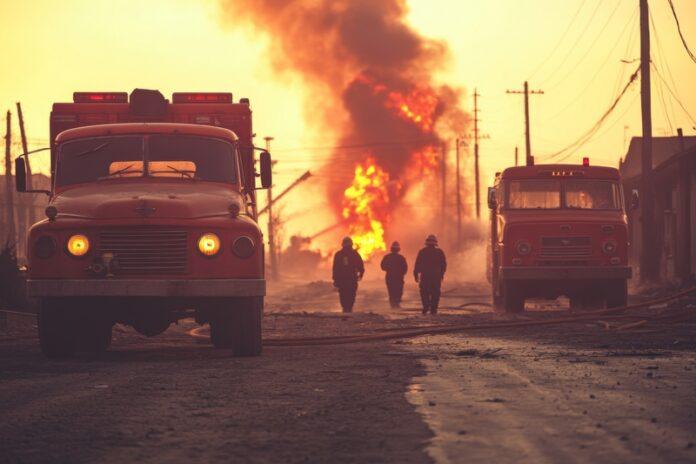
An explosion and fire at a biscuit factory in Trikala, central Greece, killed five women and injured seven others during a night shift early Monday morning, authorities said.
The blast occurred just before 4 a.m. on January 26, 2026, at the Violanta biscuit factory, located 320 kilometers north of Athens. All five victims were women working the overnight shift when the explosion tore through the facility, causing a massive fire that gutted the plant and triggered a partial collapse of the building and roof.
Thirteen workers were on site at the time of the explosion. Eight managed to escape, while six workers and one firefighter sustained injuries and were taken to hospital for treatment. The explosion was so powerful that the blast was heard up to 8 kilometers away in Trikala and surrounding villages.
Over 50 firefighters responded to the scene with 16 fire trucks, battling the intense blaze for hours. Fire crews recovered four bodies after several hours of searching through the destroyed building. Parts of a fifth body were recovered late afternoon, with one victim requiring identification using DNA testing.
Authorities identified four of the victims as Vasiliki Skambardoni, 42, a mother of two; Elena Katsarou, 45, mother of a 13-year-old; Stavroula Boukovala, a mother of three; Anastasia Nasiou; and Agapi Bounova.
“Unfortunately, the day began in the shadow of the tragic accident in Trikala, at a modern food production facility,” Prime Minister Kyriakos Mitsotakis said in a televised address at a cabinet meeting. “Our thoughts today are with the families of the victims. On behalf of the entire cabinet, I express to them our deepest condolences.”
Investigators suspect a propane gas leak as the likely cause of the explosion, which may have originated near the ovens that operate around the clock. One worker testified to investigators that there was a smell of gas in the factory shortly before the blast occurred.
A puncture was found in propane pipes located in the basement of the production wing where the explosion took place. These pipes transported propane from external tanks to the factory’s industrial ovens. Investigators are also examining the possibility that airborne flour dust could have contributed to the explosion, as flour particles suspended in air can become highly combustible under certain conditions.
The explosion occurred in a newer section of the factory that had been operating since 2023. Industrial explosions in food production facilities can result from multiple factors, including gas leaks from heating systems, combustible dust accumulation, or electrical malfunctions. Propane, commonly used in industrial baking operations for its high heat output and cost efficiency, is heavier than air and can accumulate in low-lying areas such as basements if a leak occurs. When propane reaches a concentration between 2.1% and 9.5% in air, it becomes explosive and can be ignited by even a small spark from electrical equipment or mechanical friction.
Flour dust explosions, while less common in modern facilities with proper ventilation, remain a significant hazard in food manufacturing. When fine flour particles are dispersed in the air at sufficient concentration, they present an explosion risk similar to coal dust or grain dust. The starch in flour serves as fuel, and when ignited, the suspended particles can combust rapidly, creating a pressure wave that can cause catastrophic structural damage.
A summer inspection of the facility had identified safety issues at the plant, including problems with emergency exits and gas detection systems. Workplace safety inspections in industrial facilities typically assess multiple factors, including proper ventilation systems, gas detection and alarm equipment, emergency exit accessibility, fire suppression systems, and regular maintenance protocols for heating and cooking equipment.
On Tuesday, the factory owner and two managers were arrested and face charges including manslaughter and negligence. The three arrested individuals were scheduled to appear before a prosecutor Wednesday.
The incident sparked immediate public outcry. A 24-hour strike was called in Trikala, with protests held demanding accountability for the deaths. Labor unions proposed three days of official mourning to honor the victims. A nationwide food industry strike has been scheduled for early February in response to the tragedy.
“This was an avoidable tragedy,” said a union representative at one of the protests. “These workers died because profit was placed above safety.”
Violanta produces cookies and cereal bars with national distribution throughout Greece. The company operates as a locally based business that has expanded its reach across the country, manufacturing a range of products including wholewheat cookies, chocolate-sandwich biscuits, and cereal bars.
Night shift work in manufacturing facilities presents unique safety challenges. Workers on overnight shifts may experience fatigue that can affect their ability to detect and respond to warning signs such as gas odors or equipment malfunctions. The reduced staffing levels typical of night operations can also mean fewer people available to assist in emergency evacuations.
Many of the workers at the Trikala facility were women who had chosen night shift positions to balance work with family responsibilities. This demographic pattern is common in food manufacturing operations globally, where overnight production schedules often attract workers seeking to coordinate childcare during daytime hours.
The Trikala explosion represents one of the deadliest industrial accidents in Greece in recent years. Industrial safety regulations in European Union member states, including Greece, are governed by a framework of directives covering workplace health and safety, but implementation and enforcement can vary significantly. Greece, like many countries, relies on labor inspectorates to conduct regular facility inspections, though the ratio of inspectors to workplaces often falls short of international labor organization recommendations.
The food manufacturing sector presents particular challenges for safety oversight. Production facilities often combine multiple hazards in a single location: high-temperature cooking equipment, flammable gases, combustible dusts, electrical systems, and heavy machinery. Effective safety management requires not only proper equipment installation and maintenance but also comprehensive worker training, regular safety drills, and robust reporting systems for near-miss incidents and equipment malfunctions.
Central Greece has experienced significant industrial development in recent decades as manufacturers have established facilities outside major urban centers. Trikala, situated in the Thessaly region, has attracted food processing and manufacturing operations due to its agricultural base and transportation connections. The region’s economy depends substantially on these industrial employers, which can sometimes create tensions between economic development priorities and rigorous safety enforcement.
The investigation into the Violanta factory explosion continues as authorities work to determine the precise sequence of events that led to the blast. Forensic engineers typically examine multiple factors in industrial explosion investigations, including maintenance records, equipment inspection logs, worker testimony, physical evidence from the blast site, and surveillance footage if available. The process of reconstructing such incidents can take months, particularly when structural collapse has destroyed or buried critical evidence.
Gas leak investigations focus on identifying the source and duration of the leak, the failure mode of any compromised equipment or piping, and whether detection systems functioned as designed. Modern industrial facilities typically employ continuous gas monitoring systems that trigger alarms when concentrations reach dangerous levels, along with automatic shutoff valves that can isolate gas supplies. The summer inspection’s notation of gas detection system issues will likely become a focal point of both the criminal investigation and any civil litigation that follows.
The tragedy has intensified discussions about workplace safety standards across Greece’s industrial sector. Labor advocates have long argued that enforcement of existing regulations remains inadequate, with inspection frequency falling below levels necessary to ensure compliance. The arrests of management personnel in this case reflect a growing willingness by Greek authorities to pursue criminal accountability in industrial accidents involving fatalities.