


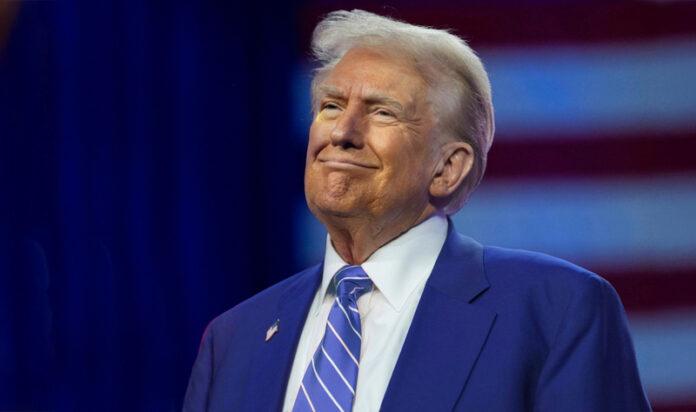
President Donald Trump, 79, stunned members of his inner circle by calmly predicting when his own body would be lying in state, according to a new report. The president reportedly made the comment at Mar-a-Lago as television screens showed Jimmy Carter’s casket at the U.S. Capitol, telling the room: “You know, within ten years that will be me.”
The remark appears in a sprawling New York Magazine profile titled “The Superhuman President” about the president’s health and psyche. Press Secretary Karoline Leavitt told the magazine she did not recall Trump making the comment.
The episode adds a morbid twist to how Trump and his team now talk about 2028. The specter of death sometimes manifests in the 2028 conversation, with aides gaming out whether the president will be willing—or able—to mount yet another run when he will be in his early 80s.
At the same time, Trump has leaned into the idea that clinging to the presidency is what keeps him alive. Trump told New York Magazine that his father, Fred Trump, had an expression he will never forget: “To retire is to expire.” It is a line he has used for years in interviews and on friendly platforms, making clear he sees work—and now the Oval Office—as a bulwark against aging.
Trump is already the oldest person ever to be elected president. Instead of talking about slowing down, he has repeatedly teased the prospect of running again, boasting that he could seek a third term and even what would amount to a fourth term, when he is 86, even as legal experts point out the constitutional two-term limit.
Trump’s brags clash with mounting unease about his health. Aides fret about his bruised hands, frequent naps in public, and a mysterious MRI trip to Walter Reed. A large bruise was visible on Trump’s left hand on Jan. 22 in Davos, Switzerland, during his appearance at the World Economic Forum.
Former White House lawyer Ty Cobb warned that Trump’s cognitive decline is palpable. Dr. Bruce Davison told a podcast that the president’s daily 325 mg aspirin regimen is the kind of dose usually reserved for stroke patients.
Inside Trump’s circle, the result is a strange dual reality of a president who talks about death, legacy, and what he will leave behind—from a $400 million East Wing ballroom to the Arc de Trump he wants erected across from the Lincoln Memorial—while still casting himself as a superhuman figure who can outwork younger rivals and defy time.
Trump’s recent behavior has raised additional concerns among observers. On Jan. 23, 2026, Trump made more than 70 Truth Social posts during a 50-minute period from 12:40 a.m. to 1:30 a.m. The late-night posting spree occurred after Trump returned from Switzerland, where he had attended the World Economic Forum in Davos.
The trip to Switzerland proved difficult for the president, as Trump backed down on plans to seize Greenland. The posting rampage covered everything from a trailer for wife Melania’s Amazon documentary to reposted video from Fox News and Joe Rogan’s podcast.
Trump also announced a TikTok joint venture during his late-night social media activity. Oracle will hold a 15 percent stake in TikTok U.S.
The president has also shared negative posts toward his political foes, including Gavin Newsom, Rep. Ilhan Omar, and Tim Walz. Trump said on Truth Social that the Department of Justice is investigating Omar over her wealth. Trump announced the move, saying the Justice Department and Congress are looking at Omar, who left Somalia with nothing and is now reportedly worth more than $44 million.
Trump’s approval rating hovers around 40 percent. After The New York Times published a survey conducted with Siena University showing his approval numbers, Trump threatened to sue over the poll results. He took to Truth Social to denounce the results as fake and fraudulent, announcing that the poll itself would be folded into his ongoing lawsuit against the paper.
The tension between Trump’s public bravado and private health concerns reflects a broader pattern in his second term. While he publicly projects strength and vitality, those closest to him witness a different reality. The contrast between his social media presence—posting dozens of times in the middle of the night—and reports of frequent public naps illustrates the complexity of assessing his fitness for office.
Trump’s aspirin regimen deserves particular scrutiny. A daily dose of 325 mg is the kind usually reserved for stroke patients, according to Dr. Bruce Davison. The unusually high aspirin dosage has raised questions among medical observers about the president’s cardiovascular health and whether it indicates a history of or heightened risk for stroke.
The bruising visible on Trump’s hands, combined with the mysterious MRI trip to Walter Reed, suggests there may be underlying health concerns that have not been publicly disclosed.
Trump’s reference to his father’s saying about retirement and expiration carries particular weight given Fred Trump’s own life trajectory. The president’s interpretation of this philosophy—that continuous work, particularly in the Oval Office, can somehow forestall aging and death—reflects a mindset that may be influencing his reluctance to acknowledge or address health concerns.
The president’s vision for his legacy includes ambitious—and expensive—physical monuments. The proposed $400 million East Wing ballroom would represent a massive addition to the White House, while the Arc de Trump across from the Lincoln Memorial would place his name on the National Mall. These projects suggest a president deeply concerned with how he will be remembered, even as he publicly dismisses concerns about his mortality and fitness for office.