


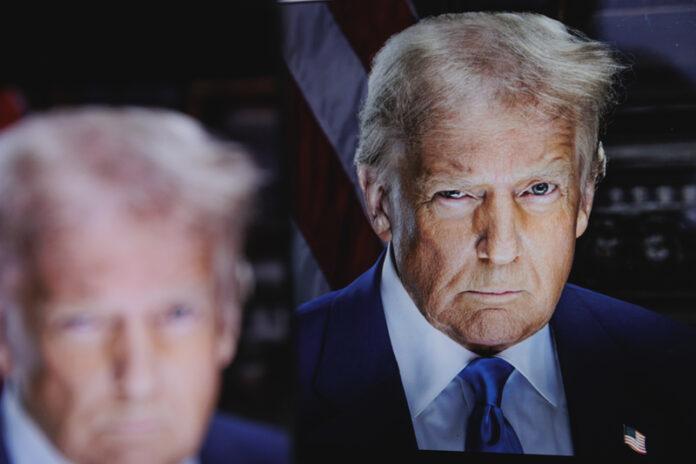
President Donald Trump issued a stark warning to Iran during a Tuesday interview, saying the country would be destroyed if its government continued to threaten him, in remarks that escalate tensions between Washington and Tehran at a moment of heightened regional instability.
Speaking from the Roosevelt Room at the White House on Katie Pavlich Tonight on NewsNation, Trump said he would hit Iran very hard if anything happens to him. The president also stated that Iran would be wiped out if anything happens to him, describing what he characterized as firm instructions already in place for a military response. The interview aired Tuesday, Jan. 20 at 10 p.m. EST.
The comments represent some of the president’s most explicit threats against the Islamic Republic since returning to office.
Pavlich, a conservative commentator who launched Katie Pavlich Tonight on Monday, secured the high-profile sit-down with the president shortly after debuting her show. She had spent 13 years as a Fox News contributor before leaving the network for NewsNation, where she had appeared on programs with Sean Hannity, Laura Ingraham, and The Five.
Trump’s warnings come against a backdrop of longstanding animosity between Washington and Tehran, rooted in part in the 2020 killing of Iranian Gen. Qasem Soleimani. That strike, ordered during Trump’s first term, continues to reverberate through U.S.-Iran relations, with Iranian officials having repeatedly vowed revenge for the general’s death.
The threats against Trump himself have taken multiple forms. In July 2024, a shooting occurred at a Trump campaign rally in Pennsylvania. Later that year, an armed suspect incident took place near Trump’s Florida golf course. While U.S. intelligence agencies have assessed that Iranian threats against the president and other American officials persist, authorities have not publicly confirmed direct Iranian involvement in those specific incidents.
During the interview, Trump criticized Joe Biden’s posture toward Iranian threats, suggesting the former president had failed to respond forcefully enough to Tehran’s hostile rhetoric. The comments reflect Trump’s broader approach to Iran, which has combined economic pressure, military deterrence, and public warnings designed to keep Iranian leadership off balance.
Iranian leaders have issued their own warnings in recent months. Iranian President Masoud Pezeshkian and Supreme Leader Ayatollah Ali Khamenei have both signaled that any attack on Iran’s leadership would trigger a massive response. Iranian Foreign Minister Abbas Araghchi warned that a U.S. military operation would not be met with restraint, referencing the 12-day Iran-Israel war in June 2025 as an example of Iran’s capacity for sustained conflict.
The June 2025 conflict between Iran and Israel marked a significant escalation in Middle Eastern tensions, drawing in regional powers and prompting the United States to deploy an aircraft carrier to the area. That deployment underscored Washington’s continued military presence in the region and its readiness to respond to threats against its interests and allies.
The interview covered domestic policy issues as well. Trump said he fired hundreds of thousands of federal employees, defending the mass terminations as necessary efficiency measures. He characterized the reductions as eliminating redundancy in the federal workforce.
When asked about protests in Minneapolis tied to Immigration and Customs Enforcement activity, Trump said he was not ready to invoke the Insurrection Act yet. The protests followed an ICE-involved fatal shooting of Renee Nicole Good on Jan. 7, an incident that sparked widespread demonstrations and renewed scrutiny of federal immigration enforcement tactics.
Trump suggested the Insurrection Act remained an option for future use, saying it might be invoked at some point. The law allows presidents to deploy military forces domestically to suppress civil disorder, rebellion, or insurrection. Its invocation would represent a significant escalation in federal response to domestic unrest and has historically been reserved for extraordinary circumstances.
The president also criticized Don Lemon and Rep. Ilhan Omar during the wide-ranging conversation, which touched on both foreign and domestic policy priorities. The interview format allowed Trump to present his administration’s positions directly to viewers without the filter of traditional news conferences or official White House statements.
For Pavlich, the Trump interview represented a significant early win for her program. After leaving Fox News, where she had built relationships with conservative audiences and Republican officials, securing a presidential interview in her first week at NewsNation demonstrated her continued access to top-level newsmakers. The network has positioned itself as an alternative to established cable news outlets.
The escalating rhetoric between Washington and Tehran raises questions about whether either side intends to follow through on its threats or whether the public warnings serve primarily as deterrence. Both governments face domestic political pressures to appear strong while avoiding a direct military confrontation that could spiral into a broader regional war.
Trump’s approach to Iran appears to mirror the maximum pressure campaign he pursued during his first presidency, combining economic sanctions, diplomatic isolation, and the threat of military force. Whether this strategy will prove more successful in constraining Iranian behavior than previous approaches remains uncertain, particularly given Tehran’s demonstrated willingness to engage in proxy conflicts and its continued development of regional influence.
The interview allowed the president to frame his administration’s actions as decisive both domestically and internationally. The Roosevelt Room setting lent formality to what was otherwise a media interview designed to reach a primetime cable news audience.