


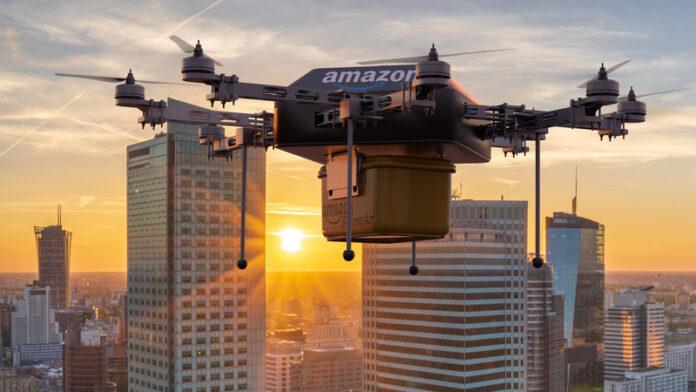
An Amazon delivery drone slammed into a Texas apartment building and crashed to the ground earlier this month, marking the latest setback for the tech giant’s ambitious aerial delivery program that has struggled with a string of high-profile mishaps.
Cessy Johnson captured the dramatic February 4 crash on video outside her Richardson apartment, witnessing what she expected would be a routine delivery spiral into a smoking disaster. The Amazon MK30 drone struck the side of the building around 5 p.m. before plummeting to the sidewalk near the front entrance, debris scattering as its propellers continued spinning.
Johnson had pulled out her phone to record the drone because she had never seen Amazon’s cutting-edge delivery technology in action. What began as an attempt to document a futuristic moment became evidence of a serious safety incident.
“The propellers on the thing were still moving, and you could smell it was starting to burn,” Johnson told local news outlets, describing the chaotic aftermath. Video from the scene shows smoke rising from the wreckage on the pavement.
Richardson firefighters responded and examined the damaged machine alongside Amazon workers. Despite the smoke, fire officials confirmed no actual blaze ignited. The building sustained only minor damage, and no one was injured in the crash, though the drone itself was destroyed.
The incident occurred just two months after Amazon launched drone delivery in Richardson. The company began service in the Dallas-Fort Worth suburb in early December 2025, operating from a fulfillment center on Research Drive. Prime members within a seven- to eight-mile radius can receive packages weighing up to five pounds for a $4.99 delivery fee, with most orders arriving within an hour.
Amazon spokesperson Terrence Clark addressed the crash in a statement to media outlets. “We apologize for any inconvenience and are actively investigating the cause of this incident,” Clark said. The company is coordinating repairs to the building while federal investigators examine the wreckage.
The Richardson crash marks the second MK30-related incident in Texas within three months and adds to a troubling pattern for Amazon’s flagship delivery drone. In November 2025, an MK30 severed an internet cable during its post-delivery ascent in Waco, Texas, prompting a federal probe. Just weeks before that, two MK30 drones struck the same construction crane minutes apart in Tolleson, Arizona, sending both aircraft crashing into nearby parking lots. One caught fire upon impact.
The Arizona collision triggered investigations by both the National Transportation Safety Board and the Federal Aviation Administration. Amazon paused deliveries briefly but resumed operations after completing an internal review, claiming no issues with the drones or their technology. The company introduced enhanced visual landscape inspections to better monitor for moving obstructions like cranes.
Earlier still, Amazon suspended all U.S. drone deliveries in January 2025 after two MK30s crashed in rainy weather at its Pendleton, Oregon testing facility. The company attributed those crashes to a software malfunction caused by light rain and implemented updates before receiving FAA approval to resume flights in March 2025.
The MK30 represents Amazon’s next-generation delivery platform, designed to be quieter, fly farther, and operate in light rain. The hexacopter can carry packages up to five pounds while cruising at about 73 mph, with a service radius of 7.5 miles. It typically flies at 200-300 feet altitude and uses a sophisticated “sense-and-avoid” system to detect obstacles including aircraft, wires, and even household pets. Packages are stored in the fuselage and dropped to the ground from about 13 feet up.
The recurring collisions with stationary objects suggest potential vulnerabilities in the drone’s perception system—the fusion of software and hardware that allows the aircraft to “see” its environment. Industry observers note that an aircraft designed to detect and avoid obstacles has now repeatedly failed to do so.
Amazon received FAA approval for the MK30 in November 2024, including permission to fly beyond visual line of sight of operators. The e-commerce giant has set an ambitious goal of delivering 500 million packages annually by drone by 2030, though current operations remain limited to a handful of U.S. markets including Richardson, Tolleson, Waco, and Pontiac, Michigan.
For Johnson and other Richardson residents, the crash served as an alarming reminder that emerging technologies can pose unexpected dangers. What should have been a routine delivery instead became a potential safety hazard requiring emergency response.
Amazon has not disclosed what specific changes it will implement following the Richardson investigation. The company faces the challenge of convincing both regulators and the public that its autonomous delivery fleet can operate safely in densely populated neighborhoods—a task made harder each time one of its drones falls from the sky.
The FAA has not publicly released details about any ongoing investigation related to the Richardson crash. As the agency considers new rules that would greatly expand commercial drone operations, the incident adds another data point to the debate over whether the technology is ready for widespread deployment in American airspace.