


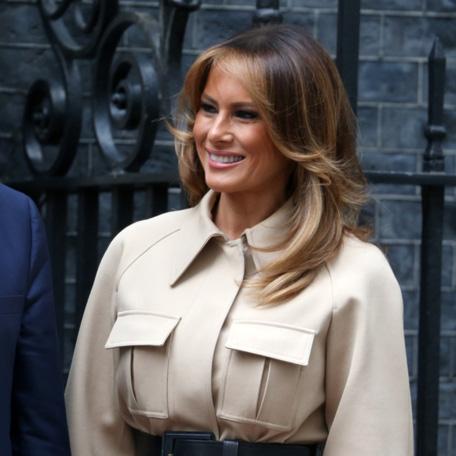
First Lady Melania Trump delivered a Valentine’s Day message unlike any other on Friday, February 13, 2026, transforming a military ceremony at Fort Bragg and Pope Army Airfield in North Carolina into a 250-year civics lesson—complete with disco dancing and midterm election appeals.
The event honored United States Army Special Forces members who participated in January’s dramatic operation to capture Venezuelan leader Nicolás Maduro and bring him to the United States to face drug-trafficking charges. What began as a solemn military tribute evolved into something far more eclectic.
Rather than offering traditional Valentine’s sentiments, the First Lady opted for a decidedly patriotic approach. “To our great armed forces of the United States stationed all over the world, I have a nostalgia-filled message: Happy Valentine’s Day,” Melania Trump told the assembled troops and their families.
Her speech centered on the historical role of wartime correspondence, connecting centuries-old love letters to modern military service. The First Lady emphasized that love letters have symbolized the union of patriotism and family devotion among American soldiers for 250 years, calling this harmony of love of country and love of family “uniquely American.”
The choice to frame Valentine’s Day through the lens of military history struck many as unexpected. The word “nostalgia”—implying wistful longing for something lost—made the greeting sound less like a celebration of romance and more like a tribute to a bygone era. Instead of celebrating contemporary expressions of love, the First Lady delivered what amounted to a history lesson wrapped in patriotic themes.
Notably absent from her Valentine’s remarks was any mention of her husband, President Donald Trump. The First Lady concluded her speech by introducing the Commander-in-Chief to the stage, describing him as “our leader who maintains a mission of peace through strength.” The President kissed her cheek before taking the microphone.
President Trump’s address shifted the ceremony’s tone decisively. While he praised the troops for demonstrating “the full military might” of the United States and assured service members that “your commander in chief supports you totally,” he soon pivoted to political territory. Standing alongside Republican Senate candidate Michael Whatley—the former Republican National Committee chairman now running for North Carolina’s open Senate seat with Trump’s endorsement—the President urged service members to support the GOP in upcoming midterm elections.
“You have to vote for us,” Trump told the crowd, referencing his administration’s decision to restore the Fort Bragg name. Defense Secretary Pete Hegseth had signed a memo in February 2025 reverting the installation’s name from Fort Liberty—though now honoring World War II hero Roland L. Bragg rather than Confederate General Braxton Bragg. Congress had ordered bases honoring Confederate officers to be renamed in 2021, a provision Trump vetoed during his first term before lawmakers overrode him with bipartisan support.
“If we don’t win the midterms, they’ll take it off again. They’ll take it off again. You can’t let that happen,” Trump warned the crowd.
The ceremony concluded with the Village People’s “Y.M.C.A” blaring over loudspeakers as attendees danced while the President and First Lady remained on stage. The festive ending transformed what had been a solemn military recognition into something resembling a campaign rally with a Valentine’s twist.
The First Lady’s visit to North Carolina came just two days after she visited The Children’s Inn at the National Institutes of Health in Bethesda, Maryland on Wednesday, February 11. During that appearance, she engaged in holiday-themed craft-making and conversations with young patients undergoing treatment for rare and serious diseases. The NIH visit marked her fourth trip to the facility as First Lady, having made three previous visits—in 2018, 2019, and 2020—during the first Trump administration.
The Office of the First Lady characterized her Fort Bragg remarks as emphasizing the balance between love of country and love of family. According to official statements, Melania Trump has long been an ardent supporter of America’s military and wanted to honor the service members’ bravery and resilience.
The capture of Maduro on January 3 represented a significant military achievement. Operation Absolute Resolve involved more than 150 aircraft launching from 20 different bases, with U.S. special forces extracting the Venezuelan leader from a military compound in Caracas. Maduro and his wife were transported to New York, where they pleaded not guilty to numerous drug trafficking charges in Manhattan federal court.
The Valentine’s Day event highlights the intersection of military recognition, political messaging, and personal celebration that increasingly defines public appearances by the nation’s highest officials. While the ceremony honored a high-risk operation, its evolution from formal ceremony to campaign-style rally with dancing and political appeals marked an unusual approach to honoring military service.
The First Lady’s decision to center her message around historical military correspondence rather than contemporary expressions of love or support for her husband struck many as an unexpected choice for the occasion—though perhaps fitting for an evening that ultimately served multiple purposes: recognizing a successful special forces operation, delivering a holiday message to troops, and providing a platform for political advocacy ahead of the midterm elections.
As military families left Pope Army Airfield following the festivities, they carried with them an unusual Valentine’s memory—one that blended wartime history, present-day military achievements, political campaigning, and disco-era pop music into a single, memorable evening.