


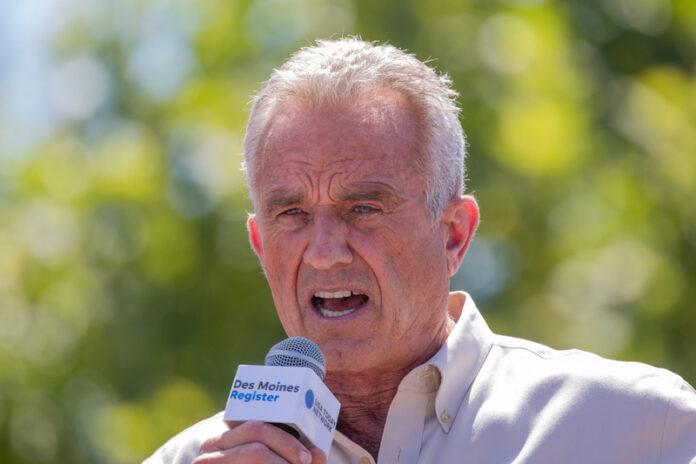
Robert F. Kennedy Jr. told a crowd at the Heritage Foundation on February 9, 2026, that working for President Donald Trump is “a joy” because the president allows him to pursue policies that no other leader would permit.
Speaking in Washington, D.C., Kennedy made the frank admission during an event marking one year of the Make America Healthy Again movement. The Heritage Foundation, the conservative think tank behind Project 2025, hosted the health secretary as he reflected on his first year leading the Department of Health and Human Services.
“So it is a joy to work for him because he lets me do stuff that I don’t think anybody else would,” Kennedy said.
Kennedy described Trump as the most business-friendly president since George Bush, praising the current president’s approach to regulation and corporate interests. He told the audience that Trump will not tolerate overreach and doesn’t care about vested interests or offending powerful people.
The health secretary, who was handpicked by Trump to lead Health and Human Services after the 2024 election, also made controversial statements about expertise and authority. Kennedy said that trusting experts is a feature of religion and totalitarianism, drawing sharp reactions from the scientific community and public health advocates.
Kennedy, a former Democrat who became an independent presidential candidate before joining Trump’s administration, has spent his first year implementing sweeping changes to federal health policy. He withdrew federal COVID vaccine recommendations for pregnant women and healthy children, a move that alarmed many medical professionals who cite extensive research supporting vaccination for these groups.
The health secretary also replaced the CDC’s expert advisory panel with anti-vaccine activists and other handpicked advisers, fundamentally altering how vaccine policy recommendations are developed at the federal level. This restructuring represents a dramatic shift from the traditional approach of relying on epidemiologists, immunologists, and other medical specialists to guide public health decisions.
At the Heritage Foundation event, Kennedy described his fight against ultra-processed foods as spiritual warfare. He warned that we’re going to lose our country if the issue wasn’t tackled, calling it a war at scale against cellular activity and an assault on our children.
Critics quickly responded to Kennedy’s admission about his relationship with Trump. Shaughnessy Naughton, president of 314 Action, an organization that aims to elect more scientists to public office, said Kennedy has profited from his anti-vax agenda. Naughton added that Kennedy and his allies stand to make millions taking down vaccine manufacturers.
Kennedy has overseen a massive restructuring of the Health and Human Services department, eliminating thousands of jobs and freezing or canceling billions of dollars for scientific research. The changes have affected multiple agencies within HHS, including the Centers for Disease Control and Prevention, the National Institutes of Health, and the Food and Drug Administration.
The CDC shakeup led to a leadership exodus at the agency, with multiple senior officials departing amid the organizational upheaval. Susan Monarez claimed she was forced out for resisting controversial policies that Kennedy pushed.
Kennedy justified the changes as absolutely necessary to address what he described as malaise in the CDC. He has argued that the agency had become too closely aligned with pharmaceutical industry interests and needed a fundamental reset to serve the American people effectively.
Joseph P. Kennedy called the health secretary a threat to the health of every American. The statement highlighted deep divisions within the Kennedy family over Robert F. Kennedy Jr.’s approach to public health and vaccine policy.
Representative Haley Stevens issued a harsh assessment of Kennedy’s tenure. Stevens said the public health system is weaker and Americans are less safe. She called for Kennedy to be impeached, marking one of the strongest rebukes from Congress regarding his leadership of Health and Human Services.
The Health and Human Services Department, which Kennedy now leads, manages a sprawling federal bureaucracy responsible for Medicare, Medicaid, the National Institutes of Health, the Food and Drug Administration, and the Centers for Disease Control and Prevention. The department directly affects the health and well-being of hundreds of millions of Americans.
Kennedy’s appointment represented an unconventional choice by Trump. His leadership has been marked by controversy over potential conflicts of interest and questioned whether his policy decisions could financially benefit him or his associates.
Supporters of Kennedy’s approach argue that he is addressing legitimate concerns about chronic illness rates in America and challenging what they view as excessive pharmaceutical industry influence over public health policy. They point to rising rates of obesity, diabetes, and other chronic conditions as evidence that the existing public health establishment has failed to protect American health.
The Make America Healthy Again movement, which Kennedy referenced in his Heritage Foundation speech, has become a rallying cry for those seeking to reform food policy, reduce reliance on pharmaceutical interventions, and promote what proponents describe as a more holistic approach to public health.