


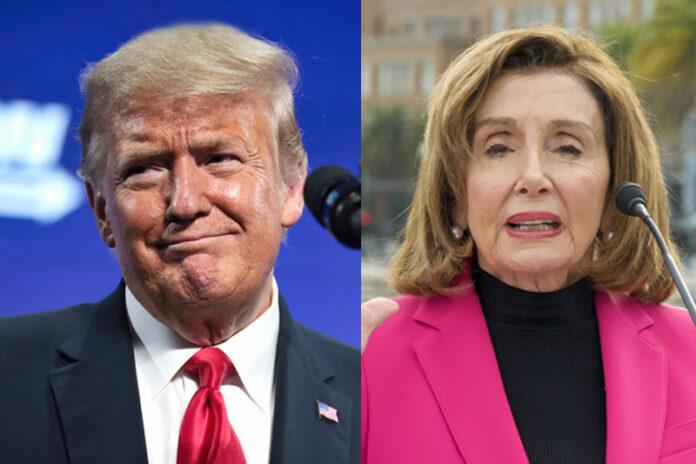
President Donald Trump delivered a pointed jab at Speaker Emerita Nancy Pelosi during his State of the Union address Tuesday night while calling for a ban on congressional stock trading—a proposal that drew rare standing ovations from Democrats who otherwise sat in stony silence throughout the evening.
Trump urged Congress to pass the Stop Insider Trading Act, legislation that would prohibit members of Congress, their spouses, and dependent children from purchasing publicly traded stocks while requiring a seven-day public notice before any sale.
“Pass the Stop Insider Trading Act without delay,” Trump declared to the joint session of Congress at the U.S. Capitol on Tuesday, February 24, 2026.
The call for reform prompted Massachusetts Democratic Sen. Elizabeth Warren—typically one of Trump’s most outspoken critics—to rise to her feet in support. Several Democrats joined her, creating a moment of unexpected bipartisan unity in an otherwise deeply divided chamber. Trump paused his address to acknowledge the display, visibly surprised by the response from across the aisle.
Then he turned the moment into a weapon.
“Did Nancy Pelosi stand up, if she’s here? Doubt it,” Trump quipped, drawing laughter from Republicans.
The targeting of Pelosi was no accident. The California Democrat, who announced in November 2025 that she will not seek reelection, has become the face of debates surrounding congressional stock trading. Her husband Paul’s investment portfolio has attracted intense scrutiny and spawned tracking apps that monitor lawmakers’ trades. According to Quiver Quantitative, Pelosi’s estimated net worth exceeds $269 million, placing the retiring congresswoman among the wealthiest members of Congress.
Between 2022 and 2025, Pelosi reported a trade volume of $56.9 million, according to Capitol Trades, a site that monitors lawmakers’ stock transactions. In January 2026 alone, her husband traded between $8.8 million and $38.6 million in stock holdings.
The Stop Insider Trading Act, introduced on January 12, 2026, by Rep. Bryan Steil, chairman of the Committee on House Administration, advanced out of committee on a 7-4 party-line vote. The legislation would ban lawmakers and their immediate families from purchasing individual stocks while in office, though investments in diversified funds, Treasury bonds, and small business interests would still be allowed. Violations would trigger penalties of $2,000 or 10% of the transaction value, whichever is greater.
Warren has supported similar legislation for years, and Pelosi herself backed the Honest Act in July 2025—a reversal from her longtime opposition to such reforms. That bill, originally named the PELOSI Act by Republican Sen. Josh Hawley as a dig at the former speaker, passed through a Senate panel before stalling.
Democrats who applauded the insider trading proposal later taunted Trump with shouts of “including you” and “you too”—a reference to the competing Democratic bill that would extend the trading ban to the president and vice president. Republicans rejected those amendments during committee consideration.
The stock trading moment was one of two instances when Democrats rose to applaud. Trump also drew bipartisan support when he announced a new retirement savings plan for workers without access to employer-sponsored 401(k) plans. The proposal would provide a federal government match of up to $1,000 annually, modeled on the Thrift Savings Plan available to federal employees.
“Half of all of working Americans still do not have access to a retirement plan with matching contributions from an employer,” Trump said. “To remedy this gross disparity, I’m announcing that next year my administration will give these often-forgotten American workers access to the same type of retirement plan offered to every federal worker.”
The exchange over insider trading marked the latest chapter in the rocky history between Trump and Pelosi at State of the Union addresses. Their previous encounters during Trump’s first term included Pelosi’s infamous tearing of his speech in 2020, creating one of the most memorable images of political division in recent American history.
Vice President JD Vance and Speaker of the House Mike Johnson sat behind Trump during the address, which lasted approximately one hour and 48 minutes—the longest State of the Union in at least 60 years. Virginia Gov. Abigail Spanberger delivered the Democratic response, accusing Trump of lying and offering “no real solutions to our nation’s pressing challenges.”
The congressional stock trading issue has gained momentum in recent years as Americans have grown increasingly concerned about conflicts of interest. Polls consistently show more than 80% of voters support banning congressional stock trading, making it one of the highest-polling reform issues in American politics.
Whether the Stop Insider Trading Act will reach Trump’s desk before the November midterms is uncertain. But Tuesday night’s display of bipartisan applause suggests the issue may have broader appeal than many of Trump’s other legislative priorities—even if the details of how to implement a ban still divide the parties.
For Pelosi, who will leave Congress in early 2027, the president’s jab added another indignity to her final year in office. The woman who twice wielded the speaker’s gavel and tore up Trump’s speech six years ago sat in the chamber Tuesday night as he invoked her name to mock the very institution she spent nearly four decades serving.