


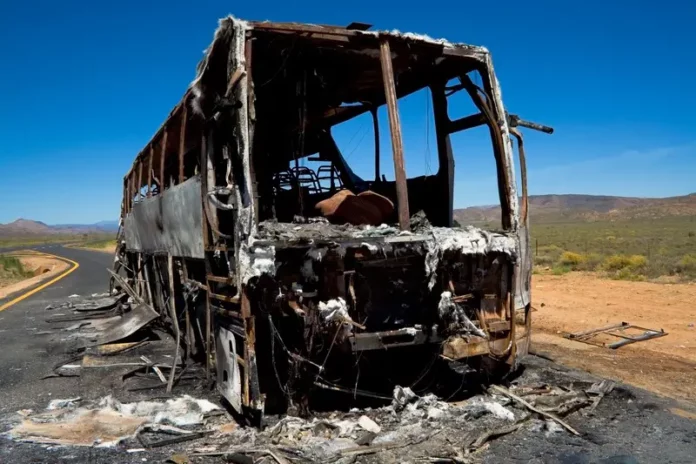
An explosive device tore through a passenger bus on Colombia’s Pan-American Highway on Saturday, April 25, 2026, killing at least 20 people and wounding 36 others in the deadliest strike in a wave of violence battering the country’s southwest.
The blast struck in Cajibío, a municipality in the Cauca department, and shattered what had already been a harrowing 48 hours marked by drone strikes, vehicle bombs and assaults on police and aviation infrastructure. Five children were among the wounded, Cauca Health Secretary Carolina Camargo told Noticias Caracol.
Octavio Guzmán, the governor of Cauca, said on X that the device detonated as the bus moved along the highway in the El Túnel sector, a vital corridor linking major cities across southwestern Colombia. The death toll — initially reported at seven — climbed to 14 by Saturday evening and reached 20 by Sunday, with 15 women and five men among the dead. Three of the injured remain in intensive care.
Authorities point to FARC dissidents
Gen. Hugo López, commander of Colombia’s Armed Forces, called the bombing a “terrorist act” and pinned responsibility on two armed networks: that of Iván Mordisco, one of the country’s most wanted fugitives, and the Jaime Martínez faction. Both are dissident structures of the now-defunct Revolutionary Armed Forces of Colombia, the rebel movement that signed a peace accord with the state in 2016. Neither group accepted that agreement, and both continue to operate across Cauca and neighboring departments.
President Gustavo Petro condemned the attack in stark terms on X, writing when the initial toll stood at seven dead and 17 wounded.
“Those who carried out the attack and killed seven civilians — and wounded 17 others — in Cajibío — many of them Indigenous people — are terrorists, fascists, and drug traffickers,” Petro wrote.
The government has placed a reward of more than $1 million for information leading to the capture of a commander known as “Marlon,” identified as the leader of the region’s dissident group. Local authorities offered more than $14,000 for tips tied to Friday’s attacks on military installations in Cali and Palmira.
A region under siege
The bus bombing capped a punishing stretch of unrest. At least 26 incidents were logged across southwestern Colombia in a 48-hour period, López said, in a campaign that until Saturday had caused mainly material damage. A Friday bomb attack on a military base in Cali wounded at least one person, according to AFP, though other accounts described only property destruction.
The attacks included a shooting at a police station in the rural reaches of Jamundí and an attempted strike on a Civil Aviation radar facility in El Tambo, where security forces brought down three explosives-laden drones earlier Saturday. On Friday, two vehicles rigged with explosives detonated near military units in Cali and Palmira.
Taken together, the strikes signal a coordinated effort to rattle the state’s security apparatus across Valle del Cauca and Cauca, two departments long contested by armed groups linked to the cocaine trade. Investigators believe rival factions are jockeying for control of the sea and river routes that feed the port of Buenaventura, a critical embarkation point for narcotics bound for Central America and Europe.
High-level response mobilized
The escalation prompted a rapid mobilization of senior officials. Defense Minister Pedro Sánchez led a delegation of regional governors and local authorities to Palmira on Saturday to coordinate the response. The bus exploded while that meeting was underway.
“These criminals seek to instill fear, but we will respond with firmness,” Sánchez wrote on X.
Dilian Francisca Toro, the governor of Valle del Cauca, urged the national government to provide “immediate support,” calling for a reinforcement of public security forces and what she described as decisive action against the armed groups operating in the region. She also pressed for stepped-up intelligence operations to anticipate further strikes.
Officials have characterized the broader campaign as a “terrorist-level escalation,” language that reflects mounting frustration in Bogotá with the pace and ambition of the dissident networks. While the Petro administration has pursued negotiations with various armed groups under its “total peace” policy, the factions blamed for Saturday’s attack have remained outside any meaningful dialogue.
Civilians bear the cost
On the Pan-American Highway, ordinary travelers — many of them Indigenous, according to the president — became the casualties of a fight ostensibly waged for control of drug corridors. Photographs from the scene showed mangled buses and vans, a deep crater blown into the roadway and relatives of victims clutching one another amid the wreckage.
Cauca has long been one of the most volatile regions in Colombia, its mountainous terrain and dense jungles providing cover for coca cultivation and clandestine processing labs. The 2016 peace accord, hailed at the time as the close of a half-century war, dismantled the FARC’s central command but left splinter groups intact. Those splinter groups, fortified by drug revenues and tactical alliances with other criminal structures, have steadily expanded their footprint.
The death toll has continued to climb as the wounded are treated at hospitals across Cauca. Guzmán declared three days of mourning on Sunday. For now, the devastation on the Pan-American Highway stands as a grim marker of a conflict that, a decade after the peace deal, refuses to end.